

Picture a Sunday night. You step onto the treadmill, set it to a comfortable 3.5 mph, press play on a podcast and walk for 30 minutes without breaking a real sweat. Afterwards a nagging thought shows up: did that actually do anything?
So, can you lose weight by walking on treadmill? Yes, you can, and for beginners it is one of the most sustainable ways to start. The catch is that the walk alone is rarely the whole story. This guide covers the pace to hold, how incline changes the effort, how long to walk, and what the research on daily steps really says, so your treadmill time pays off.
Can you lose weight by walking on treadmill? Yes, but your calorie deficit does most of the work
Walking burns energy, and burning energy while eating a little less than your body uses is how weight comes off. The CDC says it plainly in its physical activity guidance for a healthy weight: activity paired with eating fewer calories creates the calorie deficit behind weight loss, and most of the loss comes from the eating side of that equation.
That sounds discouraging, but it only tells you where the walk fits. Think of the treadmill as the part of your plan that builds fitness and a habit, while food choices set the speed of the scale.
Here is the part most walking guides skip. The same CDC page says regular physical activity is what makes weight loss last. So a treadmill habit may matter less for getting the weight off than for keeping it off later. If you build the routine now, you are practising the exact behavior you will need once the number on the scale changes.
The scale is also a narrow scoreboard. Mayo Clinic reports that a high number of daily steps is linked to a lower risk of dying from heart disease and from all causes. Those benefits do not depend on whether the number on the scale moves this month, which is a good reason to keep walking even during a slow stretch. Track other signs of progress too, such as how your clothes fit, how easily you climb stairs and how long you can walk before you feel winded.
A quick example shows how this plays out. Say you walk 30 minutes after work, then stop for a large muffin and a sweetened latte on the way home. A half-hour walk burns a modest amount of energy, and that snack can match it. The walk was still good for your heart and mood, but the scale will not budge. Keep the same walk, skip the extra snack, and a real deficit starts to exist.
If you want to see how walking compares with other options, our guide to the best exercises for weight loss ranks them. And if you are curious how far food changes alone can go, we covered who can lose weight without exercise too.
Brisk means about 100 steps a minute, not a slow stroll with your phone in hand
Pace is where treadmill walks quietly go wrong. Set the belt too slow and you are mostly passing time. The CDC describes moderate intensity as breathing and heart rate that are noticeably faster while you can still hold a conversation, and it gives brisk walking at a 15-minute mile as an example. On the belt, a 15-minute mile is 4 mph.
Steps give you a second yardstick. A review in the International Journal of Behavioral Nutrition and Physical Activity led by Catrine Tudor-Locke found that about 100 steps per minute is a reasonable floor for moderate-intensity walking. Multiply that by 30 minutes and you get at least 3,000 steps. The authors call it a guiding value, not a rule, because people differ.
How to check your pace without a monitor
Use the talk test. You should be able to speak in full sentences but not sing. If you could sing along to your playlist, nudge the speed up. If you cannot finish a sentence, ease off. If 4 mph feels too hard today, hold the fastest speed that still passes the talk test and build from there.
Mayo Clinic also says that walking faster, farther and more often is linked to greater benefits. That gives you three dials to turn, and you only need to turn one at a time. If speed feels like too much, add distance. If distance is limited by time, add a day. Changing everything at once is how people burn out by week two.
Why intervals make a walk feel shorter
Mayo Clinic notes that alternating a few minutes of fast walking with a few minutes of slower walking improves fitness efficiently. On a treadmill that is easy to set up: three minutes brisk, two minutes easier, repeat. The time passes faster, and you spend more of the session working at a useful intensity.
Incline is the easiest way to make the same 30 minutes count for more
If you cannot walk faster, tilt the belt instead. Researchers measured 24 healthy older adults, average age about 75, walking at 0%, 10% and 16% incline for five minutes each. In their study in BMC Geriatrics, the 10% grade raised net energy use by about 23% and the 16% grade raised it by about 44%, compared with flat walking.
| Treadmill incline | Net energy use (kcal per minute) | Change versus flat |
|---|---|---|
| 0% (flat) | 2.54 | Baseline |
| 10% | 3.16 | About 24% higher |
| 16% | 3.70 | About 45% higher |
Source: BMC Geriatrics, 2021. Average values for 24 healthy adults aged about 75, five minutes at each grade.
Read those numbers with two cautions. The volunteers were older adults and each stage lasted only five minutes, so your own figures will differ. A 10% grade is also steep to hold for half an hour. Start with a gentle 1% to 3% incline and raise it in small steps over several weeks.
The takeaway is the direction, not the exact kcal. More incline means more effort per minute while you stay in a walking stride instead of switching to running. If you later want to add intervals, our comparison of a HIIT workout on a treadmill versus running outside shows how the two feel and compare.
Can you lose weight by walking 30 minutes a day? It depends on the other 23.5 hours
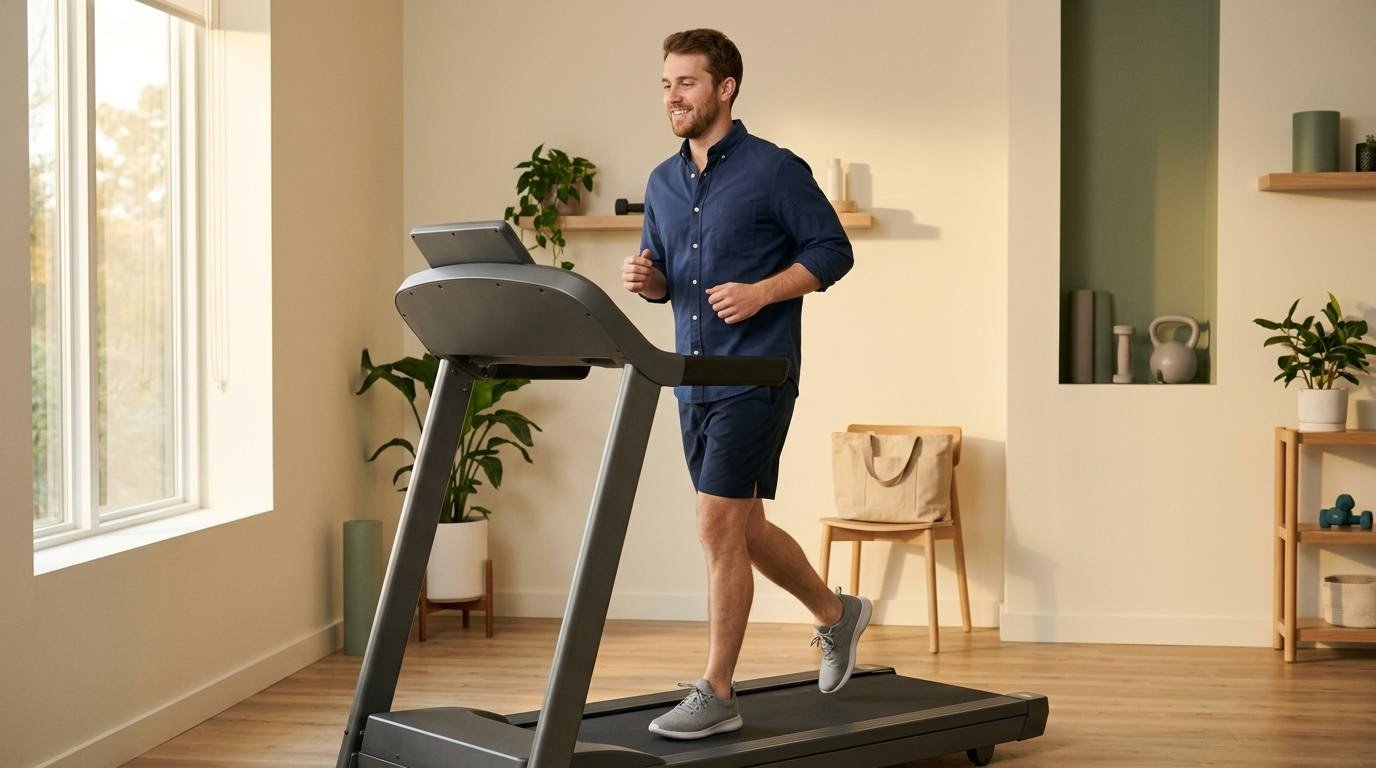
Thirty minutes a day adds up to 210 minutes a week. That clears the CDC minimum of 150 minutes of moderate activity for adults, and it sits between that baseline and the 300 or more minutes that Mayo Clinic walking guidance says may help with weight loss or keeping lost weight off.
So yes, 30 minutes a day is a respectable base. Whether it moves the scale depends on food. The CDC notes that without changes to diet, losing weight takes a high amount of physical activity, and it gives no fixed number because people differ so much. In practice that means your 30 minutes works best as half of a pair.
Here is a simple way to picture it. If your week is 210 minutes of walking and your eating stays exactly where it was, expect little change on the scale. If your week is 210 minutes of walking plus a modest, sustainable trim in portions or snacks, you have a real deficit working in your favour.
Short on time? Mayo Clinic says several shorter walks spread through the day count toward your daily goal. Three brisk ten-minute walks, one on the treadmill and two outside, still add up to 30 minutes.

Aim for roughly 8,500 steps a day, and stop treating 10,000 as magic
The 10,000-step goal feels like settled science, but the Tudor-Locke review describes it as a reasonable target for healthy adults, not a threshold with special powers. It is a round number that happens to land in a useful range.
Newer evidence points to a slightly lower target. A 2026 systematic review and meta-analysis pulled together 18 randomized trials of lifestyle programs for adults with overweight or obesity, and 14 of them went into the pooled analysis. People in the programs raised their daily steps from roughly 7,300 to roughly 8,450 and lost about 4.4% of their body weight on average. The authors suggest around 8,500 steps a day as a target and call their findings preliminary.
Notice what that does and does not prove. The programs also included diet changes, so steps were not the only reason for the weight loss. What it does show is that people who succeeded in these programs were not walking marathon distances. They walked a little more than before, and they kept it up.
The review also mentions a common coaching habit: add 250 to 500 steps every two to three days until you reach your target. That is a gentler ramp than most people try on their own.
The Tudor-Locke review adds another reality check. Across the intervention studies it examined, typical increases were on the order of 2,000 to 2,500 steps a day. So if you currently average 4,000 steps, a realistic first goal is somewhere near 6,000 or 6,500, not 12,000. Hitting a goal you can actually repeat does more for you than missing a heroic one.
A treadmill helps with the math. A brisk 30-minute walk supplies roughly 3,000 steps, which is about a third of an 8,500-step day. The rest comes from ordinary movement, such as stairs, errands and a lap around the office.
A four-week treadmill walking plan that builds without wrecking your motivation
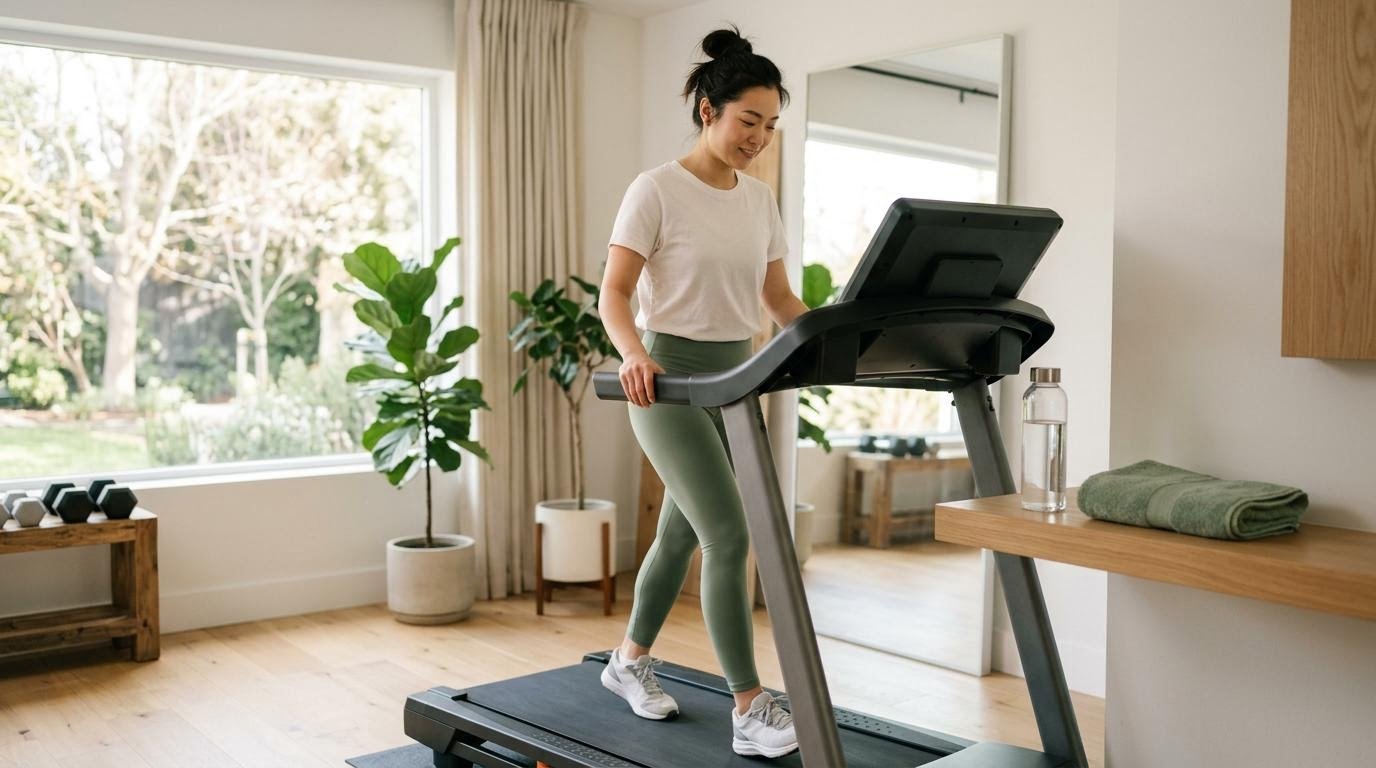
Mayo Clinic advises beginners to build up gradually, and the CDC baseline is 150 minutes a week. This plan reaches that baseline in week four. Keep each session at a talk-test pace unless a step says otherwise.
- Week 1: 25 minutes, three days, flat belt. The goal is to finish feeling like you could do more.
- Week 2: 30 minutes, four days, flat belt. Same pace, longer habit.
- Week 3: 30 minutes, four days. On two days, use a 1% to 2% incline for the middle ten minutes, then return to flat.
- Week 4: 30 minutes, five days, for 150 minutes in total. On two days, alternate three minutes brisk with two minutes easier. Add two short strength sessions, since the CDC recommends muscle-strengthening activity on at least two days a week.
If your shins ache or you dread every session, repeat the previous week instead of pushing on. Consistency beats intensity for a habit you want to keep. Many people find it easier to anchor the walk to something that already happens, such as right after work or right after dinner.
Two practical notes make the plan easier to stick with. First, log each session in a notes app, even if it is just the date and the minutes. Seeing a streak builds momentum faster than any motivational quote. Second, plan for a missed day before it happens. If life swallows Tuesday, do two short walks on Wednesday instead of abandoning the week. Mayo Clinic says shorter walks through the day still count.
For a quick visual refresher on walking basics, here is a short video from Mayo Clinic Health System.
Three mistakes that stall treadmill progress
- Treating the walk as permission to eat extra. A modest walk and a generous snack roughly cancel out, as the muffin example above shows.
- Staying at the same speed and incline forever. Your body adapts. Nudge the pace, add intervals or raise the incline slightly every couple of weeks.
- Skipping strength work. The CDC recommends muscle-strengthening activity on at least two days a week, and your legs will thank you on the incline.

Can you lose weight by walking on treadmill? The bottom line
Yes. Treadmill walking helps most when three things line up: a brisk pace you can hold, a weekly total near or above 150 minutes, and eating habits that create a modest calorie deficit. Add a little incline when flat walking starts to feel easy, track steps if numbers motivate you, and treat the habit as the long game, because regular activity is what helps weight stay off.
Your next step is small. Pick three days this week, set the treadmill for 25 minutes, and keep the pace where you can talk but not sing.
Health disclaimer: This article is general information, not medical advice. Talk to a doctor before starting a new exercise routine if you have a heart condition, joint problems, diabetes or another health concern, if you are pregnant, or if you are under 18. Stop and seek medical advice if you feel chest pain, dizziness or unusual shortness of breath while walking.

Frequently asked questions about walking on a treadmill for weight loss
How much walking on a treadmill do you need to lose weight?
Plan for at least 150 minutes a week, which is the CDC baseline for adults, and treat 300 minutes as the upper target Mayo Clinic links to weight loss and weight maintenance. In practice that means 30 minutes on five days at the low end or 60 minutes on five days at the high end. Food still sets how fast the scale moves, so pair the minutes with a modest, sustainable calorie trim.
How many steps is 30 minutes of treadmill walking?
At a brisk cadence of about 100 steps per minute, 30 minutes gives you at least 3,000 steps. Slower walking produces fewer steps and faster walking produces more, so use 3,000 as a floor rather than a promise. A step counter or a phone clipped to your waistband will show your real number.
How many steps a day should you aim for to lose weight?
A 2026 meta-analysis of lifestyle programs pointed to roughly 8,500 steps a day, and a widely cited review calls 10,000 a reasonable target for healthy adults. Neither number is a guarantee. If you currently average far fewer, add a few hundred steps every few days instead of jumping straight to the goal.
Does walking on an incline burn more calories than walking flat?
Yes. In a measured study of 24 healthy older adults, a 10% incline raised energy use per minute by about a quarter and a 16% incline raised it by close to half compared with flat walking. Those grades are steep, so begin with a 1% to 3% incline and increase in small steps as your legs and breathing adapt.
Can you lose weight by walking without changing your diet?
It is possible, but it takes a lot of activity. The CDC says that without diet changes, losing weight and keeping it off requires a high amount of physical activity, and it gives no fixed number because people vary so much. Most people find it easier to combine a regular walking habit with small changes to portions and snacks.
Is it safe to walk on a treadmill every day?
For most healthy adults, daily walking sits comfortably inside the activity guidelines, which set 150 minutes a week as a minimum. Build up gradually, vary your pace, and take an easy day when your shins, knees or feet complain. If you have a heart condition, joint problems or another health concern, check with your doctor before starting a daily routine.
References
- CDC — Physical Activity for a Healthy Weight, 2026
- Mayo Clinic — Walking: Trim your waistline, improve your health, 2026
- International Journal of Behavioral Nutrition and Physical Activity — How many steps/day are enough? for adults, 2011
- International Journal of Environmental Research and Public Health — Daily Steps During Nutritional Lifestyle Modification Programs for Obesity Management: A Systematic Review and Meta-Analysis, 2026
- BMC Geriatrics — Correlation between cardiopulmonary metabolic energy cost and lower-limb muscle activity during inclined treadmill gait in older adults, 2021
- Mayo Clinic Health System (YouTube) — Walk for better health