

Every few months, a new weight loss breakfast food takes over your feed. Chia pudding one season, egg bites the next, protein cereal after that. Each one arrives with the same promise: eat this before 9 a.m. and the scale will cooperate.
Here is the uncomfortable part. The research on breakfast is messier than the marketing, and some of the loudest claims fall apart once you read the trials behind them. We went through a major BMJ meta-analysis, a controlled protein study, and public health guidance on fiber, sugar and pace to separate what holds up from what is hype.
The short answer: what you eat in the morning matters, but not because any single food melts fat. It matters because of how full you feel at 11 a.m. and what you reach for at 4 p.m.

A weight loss breakfast food works by keeping you full, not by burning fat
Start with the claim that sells the most products: this food boosts your metabolism. No breakfast food does that in a way that changes your weight on its own. Body weight follows energy balance over weeks and months, so a single menu item cannot carry the result.
So what can breakfast do? It can change how hungry you are for the rest of the day. That is the real job of a weight loss breakfast food, and it is a job you can test in your own kitchen.
Picture two people with the same 350-calorie budget for the morning. One grabs a sweetened granola bar and a latte, then hits the office vending machine by 10:30. The other eats a bowl built around protein and fiber and does not think about food until lunch. Same calories at 8 a.m., very different calories by 3 p.m.
That is the non-obvious part. Most people judge a breakfast by its own calorie count. A better test is what it does to the next six hours. A 350-calorie breakfast that leads to a 500-calorie snack is not a low-calorie breakfast.
Use three questions to judge any breakfast claim you see online. First, did the claim come from a controlled trial or from a testimonial? Second, did the study measure weight, or only a short-term marker such as a hormone or a rating of hunger? Third, did total daily calories change, or only the timing of when you ate them? Most viral breakfast advice fails at least two of these.
Marketing leans on the weakest of the three. A food that raises a fullness hormone for an afternoon is interesting science. It is not proof that you will lose weight by eating it for a month. Keep that gap in mind as you read the rest of this piece.
We cover the basics of building a plate in our guide to what makes a good weight loss breakfast. This article asks a harder question: which of the popular claims survive the evidence?

The best trials say eating breakfast is not a weight loss shortcut
Plenty of people assume breakfast jump-starts weight loss. The strongest evidence we found points the other way. A 2019 systematic review and meta-analysis of randomised controlled trials in the BMJ compared what happens to weight and energy intake when people eat breakfast versus skip it.
Seven trials measured weight. Across them, people assigned to skip breakfast ended up slightly lighter, by a mean of 0.44 kg. Ten trials measured energy intake. People assigned to eat breakfast took in about 260 more kilocalories per day on average.
Before you cancel breakfast for good, read the fine print. A 0.44 kg difference is under one pound. The trials were short. The energy results also varied a lot from study to study, which the authors flagged as high heterogeneity. And the review compares groups assigned to a pattern, not people who chose a specific breakfast on purpose.
The useful takeaway is narrower than the headlines. Breakfast is not a weight loss switch, and adding a meal does not make you automatically eat less later. If you add 260 calories in the morning and do not subtract them anywhere else, the math does not move in your favor. That is why the food you choose carries more weight than the habit itself.
So "should I eat breakfast?" is the wrong question. The better one is "what could I eat in the morning that changes the rest of my day?" The next two sections give you two evidence-backed answers.
A practical way to read those BMJ numbers: treat them as a warning against two common beliefs. One belief says breakfast eaters automatically weigh less. The other says skippers automatically overeat later. The trials did not support either one as a rule. Individual response varies, so the smart move is to watch your own pattern for two weeks rather than adopt a rule from a headline.
Track three things while you test: your hunger at 11 a.m., what you snack on between lunch and dinner, and how you feel at dinner. Those three signals tell you more about your breakfast than a calorie app does.

Protein has the best breakfast evidence, with one honest caveat
If one nutrient has earned its reputation here, it is protein. A randomized crossover trial in the American Journal of Clinical Nutrition in 2013 tested it in 20 overweight or obese young women, average age 19, who normally skipped breakfast.
For six days each, the participants ate a 350-kcal cereal breakfast with 13 g of protein, a 350-kcal egg- and beef-rich breakfast with 35 g of protein, or kept skipping breakfast. On day seven, researchers measured hunger, fullness, hormones, brain responses to food cues, dinner intake and evening snacking.
The higher-protein breakfast produced the biggest gain in fullness. It lowered ghrelin, a hunger hormone, raised peptide YY, a fullness hormone, and reduced evening snacking on high-fat foods compared with skipping breakfast. The lower-protein cereal breakfast did not do those last things.
Does the evidence prove a weight loss breakfast food exists?
Not quite, and this is the caveat. Total daily calorie intake did not differ between the three conditions. The study shows that protein changes how you feel and what you snack on. It does not show that protein-rich breakfasts produce a particular amount of weight loss. The group was also small, young, female and observed for a short time.
That is still useful. Appetite is the lever most people struggle with. A breakfast that shrinks the pull of the 9 p.m. snack drawer is worth testing, as long as you treat it as an experiment instead of a promise.
There is also a design lesson in how the researchers built the test. Both breakfasts held calories fixed at 350. Only the protein changed. That is what makes the result believable: the difference in fullness cannot be blamed on one meal being bigger. When you evaluate a product, hold the same standard. If a "high protein" breakfast also carries far more calories, you are not comparing like with like.
For most people, a sensible first experiment is simple. Keep your usual breakfast calories, but swap in a version that leans on protein and see whether your late-day snacking shrinks. If it does, keep it. If it does not, you have saved yourself money on a trendy product.
Do eggs for breakfast to lose weight actually help?
In that trial, the egg- and beef-rich meal was simply the vehicle for 35 g of protein. Eggs are one practical way to get there. Plain Greek yogurt, cottage cheese, tofu scrambles and beans are others. What mattered in the study was the protein gap between the two 350-calorie meals, not any single ingredient, so check the label instead of trusting the front of the package.

Fiber is the quiet half of a filling breakfast
Protein gets the attention, but fiber does a different job. Mayo Clinic notes that high-fiber foods tend to be more filling, take longer to eat, and carry fewer calories for the same volume of food.
The daily amounts it cites from the National Academy of Medicine are 25 g for women aged 50 or younger and 38 g for men aged 50 or younger. For people over 50, the figures drop to 21 g for women and 30 g for men. Breakfast is one of the easiest places to claim a quarter or more of that target, because the foods are simple: oats, berries, beans, whole-grain bread, chia and nuts.
We make the longer case in our piece on why a high-fiber weight loss diet can beat counting calories. For the morning, the practical question is what to eat breakfast to lose weight without feeling deprived. A rule that works for most people: one protein source, one fiber source, and something with color.
Three combinations that follow the rule:
- Plain Greek yogurt with berries and chia seeds
- Oats cooked in milk, topped with nuts, with a boiled egg on the side
- Whole-grain toast with cottage cheese and sliced tomato
One warning: if you jump from very little fiber to a lot in a week, bloating is common. Add it gradually and drink water alongside it.
The same logic applies to variety. You do not need a "superfood." Oats are cheap, beans are cheap, and an apple with a boiled egg is a legitimate breakfast. The expensive powders and cereals sold as weight loss breakfast food rarely beat these basics on fullness per dollar.
If you are building your first week, aim for fiber from whole foods you already like and then check progress against the Mayo Clinic daily figures. Small, repeatable swaps hold up better than a total menu overhaul that you abandon by Thursday.
Added sugar is where a healthy-looking breakfast goes wrong
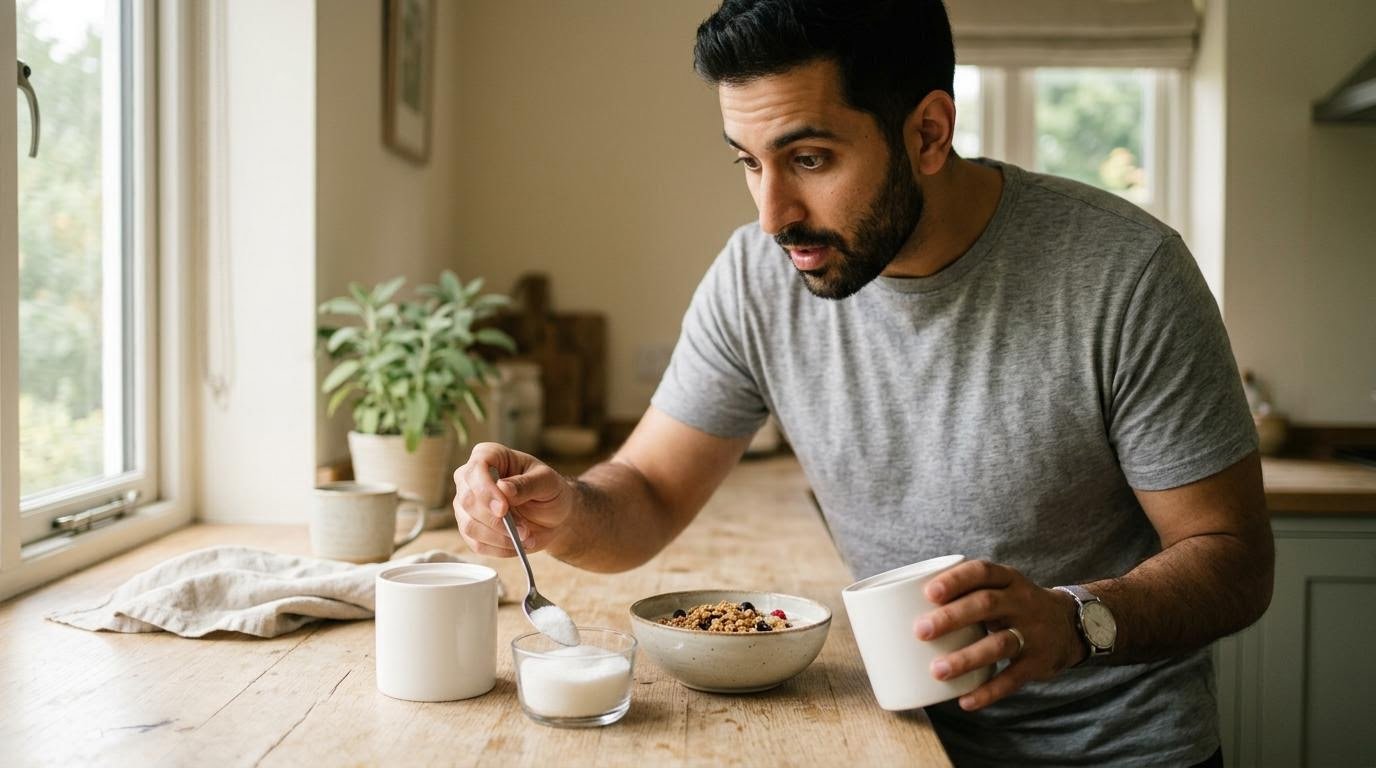
This is the section where the overhyped foods usually get caught. Flavored yogurt, granola, juice, instant oatmeal packets and "protein" bars all sit comfortably in the healthy-breakfast aisle. They can also carry real amounts of added sugar, and breakfast is the one meal where sugar rarely looks like dessert.
The American Heart Association gives a simple ceiling for daily added sugar. Use it as a yardstick against the label on whatever is in your bowl.
| Group | Daily added sugar limit (calories) | Approximate teaspoons |
|---|---|---|
| Women | 100 calories | 6 teaspoons |
| Men | 150 calories | 9 teaspoons |
Source: American Heart Association, Added Sugars
Is yogurt for breakfast to lose weight a good idea? Usually yes, with one condition: buy plain and add your own fruit. A single flavored cup can use up a big share of the limits above before you have had coffee. The fix takes ten seconds. Flip the package over and read the added sugars line, not the front-of-pack claims.
Three label habits make this easy. Read the added sugars line, not just total sugars, because fruit and milk contribute natural sugar that is a different matter. Scan the ingredient list for sugar under other names, since the order of ingredients shows what the product contains most. And compare the serving size to what you actually pour, because a "serving" of cereal is often smaller than a real bowl.
Drinks deserve the same look. A flavored latte or a bottle of juice can add sweetness to a morning that looks light on paper. If you drink your breakfast, count it.

Skip or eat? The honest verdict on weight loss breakfast food
If you are not hungry in the morning, you do not owe anyone a bowl of oatmeal. The BMJ review gives no reason to force breakfast on yourself, and the people who often do well with a later first meal are the ones who feel steady until noon. Our explainer on how to do 16/8 intermittent fasting without starving yourself walks through that approach, including who should avoid it: minors, people who are pregnant or breastfeeding, and anyone with a history of eating disorders.
Skipping breakfast starts to backfire when it pushes your eating to late evening. The protein trial above found exactly that pattern: more high-fat snacking at night after skipped breakfasts. If that sounds like your day, a protein-forward morning meal may fit you better than fasting does.
Here is a simple seven-day test you can run without buying anything. Days one to three, eat your usual breakfast and write down your hunger at 11 a.m. and 4 p.m. Days four to seven, switch to a plan built around protein and fiber from the earlier sections and track the same two times. If your hunger drops and your afternoon snacks shrink, the swap works for you. If nothing changes, keep whatever you enjoy and spend your energy on the habits that matter more, such as sleep, movement and overall portions.
That last point is the one most breakfast content avoids. A single meal is a small piece of the picture. Your whole week of eating, your activity and your sleep carry far more weight than any item on your breakfast plate.
Mayo Clinic's own take on the debate, from its official YouTube channel, adds the heart-health side of skipping the first meal.
Whichever route you pick, pace matters more than the menu. The CDC describes a gradual, steady pace of about 1 to 2 pounds a week as best, and says people who lose weight that way are more likely to keep it off. No breakfast, however clever, changes that ceiling.
So is your favorite weight loss breakfast food overhyped? As a trick, yes. As a tool, no. Pick a protein you enjoy, add fiber, check the sugar, and judge the meal by how your afternoon goes, not by the claim on the box.
Health disclaimer: This article is general education, not medical advice. Talk with a doctor or registered dietitian before changing your diet, especially if you are pregnant or breastfeeding, under 18, have diabetes, kidney disease or a history of disordered eating, or take medication that interacts with food timing. Ignore any breakfast claim that promises a specific amount of weight loss in a set number of days.

Quick answers about weight loss breakfast food
Should I skip breakfast to lose weight?
Not necessarily. In a BMJ meta-analysis of randomized trials, people assigned to skip breakfast weighed about 0.44 kg less on average across seven trials, which is a small gap. If skipping leaves you ravenous and snacking at night, a protein-forward breakfast may suit you better. Pregnant or breastfeeding people, minors and anyone with a history of disordered eating should talk to a clinician before changing meal timing.
How much protein should a weight loss breakfast food have?
There is no official per-meal target in the sources we reviewed. The 2013 trial that showed the clearest fullness benefit compared a 350-calorie breakfast with 35 g of protein against one with 13 g. Treat that as a starting point to test, and ask a registered dietitian first if you have kidney disease or another condition that affects protein needs.
Are eggs for breakfast to lose weight a smart choice?
They can be, mainly as a protein source. The egg- and beef-rich breakfast in the 2013 trial reduced evening snacking compared with skipping breakfast, but total daily calories did not differ. Pair eggs with fiber such as whole-grain toast or vegetables, and follow your doctor's advice if you have been told to limit eggs.
What to eat breakfast to lose weight when you only have five minutes?
Pick one protein and one fiber source you can grab: plain Greek yogurt with berries and chia seeds, a hard-boiled egg with fruit, or overnight oats made with milk and nuts. Check the added sugars line on any packaged version.
How fast should weight loss happen?
The CDC describes about 1 to 2 pounds a week as a gradual, steady pace, and says people who lose weight at that rate are more likely to keep it off. Faster promises on breakfast products are a red flag.
Is flavored yogurt for breakfast to lose weight okay?
It depends on the label. Flavored cups can carry added sugar, and the American Heart Association limits are about 6 teaspoons a day for women and 9 for men. Plain yogurt topped with fruit gives you control over the sweetness.
References
- BMJ: Effect of breakfast on weight and energy intake: systematic review and meta-analysis of randomised controlled trials, 2019
- American Journal of Clinical Nutrition: Beneficial effects of a higher-protein breakfast on the appetitive, hormonal, and neural signals controlling energy intake regulation in overweight/obese, "breakfast-skipping," late-adolescent girls, 2013
- Mayo Clinic: Dietary fiber: Essential for a healthy diet
- American Heart Association: Added Sugars
- CDC: Losing Weight
- Mayo Clinic (official YouTube channel): Mayo Clinic Minute: Why skipping breakfast can be bad for your heart