

A HIIT workout running machine session asks for hard effort in short bursts, then gives you time to recover before the next one. That pattern is the whole idea. You are not running flat out for 25 minutes. You run fast for 30 to 45 seconds, drop to a walk, and repeat until the clock runs out. Done well, it fits into a lunch break and still moves you toward your weekly activity target. This guide gives you the exact routine, the heart rate numbers to check yourself against, a four-week build, and the mistakes that turn a good session into a sore knee.
Most people who try interval work on a treadmill make one of two mistakes. They pick a sprint speed on day one that they can hold for ten seconds, or they treat the recovery break as a rest stop and stand on the side rails. Both are fixable with a plan, and the plan below is built around fixing them.
A running machine gives interval training something the street cannot: exact control
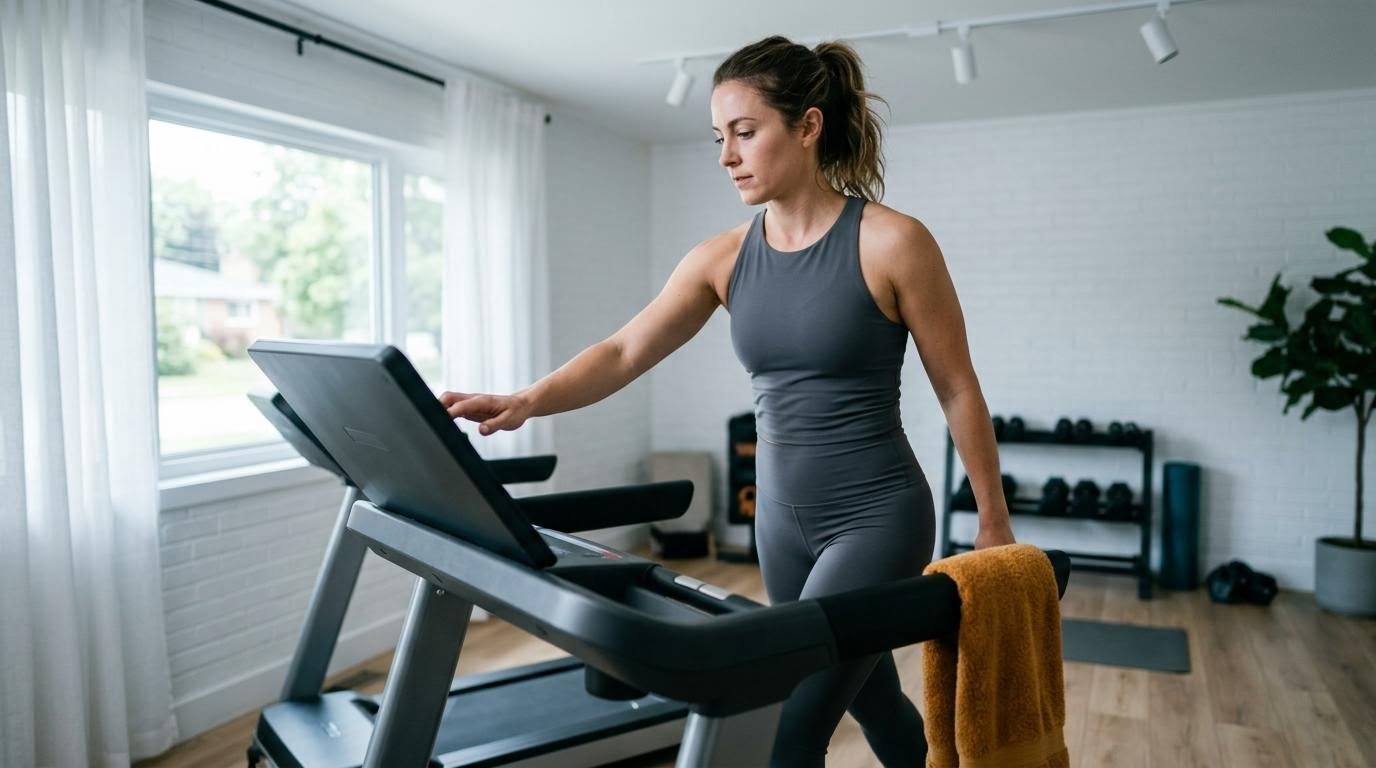
On the road, your pace drifts. A hill slows you, a crossing stops you, and by the sixth interval you are jogging at a speed you would have called a recovery pace an hour earlier. A treadmill removes that drift. You choose a number, the belt holds you to it, and the interval ends when the timer says so, not when your motivation does.
That control is also why the machine suits beginners and returning exercisers. Speed changes in small steps, you can trade a little speed for a little incline, and the handrails stay within reach if you lose your rhythm. The weather never cancels the session, and you never have to run a hard interval along a path with a pedestrian in it. Any treadmill interval workout shares these advantages, but they matter most when the plan is simple enough to follow while you are out of breath.
There is a catch worth knowing before you start. The belt keeps moving whether or not your legs feel ready. A pace that seems modest in the first minute can feel brutal in the ninth, because you cannot ease off by accident the way you would on a trail. That is why the routine below starts with conservative speeds and asks you to change only one setting at a time. If you are still deciding which gear deserves floor space at home, our breakdown of the HIIT workout equipment worth buying shows where a treadmill sits next to cheaper tools like a jump rope.

Heart rate and the talk test decide what "hard" means, not the number on the console
Speed alone tells you very little. Eight miles an hour is a sprint for one person and a warm-up for another. Effort is a better guide, and you have two tools to measure it.
The first is heart rate. The American Heart Association gives a simple estimate of your maximum heart rate: subtract your age from 220. It places vigorous activity at about 70 to 85 percent of that number. Picture a 25-year-old. The estimate gives a maximum of roughly 195 beats a minute and a vigorous range of about 137 to 166. Interval research tends to aim higher for the hardest efforts. A 2024 umbrella review in Sports Medicine describes HIIT work intervals as sitting at roughly 80 to 95 percent of maximum heart rate, which is why the top of your range is where the hard intervals belong.
| Age | Target heart rate zone (50-85% of maximum) | Average maximum heart rate |
|---|---|---|
| 20 years | 100-170 beats per minute | 200 beats per minute |
| 30 years | 95-162 beats per minute | 190 beats per minute |
| 40 years | 90-153 beats per minute | 180 beats per minute |
| 50 years | 85-145 beats per minute | 170 beats per minute |
Source: American Heart Association, 2024
These are averages, and the formula is an estimate. Your own maximum can sit well above or below the figure for your age, so a few beats either way means nothing. Use the table as a rough guardrail rather than a target to chase.
The second tool is the talk test, and it needs no equipment. During a hard interval you should manage only a few words at a time. During recovery you should be speaking in full sentences again before the next round begins. If you cannot talk freely by the last ten seconds of a recovery, the hard interval was too fast or the recovery was too short.
One more point for anyone wearing a watch or chest strap. Heart rate lags behind effort, so the number keeps climbing for several seconds after a hard interval ends. Read it at the end of the interval or in the first seconds of recovery, not halfway through, and treat it as confirmation of how the effort felt rather than a score to beat.

The 25-minute HIIT workout running machine routine, minute by minute
Mayo Clinic's physical medicine team outlines one interval format: a three-minute warm-up, four to six rounds of a 30-second sprint followed by 60 seconds of active recovery, and a three-minute cool-down. The routine below stretches that idea into a slightly longer session with a longer warm-up and cool-down, which is kinder to cold joints. Every round lasts exactly two minutes, so the clock does the counting for you.
| Time | Segment | Speed (starting point) | Incline | Effort (1 to 10) |
|---|---|---|---|---|
| 0:00 - 5:00 | Warm-up | Walk at 3.0 mph, building to an easy jog near 4.5 mph | 0-1% | 3 |
| 5:00 - 21:00 | Eight rounds of 2:00 each | Hard: 40 seconds at 5.5-7.5 mph. Recovery: 80 seconds walking at 3.0 mph | 1% | Hard 8, recovery 3-4 |
| 21:00 - 25:00 | Cool-down | Slow walk at 3.0 mph, easing toward 2.0 mph | 0% | 2 |
Source: GenZiest editorial routine. Effort levels follow American Heart Association heart rate guidance, and speeds are starting points to adjust to your own fitness.
Beginners should use the shortened version: six rounds of 30 seconds hard and 90 seconds easy, with the same warm-up and cool-down. That lands near 21 minutes in total. If even that sounds like a lot, a gentler first step is the no-equipment 15-minute cardio routine for beginners, which builds the same pacing habits without a belt moving under your feet.
How to run each round
- Clip the safety cord to your clothing before you start the belt.
- Find the quick-speed and pause buttons during the warm-up, not in the middle of round one.
- Raise the speed in two steps at the start of each hard interval instead of one jump. Your legs need a few seconds to meet the belt.
- Define hard as the speed you can hold for the full 40 seconds with good form. If your form falls apart at 30 seconds, drop the speed one notch next round.
- Lower the speed to a walk at the start of recovery and keep moving. Standing on the side rails lets your heart rate fall too far, and restarting is harder than continuing.
- Finish on schedule. Do not add extra seconds to the last round.
To feel how interval pacing works away from the belt, Mayo Clinic's own channel hosts a 30-minute class built from five exercise stations that need little or no equipment.

Raise the work first and the total time last: a four-week build
The fastest way to hurt a knee is to treat a good week as permission to double everything. A steadier approach changes one thing at a time and keeps each round at two minutes, so the session only gets longer when you add rounds.
Week-by-week progression for your HIIT workout running machine sessions
- Week 1: six rounds of 30 seconds hard and 90 seconds recovery. About 21 minutes in total.
- Week 2: six rounds of 40 seconds hard and 80 seconds recovery. Still about 21 minutes.
- Week 3: eight rounds of 40 seconds hard and 80 seconds recovery. This is the full 25-minute routine.
- Week 4: eight rounds of 45 seconds hard and 75 seconds recovery. Hold here for as long as you like.
What to change and what to leave alone
When you want more challenge, change the settings in this order: more rounds, then slightly longer hard intervals, then speed, then incline. Never change two at once, because you will not know which one caused the sore shins. If a week feels heavy, repeat it. Repeating a week is progress, not failure, and it costs you nothing.

Shorter hard efforts often beat longer ones, and the research supports restraint
That same 2024 umbrella review pooled 16 systematic reviews covering 79 randomized trials and 2,474 participants. Interval training produced a small but statistically significant extra drop in body fat percentage compared with steady moderate exercise, about 0.77 percentage points on average. The edge looked stronger in people with overweight or obesity, in programs lasting 12 weeks or longer, and in low-volume protocols with under 15 minutes of high-intensity work per session. The routine in this guide holds about five minutes and twenty seconds of hard work, well inside that range.
Read those numbers with some caution. The authors rated most of the reviews they pooled as low or critically low quality, and 0.77 percentage points is a modest edge, not a transformation. Steady moderate exercise also reduces body fat, so the lesson is not that intervals beat everything. It is that you do not need long, punishing efforts to get a benefit, and short ones may be easier to repeat week after week.
The temptation after two good weeks is to lengthen the hard intervals. The evidence points the other way: keep them short and keep showing up. For the wider picture of how this fits with fat loss, our guide to aerobic exercise for belly fat explains why overall energy balance still sets the pace, no matter how clever the workout is.
Protect your joints and your heart before you raise the speed
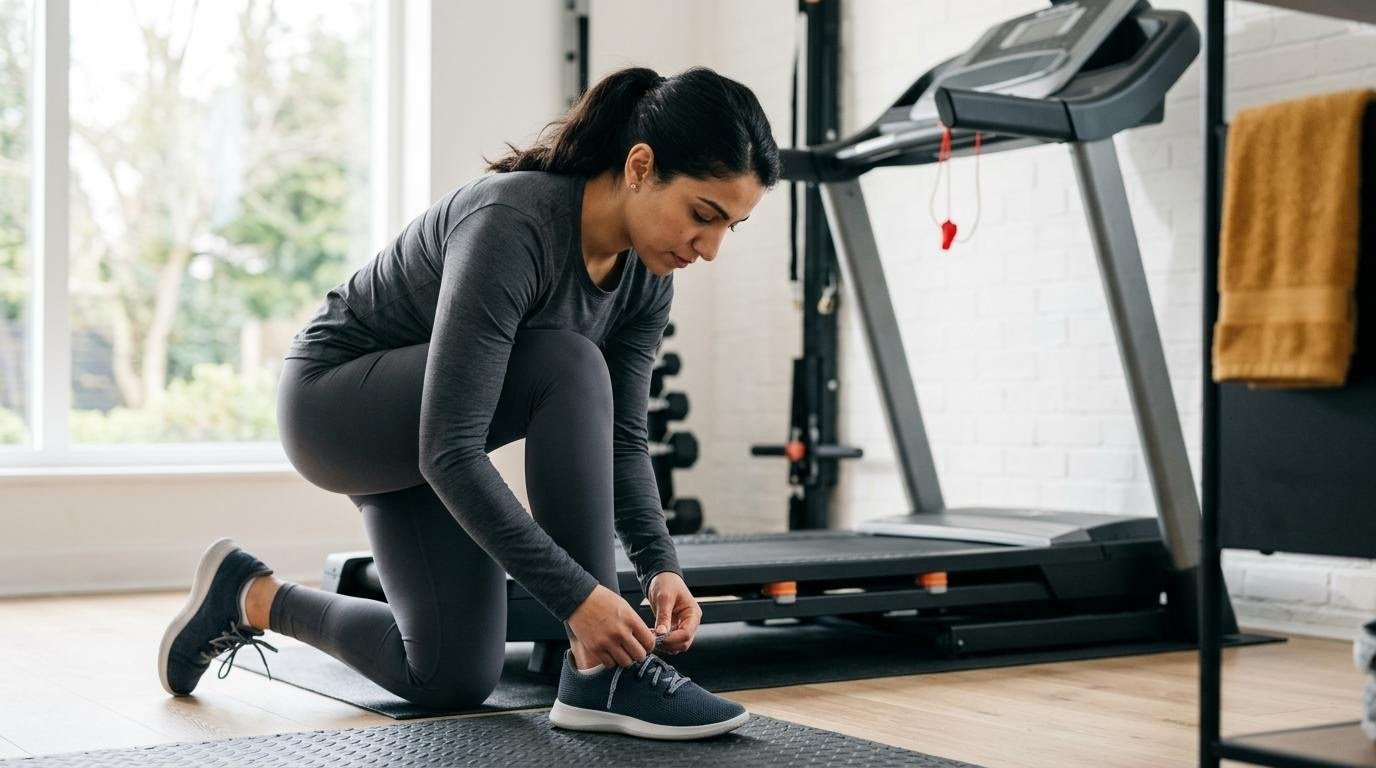
The warm-up is not optional filler. Five minutes of walking and easy jogging raise your heart rate gradually and loosen the joints that are about to take repeated impact. Wear running shoes with cushioning that still has life in it, keep the safety clip attached, and run in the middle of the belt with your hands free. Gripping the rails during a hard run changes your stride and hides how hard you are really working.
The same Mayo Clinic piece also cautions that high-impact, ballistic movement does not suit everyone, especially people with musculoskeletal injuries, and it points to lower-impact options such as cycling, an elliptical trainer or water running as ways to get the same challenge with less joint stress.
Harvard Health's guidance on high-intensity interval training makes the same point from another angle: the cardiovascular benefits are available when you adapt the session to your own ability. In practice, that means a hard interval of fast walking on a modest incline can be a legitimate version of HIIT for a beginner, a returning exerciser, or anyone managing sore knees. Effort defines the interval, not the speed on the display.
Two or three sessions a week is the dose, and rest days are part of the plan
For context, the CDC's adult activity guidelines call for about 150 minutes of moderate activity a week, or 75 minutes of vigorous activity, or an equivalent mix of the two. They also recommend muscle-strengthening work on at least two days. Only your hard intervals count as vigorous time. The warm-up, the recovery walks and the cool-down count as lighter activity. Two full sessions give you roughly 11 minutes of vigorous effort, so the rest of the weekly target comes from walking, easy jogging or anything else you enjoy.
How often to repeat a HIIT workout running machine session
Leave at least one day between sessions. A sensible week looks like this:
- Monday: interval session on the running machine.
- Tuesday: strength training for the major muscle groups.
- Wednesday: easy walk or gentle cycling.
- Thursday: second interval session.
- Friday: strength training.
- Saturday: a longer easy walk or jog.
- Sunday: full rest.
A HIIT workout running machine session is a short appointment, not a punishment. Start with the beginner version this week, keep your recovery honest, and change one setting at a time. Four weeks from now you will be running the full routine without having ever pushed through a session that felt like a mistake.
Health disclaimer: High-intensity exercise is not right for everyone. Speak with a doctor or another qualified clinician before starting if you have a heart or lung condition, high blood pressure, joint or bone problems, take medication that affects your heart rate, are pregnant or breastfeeding, are under 18, or have not exercised for a long time. Stop immediately and seek medical help if you feel chest pain or pressure, severe breathlessness, dizziness or faintness. This article is general information and not personal medical advice.

Frequently asked questions about a HIIT workout on a running machine
How long should a HIIT workout on a running machine last?
Plan on 20 to 25 minutes in total, including a warm-up and a cool-down. The hard work itself adds up to roughly 4 to 6 minutes in the beginner version and a little over 5 minutes in the full routine. The Mayo Clinic format described above works out to roughly 12 to 15 minutes overall, so a shorter session is perfectly reasonable when your time is tight.
How many times a week should I do it?
Two or three times, with at least one day between sessions. The hard efforts are demanding enough that your legs and your motivation both need the gap. Fill the other days with walking, easy cycling or strength work, and keep one full rest day.
Is a HIIT workout running machine session safe for beginners?
It can be, when you scale it. Use the 30-second version with 90 seconds of recovery, keep speeds conservative, and treat a brisk uphill walk as a valid hard interval. Anyone with a heart condition, chest pain, a joint injury, pregnancy, or a long break from exercise should speak with a doctor first.
What speed should I use for the hard intervals?
Use effort, not a fixed number. A hard interval is the speed you can hold with good form for the whole interval while managing only a few words at a time. For many beginners that is a fast jog somewhere around 5.0 to 6.0 miles per hour, but a fast walk with some incline is just as valid. If a round goes badly, lower the speed by 0.2 miles per hour next time.
Is a running machine workout for weight loss better with HIIT than with steady jogging?
Slightly, on average, but not dramatically. The 2024 umbrella review found interval training reduced body fat percentage about 0.77 percentage points more than steady moderate exercise, and most of the pooled reviews were rated low quality. Weight change still depends on overall energy balance, so pair the sessions with sleep, protein and daily movement instead of expecting the treadmill to do everything.
Should I use incline or speed to make intervals harder?
Both work, and incline is gentler on joints. Raising the incline a few percent at the same speed raises effort without adding to the pounding, which helps if your knees or shins complain at higher speeds. Change one setting at a time so you know what caused the extra difficulty.
References
- CDC - Adult Activity: An Overview, 2023
- Mayo Clinic - Sprint, rest, repeat: Exploring the benefits of high-intensity interval training, 2016
- Harvard Health Publishing - Safe and effective high-intensity interval training, 2026
- American Heart Association - Target Heart Rates Chart, 2024
- Sports Medicine (via PubMed Central) - Efficacy of Interval Training in Improving Body Composition and Adiposity in Apparently Healthy Adults: An Umbrella Review with Meta-Analysis, 2024
- Mayo Clinic (YouTube) - Mayo Clinic HIIT Workout for Mind & Body - Week 5