

The most effective workout for busy moms is rarely the longest one. It is the one that survives a sick kid, a late meeting and a toddler who treats your yoga mat like a racetrack. If your last fitness plan fell apart by week three, the plan probably asked for an hour you never had.
This guide builds a routine around the time you really have. You will turn a fuzzy wish into one measurable weekly goal, see why ten-minute blocks count toward official activity targets, and get a three-session weekly layout, a six-move circuit that needs no equipment, and a simple way to track progress without a gym membership or a spreadsheet.

A Workout for Busy Moms Starts With One Weekly Number, Not a Vague Goal
"Get in shape" and "tone up" feel like goals, but they fail one basic test: you cannot tell on Sunday night whether you hit them. Mayo Clinic's guide to starting a fitness program makes the same point plainly. Clear goals help you measure progress and stay motivated, which is why its first steps are to measure where you are today and then design a program around specific objectives.
So swap the feeling for a number. Pick one of these and write it where you will see it:
- Minutes: "I will move for 90 minutes this week."
- Sessions: "I will do two strength circuits and three brisk walks."
- Streak: "I will do at least 10 minutes on five days out of seven."
The right starting number is whatever you already did over the last two weeks, plus a small push. Mayo Clinic suggests raising your activity by no more than 10 percent a week when you are new to exercise. If you did nothing last week, a first target of 60 minutes spread across the week is plenty. If you walked 100 minutes, aim for about 110.
Here is a scenario that shows why this matters. Picture a mom with a six-year-old and a one-year-old who sets the goal "work out every morning." By Thursday the baby has a cold, she is up at 5:15 anyway and the plan is dead. A mom with the goal "90 minutes this week, any time, any shape" counts the stroller walk, the living-room circuit and the dance break during dinner prep, and she finishes Sunday at 95 minutes. Same life, different goal design.
If you want a deeper walkthrough on setting targets that actually hold, our guide on getting your fitness targets clear before you start goes step by step.
One honest note about speed. The fastest way to reach fitness goals as a parent is not harder workouts. It is showing up in a form you can repeat for months. Consistency beats intensity in the first stretch because a skipped week costs more than a slightly easier session.
Ten-Minute Blocks Count: How Short Sessions Add Up to the Weekly Target
Many moms assume that a workout under 30 minutes is not worth the sweat. Official guidance says otherwise. The CDC's overview of adult physical activity guidelines sets the weekly baseline at 150 minutes of moderate-intensity activity, plus at least two days of muscle-strengthening work. It also states that you do not have to do it all at once, and that you can break your activity into smaller chunks of time across the week.
That one sentence changes the math of a busy day. Three ten-minute blocks equal one 30-minute session as far as your weekly total goes. A walk to school drop-off, a circuit while dinner simmers and a stretch-and-squat routine after bedtime stories all count.
What the targets look like at a glance
| Group | Weekly aerobic target | Strength target | How it can be split |
|---|---|---|---|
| Adults | 150 minutes moderate, or 75 minutes vigorous | At least 2 days, all major muscle groups | Smaller chunks of time across the week |
| Postpartum (first year) | 150 minutes moderate | Ask your doctor how to adjust | Example: 30 minutes, 5 days a week |
Source: CDC, Adult Activity: An Overview (2023) and Pregnant & Postpartum Activity: An Overview (2025)
What counts as moderate and vigorous
Use the talk test. At moderate intensity you can talk but not sing, which describes a brisk walk, a bike ride with the kids or an easy dance session. At vigorous intensity you can only say a few words before pausing for breath.
The UK's NHS adds a useful detail for time-starved parents in its activity guidelines for adults aged 19 to 64. Seventy-five minutes of vigorous activity can give similar health benefits to 150 minutes of moderate activity, and the page notes that you can reach your target with several short sessions of very vigorous activity, such as high intensity interval training. That route is not for everyone, and you should build up gradually, but it explains why a hard 10-minute circuit is not a wasted effort.
Here is the non-obvious part. Because short blocks count, the real enemy of your routine is the "all or nothing" rule you quietly apply to yourself. A 12-minute workout on a day when you wanted 45 is not a failed workout. It is 12 minutes toward a weekly total, and it keeps the habit alive.

A 30 Minute Workout for Busy Moms Works Best as Three Small Sessions
Once you accept that chunks count, a 30 minute workout for busy moms becomes a puzzle you can solve around your day instead of a block you must defend. The trick is to give each chunk a job.
The three-block day
- Block one, 10 minutes, morning: a brisk walk or a loosening circuit. This is your wake-up block and it takes no planning.
- Block two, 10 minutes, midday or naptime: the strength circuit from the next section. This is your most important block, so place it where interruptions are least likely.
- Block three, 10 minutes, evening: a walk, a dance break or mobility work while the kids wind down.
You do not need all three blocks every day. Think of them as menu items. On a heavy day you may only get block two, and that is fine.
A simple weekly layout
This layout reaches about 150 minutes across the week and includes the two strength days the CDC recommends. Treat it as a template and scale it down to match your starting number from the first section.
- Monday: strength circuit (15 minutes) plus a 15-minute walk
- Tuesday: three 10-minute brisk walks, one per block
- Wednesday: strength circuit (15 minutes) plus a 15-minute walk
- Thursday: two 15-minute blocks of walking, cycling or dancing
- Friday: strength circuit (15 minutes) plus a 15-minute walk
- Saturday: 30 minutes of active play with the family, such as a playground circuit or a hike
- Sunday: rest or an easy stretch
Starter version: keep only one 10-minute block a day for two weeks, then add a second block on three days. That is the same 10 percent logic from earlier, applied to the clock.
The Best Workout for Busy Moms Needs Six Moves and Zero Equipment
Search for the best workout for busy moms and you will find endless lists of 20 exercises. You only need six, because they cover every major muscle group the CDC mentions: legs, hips, back, abdomen, chest, shoulders and arms. Each move uses your body weight or a household object.
The six-move circuit
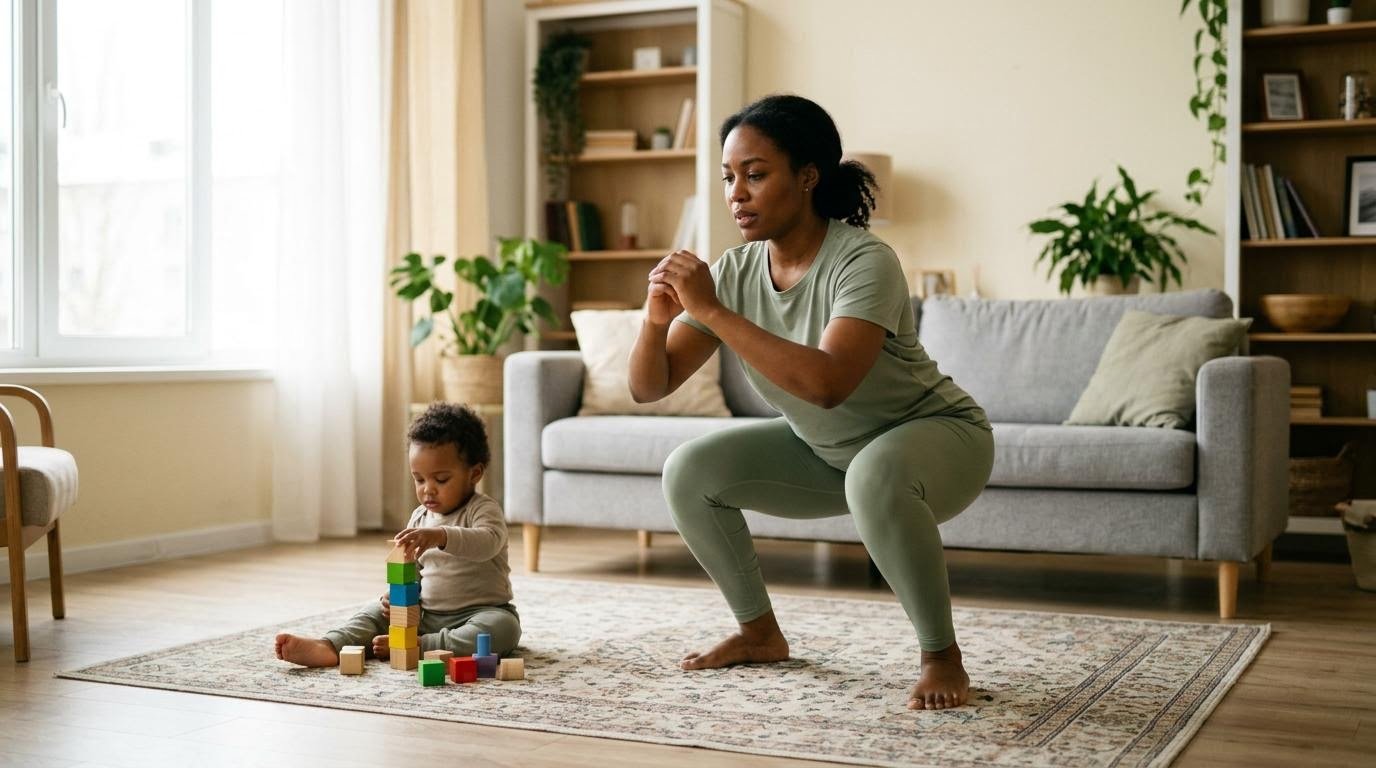
- Chair squat. Sit back to a chair, tap it lightly and stand. Works legs and hips.
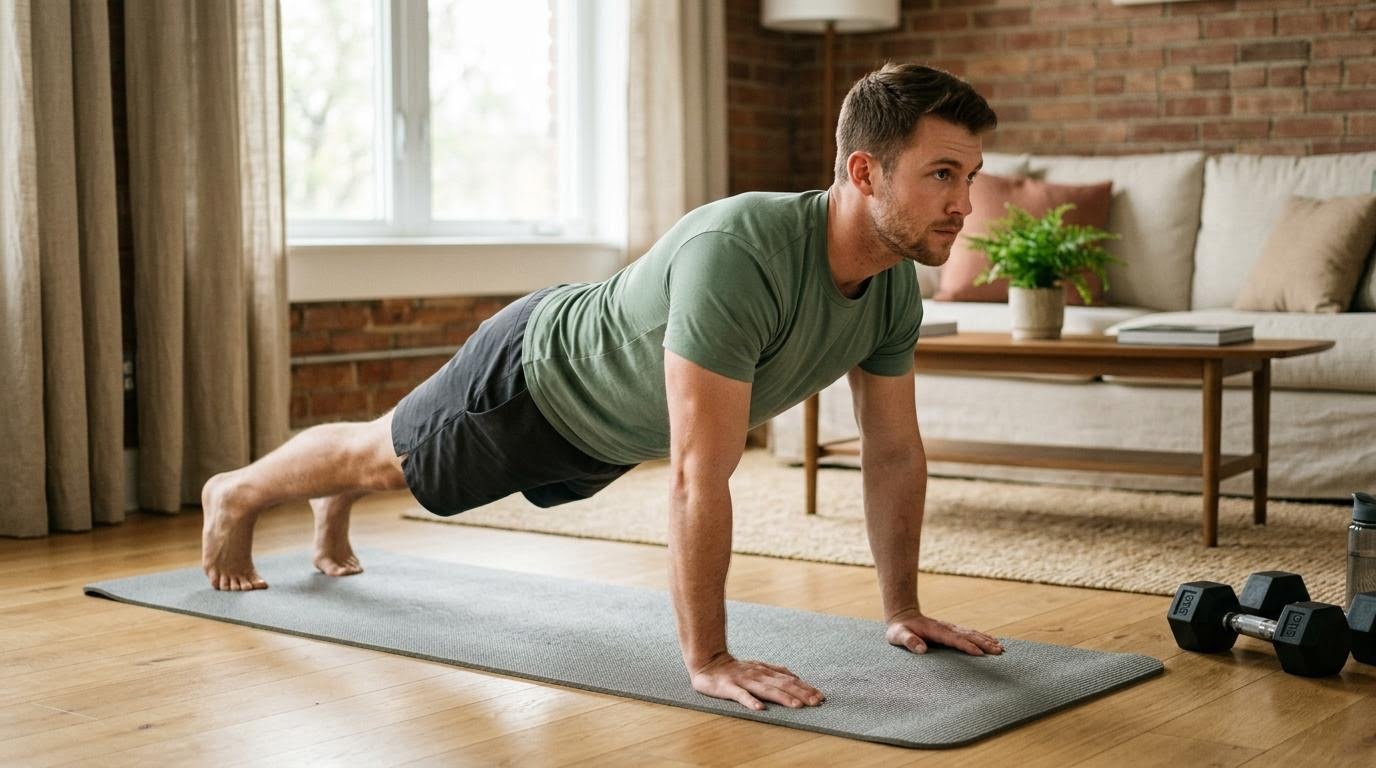
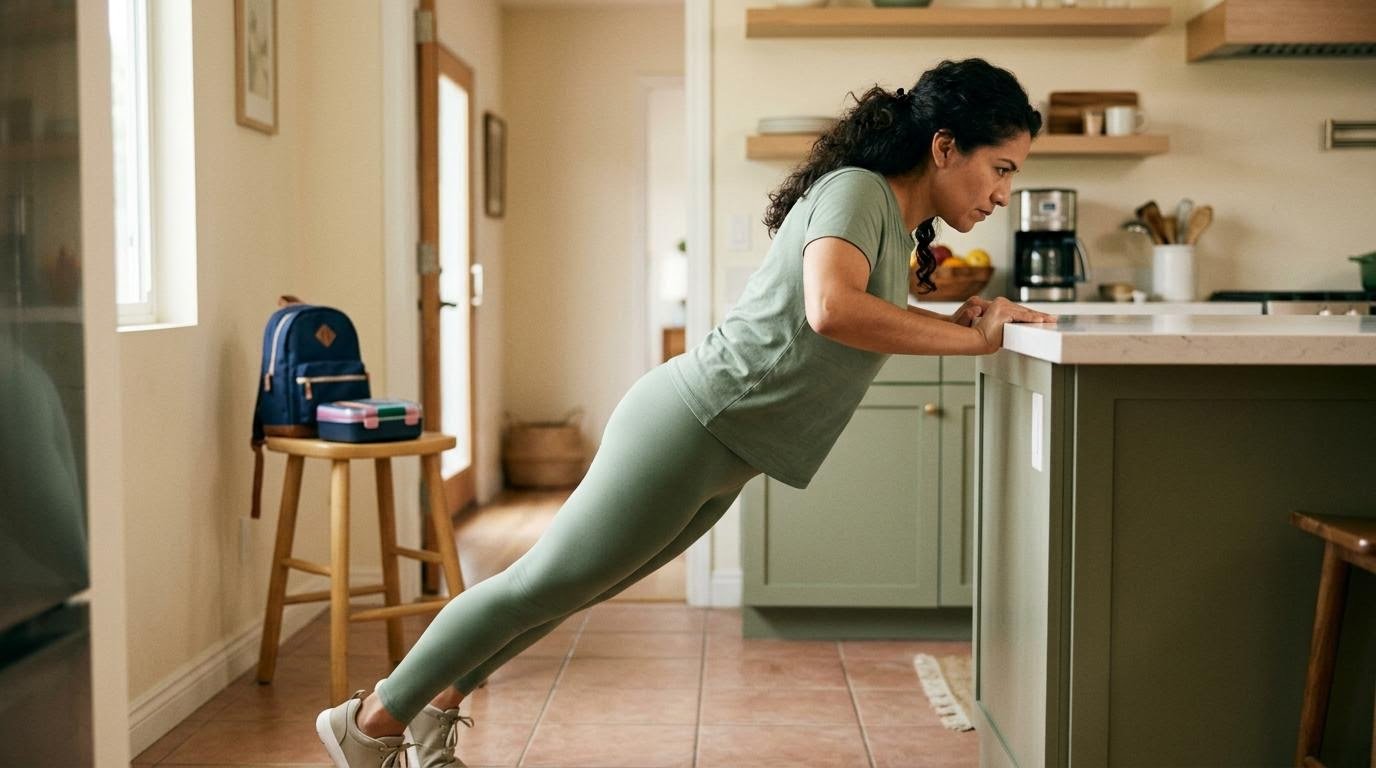
- Counter push-up. Hands on the kitchen counter, body in a straight line, lower your chest toward the edge. Works chest, shoulders and arms, and it is easier on the wrists than the floor.
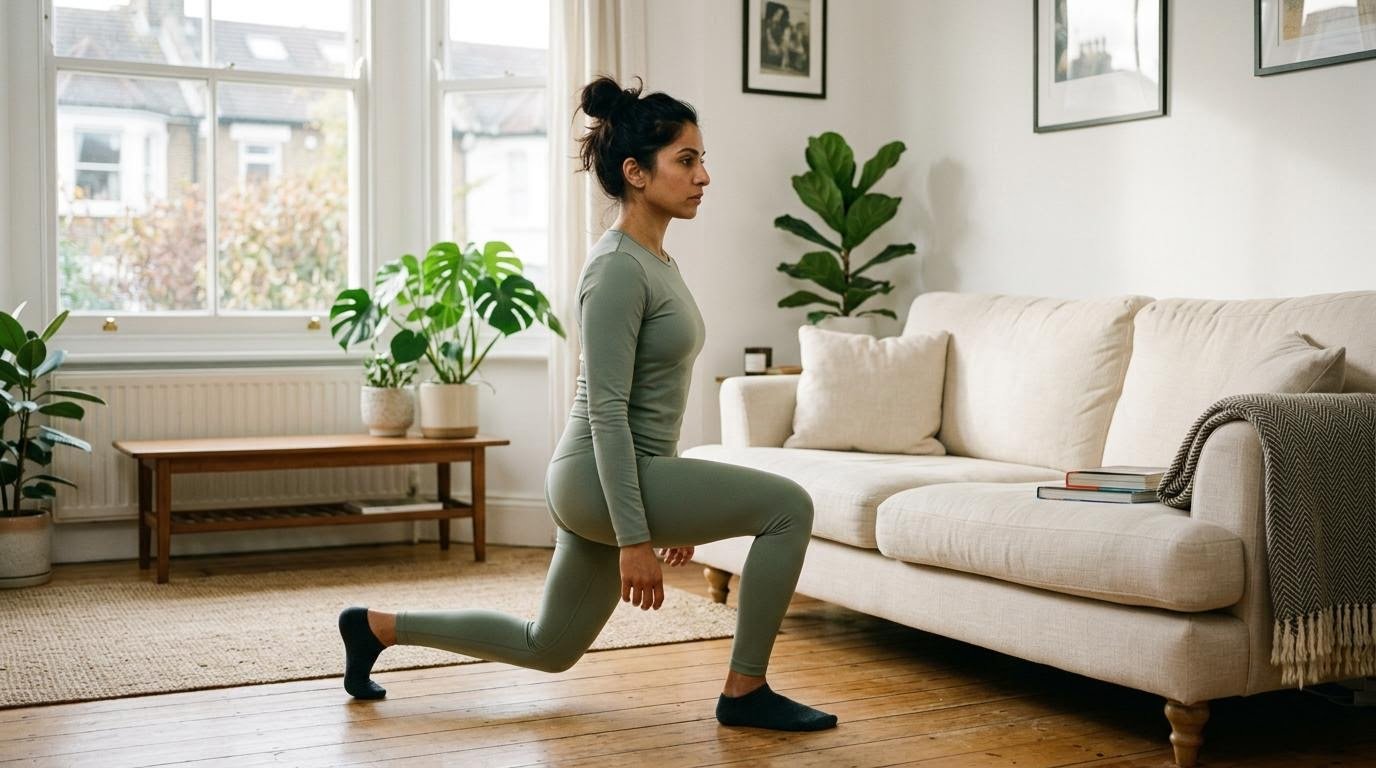
- Reverse lunge. Step back, lower both knees, push through the front heel to stand. Works legs and glutes.
- Glute bridge. Lie on your back, feet flat, lift your hips and squeeze. Works glutes and the back of the legs.
- Backpack row. Hinge forward with a loaded backpack or two water jugs and pull toward your ribs. Works the upper back.
- Dead bug. On your back, arms up, opposite arm and leg lower slowly toward the floor. Works the deep abdominal muscles gently.
How to run it
Do each move for 40 seconds, rest 20 seconds, and go through the list twice. That is roughly 12 minutes, which fits inside a single naptime block. If 40 seconds feels long, start with 20 seconds on and 40 off.
Design it so interruptions do not ruin it. Pick a spot where you can pause mid-circuit without losing your place, such as a mat in the corner of the living room with a card marking the current move. A "pause-proof" circuit lets you answer a toddler's request, then pick up at move four instead of starting over. Most beginner plans ignore this, and it is a big reason they fail with young children.
If you are within the first months after birth, or you had a cesarean or notice leaking, pressure or a bulge in your abdomen or pelvic area, check with your doctor or a pelvic floor physiotherapist before adding core work such as the dead bug. Start with walking and the squat, bridge and row until you are cleared.
Five Places an At Home Workout for Busy Moms Can Hide in a Normal Day
Time rarely appears on its own, but it does hide. These five slots show up in most households, and any of them can host a 10-minute block.
- The first-coffee window. Ten minutes before the house wakes, or while the coffee brews, is the lowest-friction slot you have.
- Naptime or quiet time. Treat the first 15 minutes of it as workout time, not laundry time. The laundry will still be there.
- Screen-time pockets. A 20-minute show buys a full circuit. Use it on purpose rather than by accident.
- Dinner simmer. Counter push-ups and chair squats fit into the five minutes while something cooks.
- The kids' practice. Walk laps around the field during a sports practice instead of scrolling on the sideline.
You can also involve the kids without turning it into a performance. Follow-the-leader games, a race to the mailbox and stroller intervals (fast for one block, easy for the next) all raise your heart rate. For a ready-made routine with no gear, try the 15 minute plan in our beginner cardio workout at home, which pairs well with the strength circuit above.
A practical rule for choosing the slot: attach the block to something that already happens every day. "After I drop the kids at school I walk for 10 minutes" survives chaos far better than "I will work out when I find time." Behavior researchers call this an implementation intention, and in daily life it simply means deciding the when and where ahead of time.
Guilt and Shifting Schedules Derail Busy Mom Fitness More Than a Lack of Time
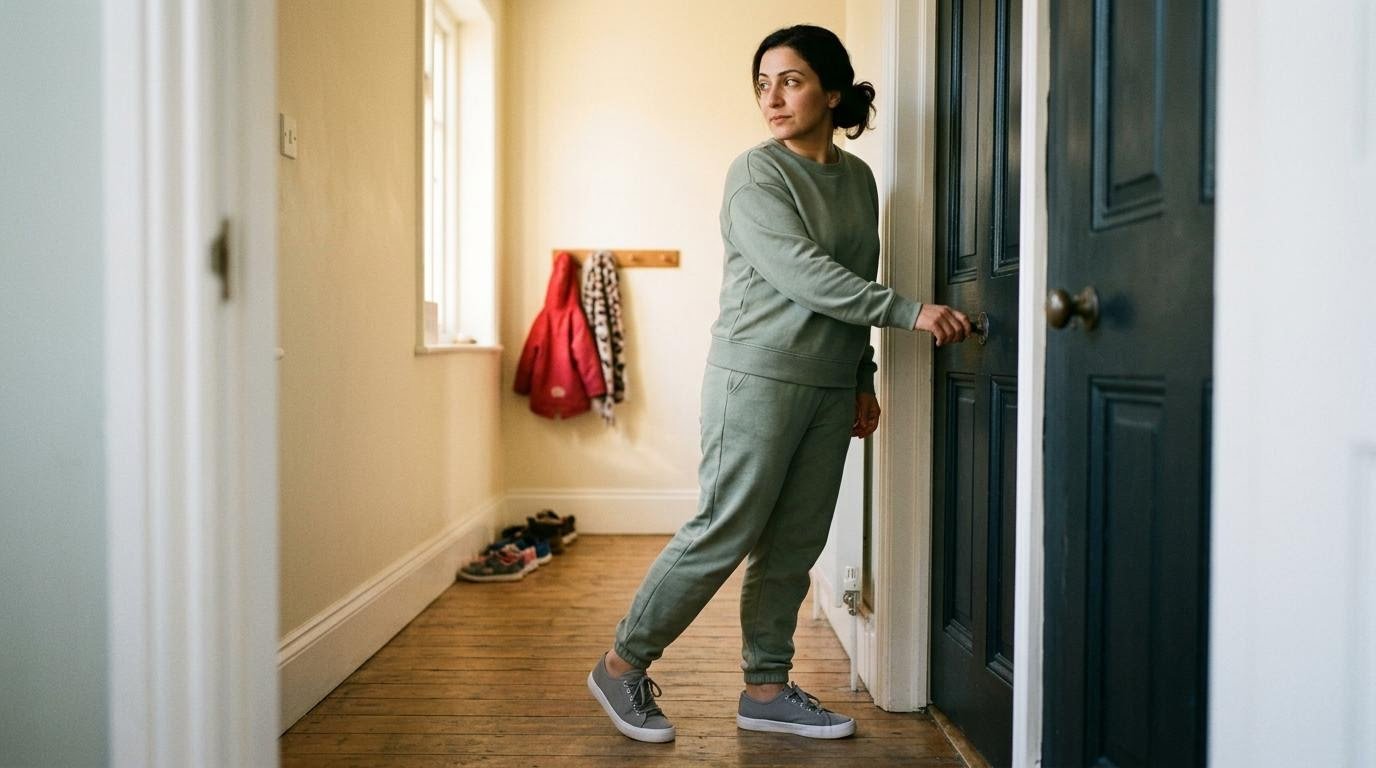
Ask a group of parents why they skip exercise and most will say, "I have no time." Research suggests the story is more layered. A 2014 qualitative study of 13 working mothers and 12 working fathers, published in BMC Public Health, looked at physical activity barriers and facilitators among working parents. Both groups described family responsibilities, guilt, scheduling constraints, work demands and a lack of support. The mothers added a distinct worry, feeling guilty about taking time during the workday and concern about appearing less committed to their jobs.
It is a small study, so treat it as a window and not a verdict. But it lines up with what many women say out loud: the barrier is not only the clock. It is the feeling that exercise is something you take from other people.
Three ways to defuse the guilt
- Reframe the purpose. You are not abandoning the family for 10 minutes. You are building the energy and strength to keep up with them. The CDC even notes that physical activity in the first year after delivery can reduce symptoms of postpartum depression.
- Name the slot out loud. Tell your partner or the kids, "Between 7:30 and 7:40 is my walk." A spoken, predictable slot feels less like stolen time than a surprise disappearance.
- Trade, don't beg. Swap a 20-minute window with another parent each week. Both of you get a protected block and neither of you owes an apology.
Plan for the bad day
Set a minimum version of your routine, a floor you can do on your worst day. A good floor is one move: ten chair squats, or a five-minute walk around the block. When the day collapses, you do the floor and count it as a win. A floor protects the habit, and the habit protects the long-term goal.
The scheduling piece is solvable with the if-then plans described earlier. The guilt piece is solved by repetition. Each time you finish a short block and the household keeps running, the story you tell yourself gets a little less loud.
Track One Number and Adjust Every Two Weeks
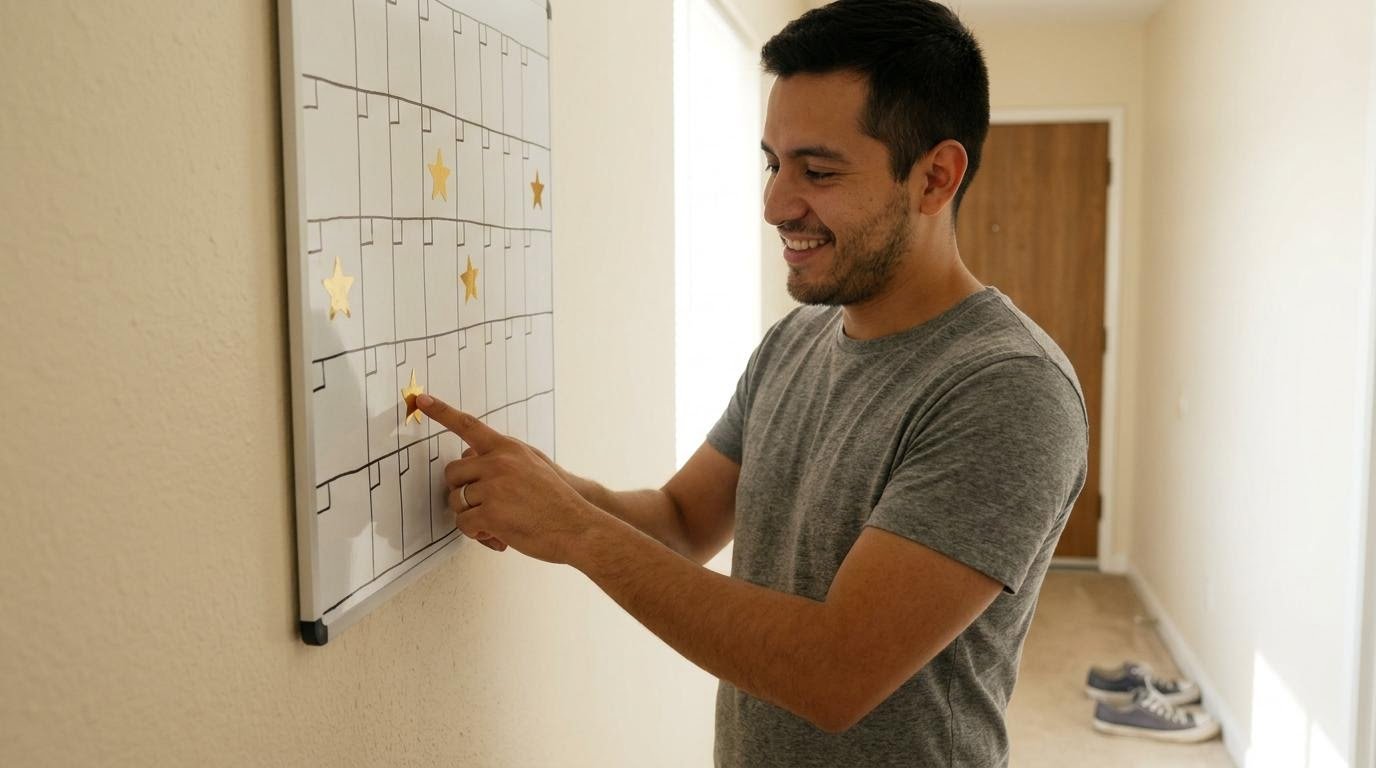
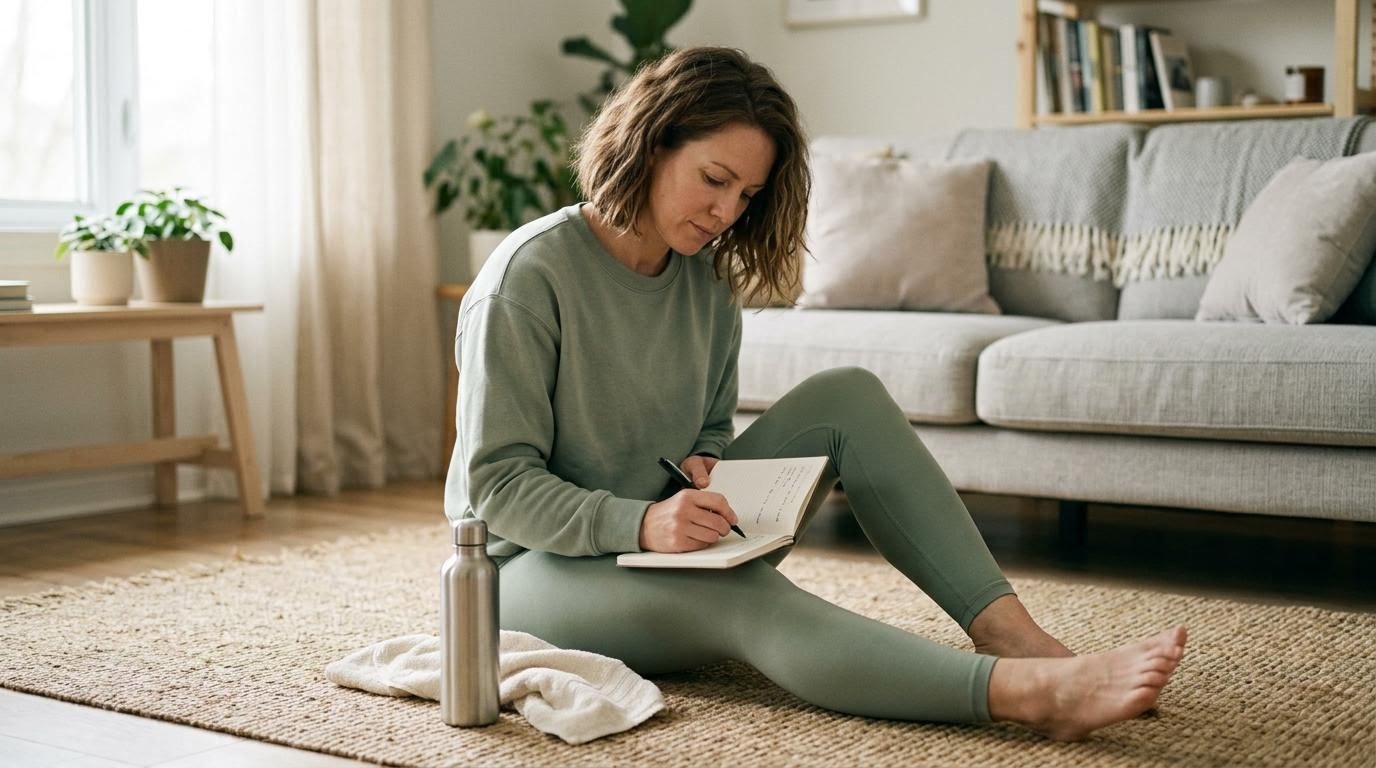
You set a weekly number at the start. Now the only tracking you need is whether you hit it. A paper calendar on the fridge works, or the notes app on your phone. Write down the total minutes at the end of each week and put a check next to every day you hit your floor.
Every two weeks, ask three questions:
- Did I hit my number in at least one of the last two weeks?
- Which block was easiest to protect, and which kept getting bumped?
- Do I need to move a block, shrink it or add time?
If you hit your number two weeks in a row, raise it by about 10 percent. If you missed it twice, lower the number or move the weak block to a more reliable slot. Do not interpret a miss as a character flaw. It is data about your schedule. Mayo Clinic also recommends reassessing your fitness after about six weeks, using the same measures you started with, such as how many push-ups you can do or how long a brisk walk takes. A physical test shows you progress that the scale does not.
The plan should also bend around your body. If you are postpartum, the CDC advises talking with your doctor about adjusting physical activity after pregnancy, so build in that check-in before increasing intensity. For more ways to make the routine stick over months, our piece on sustainable habits that actually stick covers cues, rewards and what to do after a missed week.
The bottom line is a short list. Set one weekly number. Count ten-minute blocks. Use six moves you can pause and resume. Protect a floor for bad days. Review every two weeks. A workout for busy moms succeeds when it bends around your life instead of asking your life to bend around it.
Health disclaimer: This article is general information, not medical advice. Talk with your doctor before starting or changing an exercise routine, especially if you are pregnant, recently gave birth, had a cesarean delivery, are breastfeeding, have a heart, joint or blood pressure condition, or have not exercised in a long time. Stop and seek medical advice if you feel chest pain, dizziness, unusual shortness of breath or pelvic pain.
Frequently Asked Questions About Fitness for Busy Moms
How long should a workout for busy moms be?
As short as 10 minutes counts. The CDC target for adults is 150 minutes of moderate activity a week, and it says you can break that into smaller chunks across the week. Three 10-minute blocks a day on five days gets you there with room to spare.
What is the best workout for busy moms with no equipment?
A six-move body-weight circuit covers the major muscle groups: chair squats, counter push-ups, reverse lunges, glute bridges, backpack rows and dead bugs. Do each for 40 seconds with 20 seconds of rest, and repeat twice for about 12 minutes.
Can 10-minute workouts really help me reach my fitness goals?
Yes, as long as they add up to a weekly total and you do them consistently. Ten minutes done five days a week is 50 minutes, a solid starting number that you can raise by roughly 10 percent a week as the habit settles.
How many days a week should a busy mom exercise?
Aim for movement on most days and strength work on at least two days. The CDC recommends muscle-strengthening activities on at least two days a week for adults, and a layout of three strength days with walking on the other days covers that comfortably.
When can I start working out after having a baby?
It depends on your delivery and recovery, so ask your doctor or midwife. The CDC's pregnant and postpartum activity guidance recommends at least 150 minutes of moderate-intensity aerobic activity a week and advises discussing adjustments with your doctor.
How do I stay consistent when my kids' schedules keep changing?
Attach your block to a daily event instead of a clock time, such as after school drop-off or when dinner goes on the stove. Keep a one-move floor for chaotic days, and review your plan every two weeks so you can shift blocks that keep getting bumped.
References
- CDC — Adult Activity: An Overview, 2023
- CDC — Pregnant & Postpartum Activity: An Overview, 2025
- Mayo Clinic — Fitness program: 5 steps to get started, 2023
- NHS — Physical activity guidelines for adults aged 19 to 64
- BMC Public Health (PMC) — Physical activity barriers and facilitators among working mothers and fathers, 2014