


You've been hitting the gym four or five days a week, doing a mix of everything, and your arms and chest look different but your legs and back haven't budged in months. That's not a genetics problem, it's a programming problem. The fix usually comes down to picking the right workout split so you actually target specific muscle groups, instead of doing a little bit of everything every session. This guide breaks down what doctors and exercise physiologists actually recommend for training frequency, volume, and recovery, muscle group by muscle group, not just "lift more."
The CDC's physical activity guidelines are the baseline everyone starts from: muscle-strengthening activity on 2 or more days a week, working all major muscle groups, legs, hips, back, abdomen, chest, shoulders, and arms. That's the floor. What separates someone who's been "working out" for a year with nothing to show for it from someone who's visibly changed is what happens above that floor, and that's almost entirely about how you split your training across those muscle groups.

Why You Need to Target Specific Muscle Groups Instead of Training Everything the Same Way
Most beginner routines fail for one specific, fixable reason: every muscle group gets treated identically regardless of how big it is or how fast it recovers. Your calves and your quads don't need the same volume. Your biceps and your back don't recover on the same timeline. Training them as if they do is why progress stalls even when you're technically "working hard."
Mayo Clinic's strength training guidance is direct about the fix: rest one full day between exercising each specific muscle group. That's not a suggestion for people who feel sore, it's the baseline recovery window every major muscle group needs before you load it again with real intensity. Train chest hard on Monday, and Tuesday isn't a rest day from training in general, it's specifically a rest day from chest.
This is where a lot of well-intentioned beginners go wrong without realizing it. Doing "full body" workouts five days a week sounds like more effort, and it often produces less muscle growth than three well-structured sessions, because every muscle group is getting hit before it's actually recovered enough to respond productively to the next stimulus.
There's a non-obvious wrinkle worth knowing here: "training a muscle group" doesn't only mean the day you dedicate to it directly. A heavy leg day taxes your lower back and core through stabilization, a heavy pull day taxes your biceps and forearms as secondary movers, and a heavy push day taxes your triceps and shoulders the same way. If your split has you training triceps directly on Monday and then hitting a heavy chest press on Tuesday, your triceps are getting real work two days in a row even though only one of those was "triceps day" on paper. This is why experienced lifters sequence their splits deliberately, chest and triceps together, back and biceps together, rather than scattering push and pull movements randomly across the week.
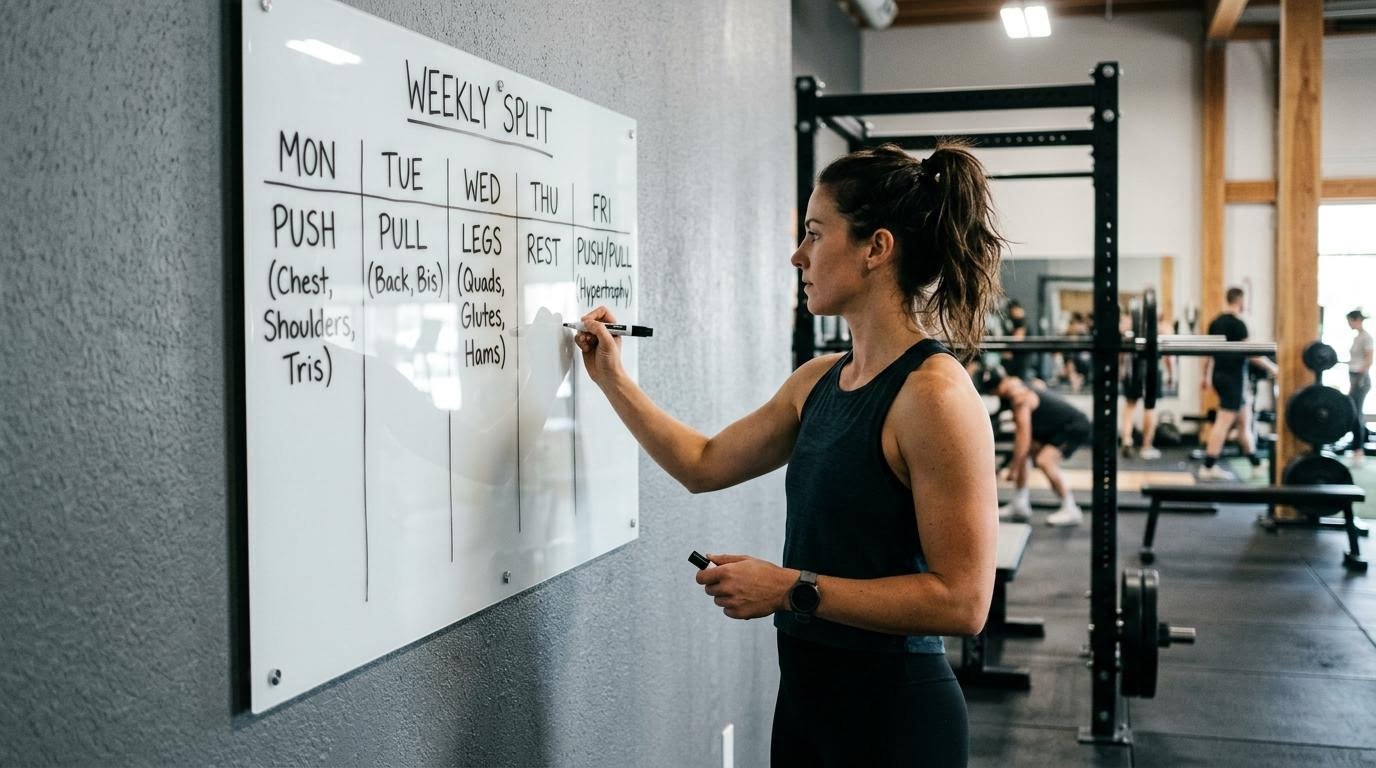
The Split That Matches Your Actual Recovery Window
Once you accept that different muscle groups need dedicated rest, the next question is which workout split actually structures a week around that. The three splits worth knowing:
Full body (2-3x/week)
Every major muscle group, every session, with a full rest day between sessions. This directly matches the CDC's 2+ days/week floor and works well for genuine beginners, since it maximizes how often each muscle group gets trained per week without violating the one-day recovery rule Mayo Clinic recommends, as long as you're only training 2 to 3 days total.
Upper/lower split (4x/week)
Upper body one day, lower body the next, repeating twice across the week. This lets you push harder per muscle group per session than full body allows, since you're not trying to fit everything into one workout, while still respecting the one-day rest window for each region.
Push/pull/legs (3-6x/week)
Chest, shoulders, and triceps on push day; back and biceps on pull day; quads, hamstrings, glutes, and calves on leg day. This is the split most intermediate lifters graduate to, because it lets you dedicate real volume to each muscle group without any of them showing up twice in 48 hours.
There's no single "best" split in an absolute sense. The one you'll actually stick with, that fits your schedule and still respects the recovery window each muscle group needs, beats a theoretically optimal plan you abandon in three weeks.
A practical way to choose: count the days you can realistically commit to the gym in a normal week, not an ideal one. If that number is 2 or 3, full body is your split, full stop, don't try to force a 5-day push/pull/legs/upper/lower routine into 3 sessions, since you'll end up skipping muscle groups entirely rather than under-training them evenly. If it's 4, upper/lower gives you the most balanced structure. If it's 5 or 6, push/pull/legs, possibly repeated twice in the week, lets you dedicate real, focused volume to each muscle group without any of them going more than 2 days without work.

How Many Sets and Reps Each Muscle Group Actually Needs
Mayo Clinic's foundational guidance for beginners is a single set of 12 to 15 repetitions per exercise, using a weight heavy enough that the last couple of reps genuinely challenge you. That's a legitimate, evidence-backed starting point, not a "beginner's version" you need to graduate away from immediately.
As you get more specific about training individual muscle groups, most people move toward 2 to 4 sets per exercise, 2 to 4 exercises per muscle group per session, once or twice a week depending on your split. A back day in a push/pull/legs split, for example, might include a compound row, a pulldown or pull-up variation, and a single-arm row, roughly 8 to 12 total working sets for that one muscle group across the week.
Harvard Health's research on muscle building points to something worth knowing if you're impatient with results: strength gains in the first two weeks come mostly from your nervous system getting more efficient at recruiting the muscle you already have, not new muscle tissue. Visible muscle growth typically shows up after eight to 12 weeks of consistent progressive resistance training two to three times a week, challenging major muscle groups. If you're not seeing visible change at week three, that's not a sign the program failed, it's roughly on schedule.
| Muscle Group | Minimum Weekly Frequency | Rest Before Retraining |
|---|---|---|
| Legs (quads, hamstrings, glutes) | 2x/week | 1 full day minimum |
| Back | 2x/week | 1 full day minimum |
| Chest, shoulders, arms | 2x/week | 1 full day minimum |
| Abdomen / core | 2x/week | 1 full day minimum |
Source: Centers for Disease Control and Prevention; Mayo Clinic, 2026

Recovery and Protein: The Half of "Training" Most People Skip
The workout is the stimulus, not the result. Cleveland Clinic's research on post-workout soreness explains the actual mechanism: the microtears in muscle tissue from a hard session repair and strengthen over the following days, given adequate protein and rest, which is when the muscle group actually grows. Skip that repair window and you're just accumulating fatigue, not gains.
Delayed onset muscle soreness (DOMS) typically develops hours or days after an intense session and resolves on its own within a few days, becoming less severe the more consistently you train that muscle group. Cleveland Clinic's guidance is nuanced on training through it: light activity can actually ease the achiness, but if the soreness is sharp enough to change how you move or makes your normal exercises noticeably harder, that's the signal to back off that muscle group specifically until it resolves.
On the nutrition side, the Academy of Nutrition and Dietetics notes that protein needs vary meaningfully for people who are more physically active than the general population baseline. If your training is targeting specific muscle groups with real intensity two or more times a week, that's exactly the population where the standard sedentary-adult RDA is a floor, not a target. A practical approach: aim for a protein source at each meal rather than trying to hit an exact gram number, which gets you most of the benefit without turning eating into a spreadsheet.
One progression rule worth borrowing from injury-prevention research: Cleveland Clinic recommends no more than a 10% increase per week in weight, volume, or intensity, whichever you're adjusting. Jumping your bench press by 20 pounds in a week because "it felt easy" is a common way lifters turn a good week into a two-week setback.
Sleep belongs in this conversation too, even though it rarely gets mentioned alongside sets and reps. Most of the actual tissue repair that turns a workout into visible muscle happens during deep sleep, when growth hormone release peaks. Someone training hard on 5 hours of sleep a night is working against the exact biological process they're trying to trigger, which is part of why two people doing identical programs can see very different results if one of them is chronically underslept. If your training and nutrition are both dialed in and progress has stalled anyway, sleep is worth auditing before you touch your program again.
Health disclaimer: This article is educational and not a substitute for personalized medical advice. Talk to your doctor before starting a new strength training program if you have a heart condition, joint problems, a previous injury, or haven't trained in a while, and consult a registered dietitian before making significant changes to your protein intake, especially if you're pregnant, breastfeeding, under 18, or managing a medical condition.

Progressive Overload: The One Variable That Decides If You Grow
Everything above, the split, the sets and reps, the recovery window, only works if one more thing is happening across weeks: progressive overload. That's the gradual increase in weight, reps, or sets over time that keeps giving each muscle group a reason to adapt. Harvard Health's research is clear that visible muscle growth depends on progressive resistance training, not just repeating the same workout indefinitely.
In practice, this doesn't mean adding weight every single session. It means tracking what you lifted last time for each exercise and aiming to beat it, even slightly, every week or two, whether that's one more rep, five more pounds, or one more set. A muscle group that's lifting the exact same weight for the exact same reps every week for three months has no biological reason to keep growing. It's already adapted to that specific demand.
Combine that with the 10% weekly progression ceiling from the recovery section above, and you have a plan that pushes each muscle group forward without outrunning what it can actually repair between sessions. That balance, not any single "best exercise" or supplement, is what separates people who keep making visible progress a year in from people who plateaued in month two.
A simple example makes this concrete. Say your first leg day includes a goblet squat at 25 pounds for 3 sets of 12. Two weeks later, if you're still doing 25 pounds for 3 sets of 12 and nothing has changed, your legs have no new reason to add muscle, they've already adapted to exactly that demand. Progressive overload here could mean 27.5 pounds for the same 3 sets of 12, or 25 pounds for 3 sets of 14, or adding a fourth set. Any one of those is enough. The mistake isn't picking the wrong option, it's picking none of them and wondering why three months of consistent gym attendance produced consistent soreness but not much visible change.
It's worth being honest about the exercises themselves too, since program structure only matters if the exercises inside it are actually working the muscle group you're targeting. Compound movements, squats, deadlifts, rows, presses, recruit multiple muscle groups at once and are the most time-efficient way to build a training base. Isolation movements, bicep curls, leg extensions, lateral raises, let you add targeted volume to a specific muscle once the bigger compound lifts are in place. A session built entirely around isolation work, without a single compound movement, tends to accumulate fatigue without building the base strength that makes future progressive overload possible. The reverse, all compounds and no isolation, works fine for general strength but leaves smaller, harder-to-target muscles like rear delts or calves chronically under-trained relative to the bigger movers around them.
Your Workout Split Blueprint to Target Specific Muscle Groups
Bringing it together: pick a split that matches how many days you can actually train (full body 2-3x/week, upper/lower 4x/week, or push/pull/legs 3-6x/week), rest at least one full day before hitting the same muscle group again, aim for 2 to 4 exercises and 8 to 12 total sets per muscle group each week, and add a small amount of weight or a rep every week or two rather than jumping in big leaps. That's the actual mechanism behind learning to target specific muscle groups effectively, not a specific exercise or supplement, but a structure your recovery can keep up with.
Before you build that structure, it helps to get your fitness targets clear before you start, since the split you pick should match the goal, not the other way around. And if your strength sessions are also meant to help with body composition, this piece on whether strength training actually helps with cellulite reduction is worth reading alongside the muscle-focused advice here.
Frequently Asked Questions
How many days a week should you train each muscle group?
At minimum, 2 days a week, per CDC guidelines, with at least one full rest day between sessions targeting the same muscle group, per Mayo Clinic. Most people training for visible muscle growth land in that 2x/week range per muscle group, whether that comes from a full-body split or a more specialized upper/lower or push/pull/legs structure.
What's the best workout split for beginners?
A full-body split trained 2 to 3 times a week is the best starting point for true beginners, since it naturally respects the one-day rest window each muscle group needs while still meeting the CDC's 2+ days/week muscle-strengthening guideline. Move to an upper/lower or push/pull/legs split once you're training 4 or more days a week.
Can you build muscle training a muscle group only once a week?
You can, but it's generally less efficient than training it twice. Since Mayo Clinic's guidance calls for at least two sessions a week per major muscle group for visible results, a once-a-week "bro split" approach usually means each muscle group gets less total weekly volume than a 2x/week structure would provide.
How many exercises per muscle group is ideal?
Roughly 2 to 4 exercises per muscle group per session works for most people, totaling around 8 to 12 working sets for that muscle group across the week, once you're past the single-set beginner phase Mayo Clinic recommends for people just starting out.
Should beginners do full body or a split routine?
Full body, for the first several months. It's simpler to program, easier to recover from at 2 to 3 sessions a week, and gives every muscle group the training frequency research links to visible growth. A specialized split becomes worth the added complexity once you're training 4 or more days a week and want more volume per muscle group than full body sessions can fit.
References
- Centers for Disease Control and Prevention — Adult Activity: An Overview
- Mayo Clinic — Strength training: Get stronger, leaner, healthier, 2026
- Cleveland Clinic — If You're Sore After a Workout, Should You Be Concerned?, 2025
- Harvard Health Publishing — How Long Does It Take to Build Muscle?, 2026
- Academy of Nutrition and Dietetics — How Much Protein Should I Eat?, 2026