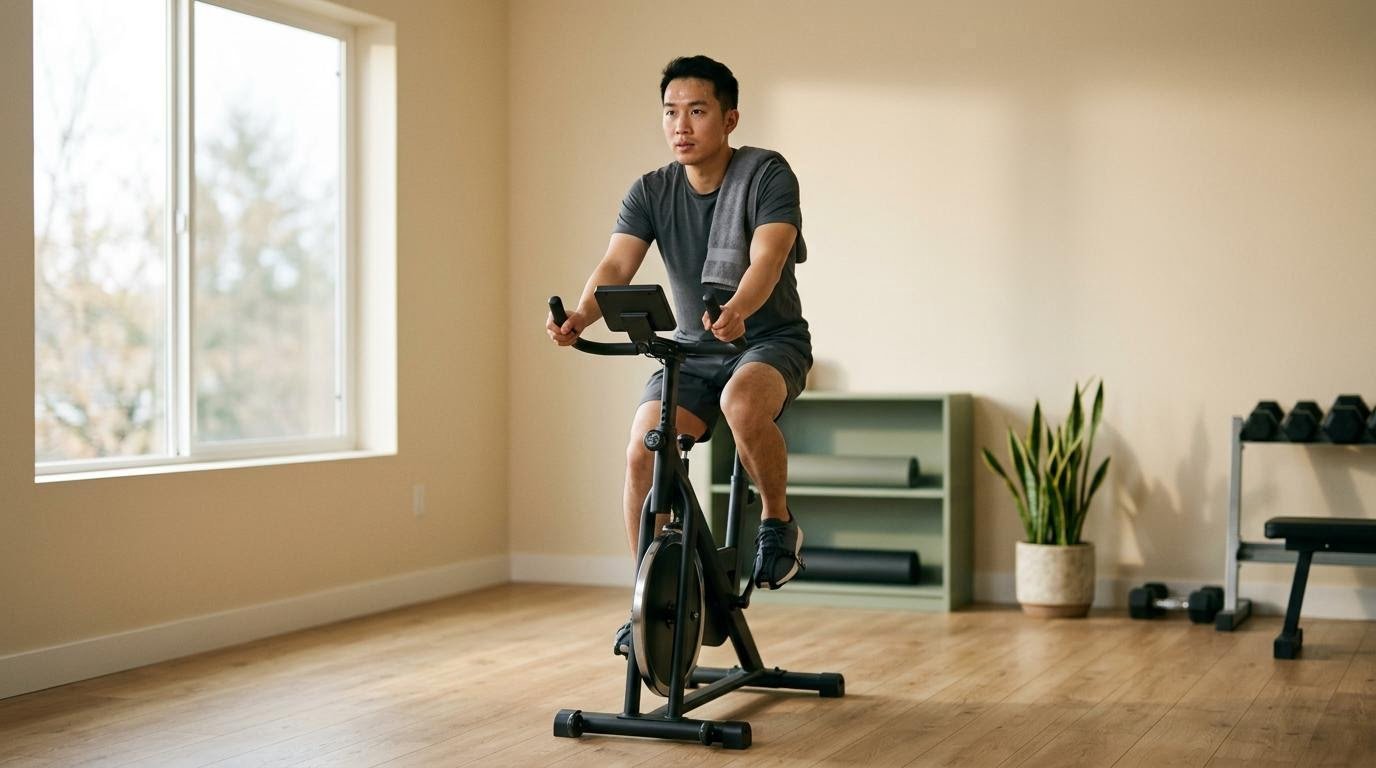


You have 30 minutes, a gym membership and one decision to make. Does a hiit workout on a treadmill give you more than a run outside, or is the belt just a warm, dry place to suffer? The honest answer is that each wins in a different category. The treadmill wins on control. The road or trail wins on variety. Which one is "better" depends on what you want from the session and what you will actually repeat next week.
This guide settles the argument with evidence, not gym folklore. You will see how treadmill and outdoor running compare on mechanics, heart rate and joint load, then get three ready-to-use interval plans, a heart rate table by age and a short safety checklist. If you only have 90 seconds, here is the short version: for structured intervals, the treadmill is hard to beat. For everything else, mix both.
Quick answer: A HIIT workout on a treadmill is better for precise, repeatable intervals and for exercising in any weather. Running outside is better for terrain variety, mental freshness and race-style training. Studies show the two are far more alike than different, so pick the one you will do consistently.

A HIIT workout on a treadmill packs the cardio payoff of a longer run into a short session
High-intensity interval training, or HIIT, alternates hard efforts with easier recovery. Harvard Health describes interval training as adding brief bouts of strenuous exercise to a workout, and notes that it is especially effective for cardiorespiratory fitness and may keep your calorie burn higher after you stop. That time-saving appeal is the reason a HIIT treadmill workout fits so neatly into a lunch break.
Here is the part most articles skip. Intervals are only as good as your ability to hit them on schedule. Outside, a sprint depends on traffic lights, dogs, hills and how brave you feel at minute twelve. On a treadmill, you press a button, the belt reaches 9 mph, and you either keep up or you do not. That pressure is the point. The machine removes the quiet negotiation that makes outdoor intervals slowly drift into "fast-ish jogs."
How much exercise do you actually need?
Official guidance sets the weekly bar clearly. The CDC recommends adults get at least 150 minutes of moderate-intensity activity a week, plus muscle-strengthening work on two days. The NHS guidelines for adults aged 19 to 64 add that 75 minutes of vigorous activity can stand in for the 150 moderate minutes. Vigorous work is exactly where HIIT lives, which is why three 20-minute interval sessions can cover a large share of your weekly target.
What a good interval session looks like
- A 5-minute easy warm-up so your joints and heart rate rise gradually.
- Hard efforts you could not hold for more than a couple of minutes, roughly 8 out of 10 on a 10-point effort scale.
- Recovery periods slow enough that you can speak in short sentences again.
- A 5-minute cooldown that brings your breathing back toward normal.
Notice what is missing: heroics. A good interval session ends with you feeling worked, not wrecked. If you cannot repeat the same workout in three days, the effort was set too high.

Running outside wins on variety and mood, but the mechanics are closer than you think
The treadmill has a reputation problem. Plenty of runners swear it feels "easier" or "different," and a few insist it ruins your form. The research is less dramatic than the gym-floor debate.
A 2019 systematic review and meta-analysis in Sports Medicine pooled 33 studies and 494 participants. Its authors concluded that spatiotemporal, kinematic, kinetic and muscle activity measures are largely comparable between treadmill and overground running. The differences that did show up were specific. On the treadmill, the foot met the ground at an angle about 9.8 degrees lower at footstrike, and peak propulsive force was slightly lower. The review also flagged that you should be careful when you extrapolate treadmill technique to the road.
Translation for your training: treadmill running is real running, with a few mechanical quirks around how your foot lands and pushes off. It is not a lesser workout.
Treadmill vs running outside: a side-by-side look
| Factor | HIIT on a treadmill | HIIT running outside |
|---|---|---|
| Pace control | Exact. The belt holds your speed. | Approximate. Terrain, wind and traffic interfere. |
| Interval timing | Easy to program and repeat week to week. | Needs a watch, a flat route and discipline. |
| Weather | Not an issue. | Heat, cold, rain and darkness all matter. |
| Surface | Same cushioned belt every time. | Pavement, trail or track, each with a different feel. |
| Footstrike | Foot lands at a lower angle on average. | Closer to your natural race mechanics. |
| Mental load | Can feel repetitive without music or a screen. | Scenery and fresh air help many people stay engaged. |
| Safety | Fall risk if you lose focus at speed. | Traffic, uneven ground and visibility risks. |
Source: Differences summarised from Van Hooren et al., Sports Medicine, 2019 (PMC), and general training practice.
The honest scorecard is closer to a tie. Many people find the treadmill the more effective place to do intervals, and the outdoors the better place to do long, easy runs. Treat them as two tools, not rivals.
The non-obvious catch: easier does not mean you will do more
Here is the insight that surprises most people. The treadmill's biggest advantage is not calories or joint load. It is that the workout is already planned. A runner who has to decide where to run, how hard to go and when to stop makes dozens of small choices, and every choice is a chance to skip. The belt turns the whole session into one decision: get on.
If you are still working out when your energy peaks, even better. Timing matters more than most people expect, and our look at the best time to work out covers what experts say about it.

Treadmill settings decide whether your intervals work
Stepping onto a treadmill and mashing the speed button is not a plan. Three settings do most of the work in any HIIT workout on a treadmill: speed, incline and interval length.
Speed: choose effort, not a number
A speed that is a sprint for you may be an easy jog for a trained runner. Ignore other people's numbers. Find your hard-effort speed by running one test minute and stopping when you reach roughly 8 out of 10 effort. Write the number down and use it as your interval speed. Your recovery speed is the one where you can walk or jog and slow your breathing down within about a minute.
Incline: a tool, not a requirement
Raising the incline makes the same speed harder without making your legs move faster. That is useful if sprinting feels risky, or if your shins complain at high speeds. Start flat, then try 2 to 4 percent on your hard efforts once the basic pattern feels comfortable. Keep the recovery intervals at a gentler grade so you actually recover. These are practical starting points rather than research-backed prescriptions, so adjust them to how your body responds.
Interval length: shorter than you think
Most beginners fail a HIIT session because they start with efforts that are too long. Thirty seconds hard is plenty at first. Work up to 45 or 60 seconds only after you can finish the shorter version feeling fresh.
If you are still deciding what to buy for home sessions, our guide to the HIIT workout equipment worth buying sorts the useful gear from the clutter. And when you are ready for a full structured routine, try our 25-minute treadmill HIIT plan.

A beginner HIIT treadmill workout starts with 30-second efforts and 90-second recoveries
Beginners get the most from a plan that is boring on paper. Short efforts, long recoveries and a low total volume let your tendons and joints catch up with your heart and lungs. Here are three sessions, from gentlest to hardest.
Session 1: the starter (about 26 minutes)
- 5 minutes: walk, then easy jog, building to a comfortable pace.
- 8 rounds: 30 seconds at your hard speed, then 90 seconds of walking or very easy jogging.
- 5 minutes: slow walk to cool down.
Session 2: the builder (about 28 minutes)
- 5 minutes warm-up.
- 8 rounds: 45 seconds hard, then 75 seconds easy.
- 5 minutes cooldown, plus 3 minutes of gentle stretching.
Session 3: the 1-to-1 challenge (about 27 minutes)
- 5 minutes warm-up.
- 8 rounds: 60 seconds hard, then 60 seconds easy.
- 5 minutes cooldown.
Take the starter for two weeks before you move on. Here is a real scenario. Priya, 24, works a desk job and has not run since school. She starts with Session 1 on Monday and Thursday. In week three she notices she is recovering within 60 seconds instead of 90, so she moves to Session 2. She never sprints at full tilt. She just keeps showing up, and the plan does the rest.
Aiming for fat loss? A HIIT workout on a treadmill helps, but energy balance across your whole week still sets the direction. No interval format delivers a guaranteed rate of loss, and no honest source promises one. Think of intervals as one strong tool alongside sleep, food quality and daily movement.

Your heart rate, not the speed on the screen, tells you if the effort is hard enough
Speed is a poor measure of intensity because it ignores how fit you are today. Heart rate adds context. The American Heart Association target heart rate guidance estimates your maximum heart rate as 220 minus your age, then defines a moderate zone of about 50 to 70 percent of that maximum and a vigorous zone of about 70 to 85 percent.
The table below shows the 50 to 85 percent range for common ages. Hard intervals should push you toward the upper end. Recovery should bring you back down toward the lower end.
| Age | Estimated maximum heart rate (beats per minute) | Target zone, 50 to 85 percent (beats per minute) |
|---|---|---|
| 20 | 200 | 100 to 170 |
| 30 | 190 | 95 to 162 |
| 40 | 180 | 90 to 153 |
| 50 | 170 | 85 to 145 |
| 60 | 160 | 80 to 136 |
Source: American Heart Association, 2024
Treat these as population averages. A formula cannot know your medications, your genetics or how you slept last night. If you take a beta blocker or have a heart condition, your doctor's targets override any chart.
No heart rate monitor? Use the talk test
During a hard interval you should manage a word or two at most. During recovery you should speak in short sentences. If you can chat comfortably in the hard phase, go faster. If you cannot catch your breath in the recovery phase, slow down or lengthen it.
You can also check your pulse the old-fashioned way. Press two fingers on the inside of your wrist, count beats for 15 seconds and multiply by four.

Cooling down and recovering decide how good your next session will be
Most people treat the cooldown as optional. It is not. Walking slowly for five minutes lets your heart rate fall in steps instead of dropping the moment you step off the belt, and it gives your legs a chance to flush out the work you just did.
How often should you do it?
For most healthy beginners, two or three interval sessions a week is a sensible ceiling, with at least one easier day between them. Fill the gaps with walking, easy cycling or strength work. That pattern also helps you reach the CDC's two weekly muscle-strengthening days without piling more stress on your legs.
Signs you are overdoing it
- You dread sessions that used to feel manageable.
- Your resting pulse or your usual effort pace feels noticeably higher than normal.
- Pain that lingers in your shins, knees or hips after the day of the workout.
- Poor sleep, low mood or constant fatigue for several days in a row.
If two or more of these show up, take two or three easy days before the next hard session. Sleep, protein and plenty of water do more for your progress at this point than another interval would.

Safety habits keep a HIIT workout on a treadmill from going wrong
A treadmill is a moving belt, and a sprint is a fast one. Both are fine together when you respect a few rules, and risky when you do not.
- Clip the safety cord to your clothing every time. If you stumble, the belt stops.
- Stand on the side rails while you change the speed, then step onto the belt only once it is moving at walking pace.
- Keep your eyes forward and your hands off the rails while running. Hanging on changes your posture and can reduce the effort.
- Never step off a moving belt. Slow to a walk, press stop and wait for the belt to halt.
- Wear shoes with good grip and secure laces. Skip headphones that block out the sound of your own footsteps if you tend to lose focus.
Fatigue is the quiet risk. Mayo Clinic's sports medicine physician Dr. Edward Laskowski explains in the video below that complex or ballistic high-intensity workouts raise injury risk, and that tiredness leads to sloppy form. A treadmill sprint is simple, but the same lesson applies: when your form falls apart, stop the interval.
When to skip HIIT and see a clinician first
Talk to a doctor before starting if you have a heart or lung condition, high blood pressure, diabetes, joint problems, a history of fainting during exercise, or you are pregnant or have not exercised in a long time. Stop any session immediately if you feel chest pain, dizziness or unusual shortness of breath.
Health disclaimer: This article is for general education and is not medical advice. Check with your doctor or another qualified healthcare professional before starting a new exercise program, especially high-intensity training, if you have a health condition, take medication, are pregnant, or are under 18. Stop exercising and seek medical help if you feel chest pain, severe dizziness or unusual breathlessness.
So, which one should you choose?
Pick the HIIT workout on a treadmill when you want exact intervals, a plan you can repeat and a session that ignores the weather. Pick the road or trail when you want fresh air, uneven ground and a break from screens. Most people do best with a mix: intervals indoors once or twice a week, easy runs or walks outside on the other days.
Whichever you choose, start small, track your effort by heart rate or the talk test, and add intensity slowly. The best workout is the one you can do again next week.
Frequently asked questions
Is a HIIT workout on a treadmill better than running outside for weight loss?
Neither one is better by default. Weight change depends on your overall energy balance across the week. A HIIT workout on a treadmill makes it easier to hit exact intervals in a short session, while outdoor running often lets you stay out longer at a steady pace. Choose the one you will repeat consistently.
How long should a HIIT workout on a treadmill be?
Most beginners do well with 20 to 30 minutes in total, including a 5-minute warm-up, 15 to 20 minutes of intervals and a 5-minute cooldown. Longer is not better if your form or effort drops.
How many times a week can you do treadmill HIIT?
Two or three sessions a week with at least one easier day in between is a sensible limit for most healthy beginners. More experienced exercisers may add a third, but recovery still matters.
What incline should you use for a HIIT treadmill workout?
Start at a flat or 1 percent grade. Once you feel comfortable, try 2 to 4 percent on the hard efforts and return to a gentler grade for recovery. These are practical starting points, so reduce the incline if your calves, shins or Achilles complain.
Is treadmill running easier than running outside?
Not necessarily. A 2019 meta-analysis of 33 studies found most biomechanical measures were similar, with differences in foot angle at footstrike and propulsive force. Perceived effort also varies with pace, incline and wind, so the same speed can feel different in each setting.
Can beginners do HIIT on a treadmill?
Yes, with a gentle start. Use 30-second efforts, 90-second recoveries and a pace that feels hard but controlled. Clear it with your doctor first if you have a health condition or have been inactive for a long time.
References
- CDC: Adult Activity: An Overview (Physical Activity Guidelines for Adults), 2023
- NHS: Physical activity guidelines for adults aged 19 to 64, 2024
- Van Hooren et al., Sports Medicine (PMC): Is Motorized Treadmill Running Biomechanically Comparable to Overground Running? A Systematic Review and Meta-Analysis of Cross-Over Studies, 2019
- American Heart Association: Target Heart Rates Chart, 2024
- Harvard Health Publishing: Harnessing the power of high-intensity interval training, 2019
- Mayo Clinic (YouTube): Mayo Clinic Minute: High-intensity workouts and reducing risk of injury