


You searched for a fat loss exercise routine because the internet keeps handing you two extremes: a 90-minute daily gym plan you'll quit by Thursday, or a vague "just move more" that gives you nothing to actually schedule. Neither one holds up past week two. A routine that works is specific about how much, how often, and what kind of effort, and it's built around what your body does with muscle and calories, not around what looks impressive on a fitness app.
That's the version this guide builds. You'll get the actual weekly minutes recommended by the CDC's physical activity guidelines, a four-day sample week you can start this week, and the reasoning behind why strength training belongs in a fat loss plan even if your only goal is a smaller number on the scale.

What Actually Makes a Fat Loss Exercise Routine Work
Fat loss happens when you burn more energy than you take in, and exercise is one lever on that equation, not the whole machine. Diet moves the needle faster for most people in the first few months, but a fat loss exercise routine does something diet alone can't: it protects the muscle tissue that keeps your metabolism from dropping while you're in a deficit.
Here's the part most routines skip explaining. When you lose weight through diet alone, a meaningful share of what comes off is muscle, not just fat. Add regular resistance work and aerobic activity to that same deficit, and your body preferentially holds onto lean mass while still losing fat, according to guidance from the Mayo Clinic on strength training. Muscle burns more energy at rest than fat tissue does, so this isn't a cosmetic detail. It's the difference between a metabolism that keeps working for you and one that quietly slows down every time you lose weight.
This is also where diet and training actually connect. If you're rebuilding your eating pattern at the same time — say, working from a low carb diet sheet with specific gram targets — your exercise routine should account for lower glycogen stores in the first week or two, since that's when energy for hard cardio sessions tends to dip. Building both habits at once isn't wrong, but expect the first week of workouts to feel harder than week three.
Take a realistic scenario: someone in a moderate calorie deficit who trains only with cardio for eight weeks versus someone in the same deficit who adds two weekly strength sessions. Both groups typically lose a similar number of pounds on the scale. The difference shows up in body composition, not the number itself. The cardio-only group tends to lose a noticeably higher share of that weight as lean tissue, while the group that strength trains loses proportionally more fat and holds onto more muscle. Six months later, the strength-training group's resting metabolism has a real advantage, because a pound of muscle costs your body more energy to maintain than a pound of fat does, even while you're sitting still. That's the mechanism behind why two people who lose the exact same amount of weight can end up with very different long-term outcomes.

How Much Cardio and Strength Training You Actually Need Each Week
There's no universal number, but there are two different targets depending on what you're trying to do, and mixing them up is one of the most common reasons a plan underperforms.
For general health, the CDC recommends at least 150 minutes a week of moderate-intensity aerobic activity plus two days of muscle-strengthening work covering all major muscle groups. That's the floor, and it's genuinely enough to meaningfully lower your risk of chronic disease.
For active weight loss and, more importantly, for keeping weight off once it's gone, the bar sits higher. A 2026 scientific statement highlighted by the American Heart Association found that 200 to 300 minutes per week of moderate-intensity activity is associated with long-term weight-loss maintenance, considerably more than the 150-minute general health baseline. The NIH's National Institute of Diabetes and Digestive and Kidney Diseases states this plainly too: to lose weight and keep it off, aim for roughly 300 minutes a week, or an hour a day five days a week, alongside strength work on at least two of those days.
| Goal | Weekly aerobic minutes | Strength sessions | Source |
|---|---|---|---|
| General health maintenance | 150 min moderate (or 75 min vigorous) | 2 days/week | CDC |
| Active fat loss | 200–300 min moderate | 2–3 days/week | American Heart Association |
| Long-term weight-loss maintenance | ~300 min moderate | 2+ days/week | NIH (NIDDK) |
Source: CDC, American Heart Association, and NIH (NIDDK), 2026.
If 300 minutes sounds unreachable right now, it isn't the starting line. Start at 150 and build up over four to six weeks. Jumping straight to the top number in week one is a reliable way to burn out before the routine has a chance to become a habit, which mirrors the same pattern covered in our weight loss tips for beginners — gradual buildup beats a hard start every time.

Why Strength Training Is the Piece Most Fat Loss Routines Skip
Ask most people to picture a fat loss workout and they'll picture a treadmill. That instinct isn't wrong, but it's incomplete, and it's the single biggest gap between routines that work and routines that stall.
Fat loss routines that skip resistance work run into the same problem eventually: cardio alone burns calories during the session and very little after it. Strength training does something cardio can't replicate as efficiently — it builds the kind of muscle tissue that keeps burning energy hours after you've left the gym, and per Mayo Clinic's guidance, a weight or resistance level heavy enough to tire the muscle within 12 to 15 repetitions is enough to build strength efficiently for most people, no advanced program required.
There's a specific, non-obvious reason strength training matters more as a fat loss tool than most people assume: your resting metabolic rate — the calories you burn just existing — is largely determined by how much muscle you're carrying. Two people at the exact same body weight can have meaningfully different daily calorie burns based on muscle mass alone. Cutting calories without strength training risks losing some of that muscle along with the fat, which shrinks your resting burn right when you need it working hardest.
A realistic starting point: two full-body strength sessions a week, working legs, back, chest, shoulders, and core in each session, resting a full day between sessions on the same muscle group. You don't need a gym membership. Bodyweight squats, push-ups, rows using a resistance band, and lunges cover the same major muscle groups a gym machine circuit does.
A Sample 4-Day Fat Loss Exercise Routine You Can Start This Week
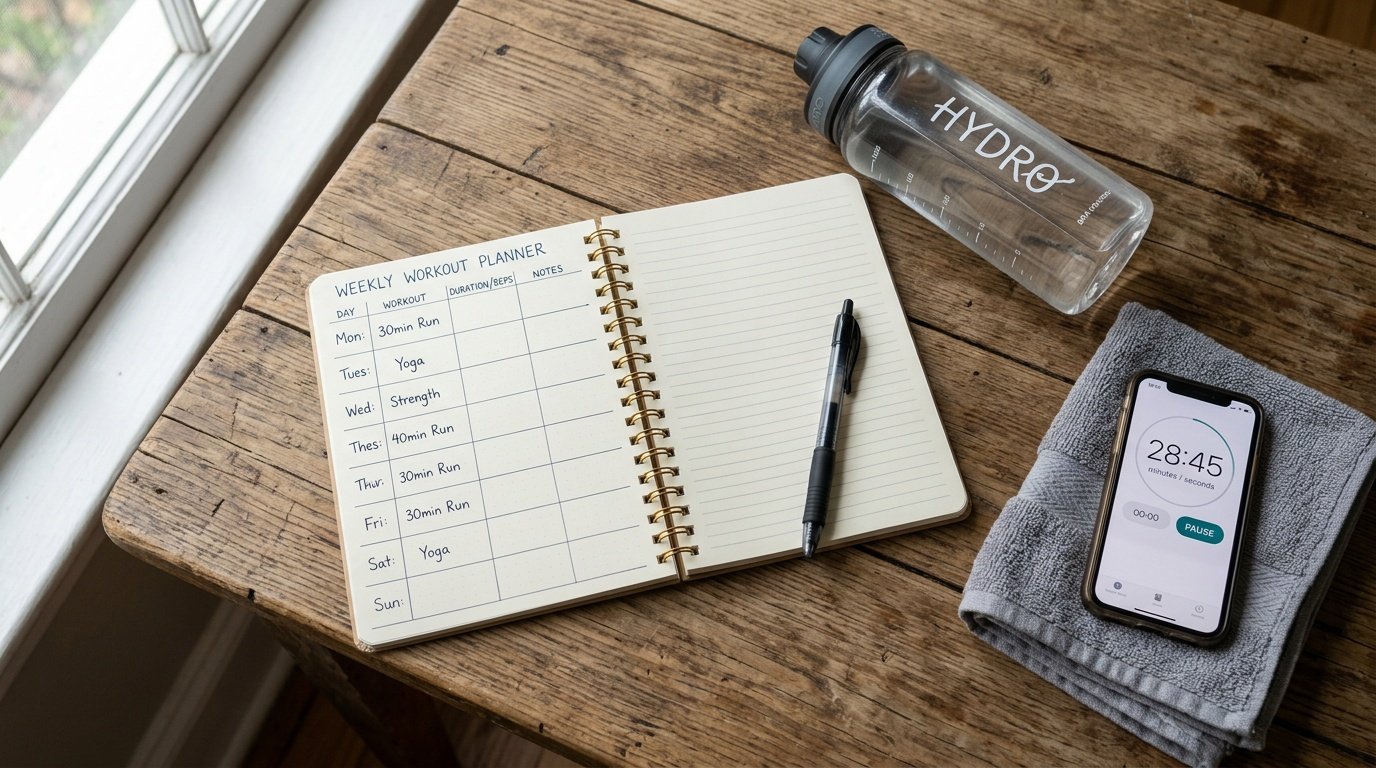
Here's a structure built around the 150-to-300-minute range above, split across four days so it fits around a job or school schedule without requiring daily gym trips.
Day 1 — Full-body strength (35–40 minutes). Squats, push-ups, rows, and a plank hold, 3 sets of each, resting 60–90 seconds between sets. This covers your two required strength sessions in combination with Day 3.
Day 2 — Moderate cardio (30–40 minutes). Brisk walking, cycling, or swimming at a pace where you can talk but not sing. This is the CDC's benchmark for moderate intensity, and it's the easiest day to fit around a busy schedule since it requires no equipment beyond shoes.
Day 3 — Full-body strength, different variation (35–40 minutes). Lunges, dumbbell or band shoulder presses, glute bridges, and a core circuit. Rotating exercises within the same muscle groups reduces boredom without changing the underlying stimulus.
Day 4 — Interval-style cardio (20–25 minutes). Alternate one minute of higher effort (fast walking uphill, cycling hard, jumping jacks) with two minutes of easy recovery pace, repeated six to eight times. Shorter total time than Day 2, but the intensity shift matters for the next section.
That's four structured sessions totaling roughly 130 minutes of dedicated exercise, plus whatever incidental walking happens across a normal week. Add a fifth light day — a 20-minute walk, a bike ride, a recreational sport — and you're inside the 200-to-300-minute active fat loss range without a single two-hour gym session. Swap the order of days if your week doesn't cooperate; what matters is the total weekly volume and the rest day between strength sessions on the same muscle group, not which specific day of the calendar each workout lands on.

The Afterburn Effect: Why Intensity Beats Duration for Fat Loss
I know what you're thinking: if 300 minutes a week is the target, shouldn't every session run as long as possible? Not necessarily, and this is the non-obvious part most fat loss content leaves out entirely.
Excess post-exercise oxygen consumption, or EPOC, is the extra energy your body burns after a workout ends, while it restores oxygen levels, clears lactic acid, and repairs muscle tissue. According to Cleveland Clinic, the EPOC effect adds roughly 6% to 15% on top of the calories burned during the workout itself. Burn 300 calories in a session, and EPOC can add up to another 45 calories in the hours that follow, without you doing anything extra.
The intensity of the workout drives how large that afterburn is. Higher-intensity sessions — interval training, heavier resistance work — produce a bigger EPOC effect than steady, moderate-paced cardio held for the same amount of time. That's the mechanism behind Day 4 in the sample routine above: a shorter, harder session can extract more total calorie burn than a longer, easier one, which matters on the days a full 40-minute block simply doesn't fit.
This doesn't mean longer moderate sessions are wasted. Both intensities count toward your weekly minutes, and a mix of the two is more sustainable than pure high-intensity work five days a week, which tends to raise injury risk and burnout for anyone new to structured exercise.

Mistakes That Quietly Stall a Fat Loss Exercise Routine
A few patterns show up over and over in people who are doing real, consistent work and still aren't seeing the results the effort should produce.
Skipping strength training entirely. Cardio-only routines plateau faster because they don't address the muscle-preservation piece covered earlier. Two sessions a week is a low bar to add.
Treating exercise as a license to eat back the calories burned. A 40-minute moderate workout might burn 250 to 350 calories. A single fast-food side item or sugary drink can erase that in under a minute of eating. Exercise supports a deficit, it doesn't replace paying attention to intake.
Doing the same session at the same intensity every single time. Your body adapts to a fixed stimulus within a few weeks, and calorie burn from an unchanged routine drops as your fitness improves. Rotating exercises, adding weight, or occasionally increasing intensity keeps the stimulus meaningful.
Under-recovering. Take someone who adds daily hard workouts on top of an already demanding job and inconsistent sleep. Within three or four weeks, workouts start to feel harder rather than easier, a sign of accumulating fatigue rather than a fitness plateau. One full rest day between strength sessions on the same muscle group, and at least one lower-intensity day per week, prevents this from compounding.
Expecting the scale to move in a straight line. Water retention from new muscle repair, hormonal cycles, and sodium intake can mask fat loss on the scale for a week or two even when the routine is working exactly as intended. Judging progress by a single weekly number is one of the fastest ways to quit a plan that's actually succeeding.
Under-fueling around workouts. A deep calorie deficit combined with hard training sessions is a common way people end up dragging through every workout and eventually skipping them altogether. Eating a small amount of protein and carbohydrate within a couple of hours of a strength session supports muscle repair, and this matters more on the days you're doing resistance work than on rest days. If your current eating pattern already runs a large deficit, this is often the first place to adjust before touching the workout schedule itself, since a routine only works if you can actually show up for it consistently.
None of this requires perfection. A **fat loss exercise routine** that survives real life, missed days included, outperforms a flawless one you can't sustain past month one. The goal is a structure you can return to after a bad week, not a streak you're afraid to break.
Health disclaimer: This guide is general education and isn't a substitute for personalized medical advice. If you're pregnant, breastfeeding, under 18, managing a chronic condition, or recovering from an injury or surgery, talk with a doctor or physical therapist before starting a new exercise routine, especially one involving strength training or interval-intensity cardio.
Watch how a certified specialist walks through structuring strength work for fat loss and muscle preservation together:
Frequently Asked Questions
What is the best fat loss exercise routine for a complete beginner?
Start with two full-body strength sessions and two to three moderate cardio sessions per week, totaling around 150 minutes. Build toward 200 to 300 minutes over four to six weeks rather than starting there, since a slower ramp-up is more sustainable long term.
How many days a week should a fat loss exercise routine include cardio?
Three to five days works for most people, mixing moderate-intensity sessions with one or two shorter, higher-intensity sessions. The exact split matters less than hitting a weekly total in the 200-to-300-minute range for active fat loss.
Can I lose fat with strength training alone, no cardio?
Strength training alone can support fat loss, particularly by preserving metabolism-supporting muscle, but combining it with aerobic activity produces a larger calorie deficit across the week and is what current guidance from the CDC and American Heart Association both recommend for weight management.
How long before a fat loss exercise routine actually shows results?
Most people notice clothes fitting differently within three to five weeks of consistent training, even before the scale reflects a clear trend. Visible fat loss on top of that timeline usually takes six to eight weeks of sustained effort.
Do I need to work out every day to lose fat?
No. Four to five structured sessions a week, with at least one full rest day, outperforms daily training for most people because it allows for the muscle repair and recovery that actually drives results. Overtraining without rest tends to stall progress rather than accelerate it.
Is HIIT better than steady-state cardio for a fat loss exercise routine?
HIIT produces a larger afterburn effect (EPOC) per minute of exercise, making it more time-efficient, but steady-state cardio is easier to sustain for longer and carries lower injury risk for beginners. A mix of both across the week outperforms relying on either exclusively.
References
- CDC — Adding Physical Activity as an Adult, 2025
- American Heart Association — Move More for Your Health, Not Just for the Scale, 2026
- Mayo Clinic — Strength Training: Get Stronger, Leaner, Healthier, 2026
- Cleveland Clinic — What Is EPOC? (And Why It Matters), 2023
- National Institutes of Health (NIDDK) — Keep Active & Eat Healthy to Improve Well-being & Feel Great