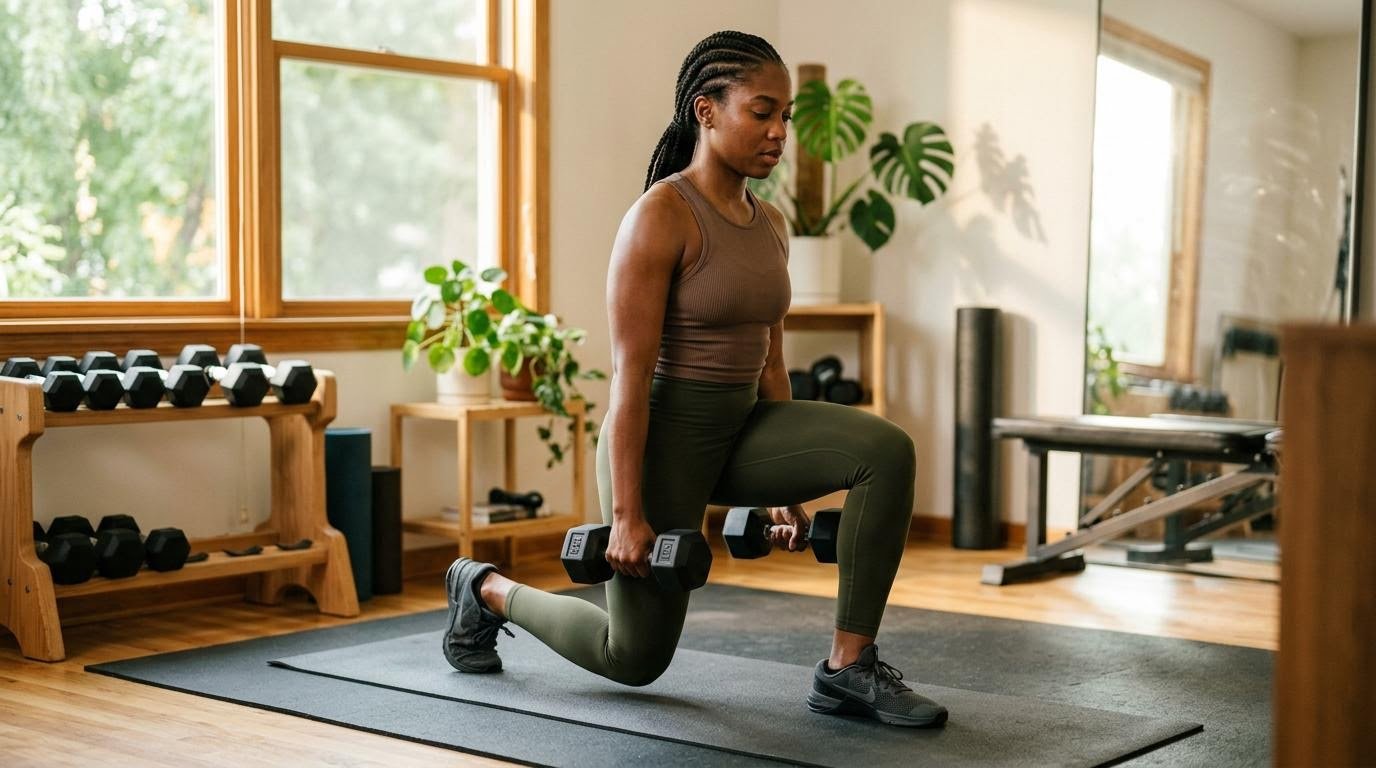


You've saved four different workout plans this month. Maybe five. Each one promised to be the last one you'd ever need, and each one is currently sitting untouched in a bookmarks folder or a screenshot album, right next to the other ones you abandoned by day nine. If that's you, the problem isn't willpower. It's that most beginner workout plans are built for people who already know how to work out.
Simple workout routines for beginners don't need twelve exercises, a gym membership, or a spreadsheet to track. They need a small number of movements, done consistently, with a clear rule for when to add more. That's it. This guide walks through exactly that: a starter framework, a full-body routine you can run this week, a no-equipment backup, and the specific mistakes that quietly stall most people before month two.
A friend of mine started with a fifty-minute, six-exercise routine she found online, did it twice, and then didn't touch a workout for three months. When she finally came back, we cut it down to four exercises and twenty-five minutes. She's now on week fourteen without a single gap longer than her planned rest days. Nothing about her body changed between attempt one and attempt two. The plan changed. That's the part most fitness content skips over: the exercises matter far less than whether the plan fits into the life you actually have.

Why Most Beginner Workout Plans Fall Apart by Week Three
Here's the pattern, almost every time. Someone starts strong with an ambitious five-day split copied from a fitness influencer, feels sore and accomplished for the first ten days, misses a session because life happens, and then never quite restarts. The plan wasn't wrong on paper. It was wrong for a person with a job, a commute, and zero baseline conditioning.
The CDC's Physical Activity Guidelines for adults recommend at least 150 minutes of moderate-intensity aerobic activity per week plus muscle-strengthening activity on two or more days, and notably, that's the floor for general health benefit, not some advanced target. Most beginner programs overshoot this by a wide margin in week one, which is exactly why they collapse. A sustainable starting point undershoots what looks impressive and overshoots what most people are currently doing, which for a true beginner is often nothing.
I know what you're thinking: doesn't more effort mean faster results? Not for someone whose joints, tendons, and habits haven't adapted yet. The body needs weeks of consistent, moderate stress before it can safely handle more. Rushing that stage is the single biggest reason simple workout routines for beginners get abandoned before they've had a chance to work.
Health disclaimer: This article offers general fitness guidance and is not a substitute for individualized medical advice. Talk with a doctor before starting a new exercise routine if you're pregnant, managing a chronic condition, recovering from an injury, or have been inactive for an extended period.
The Four-Movement Framework That are Simple Workout Routines for Beginners
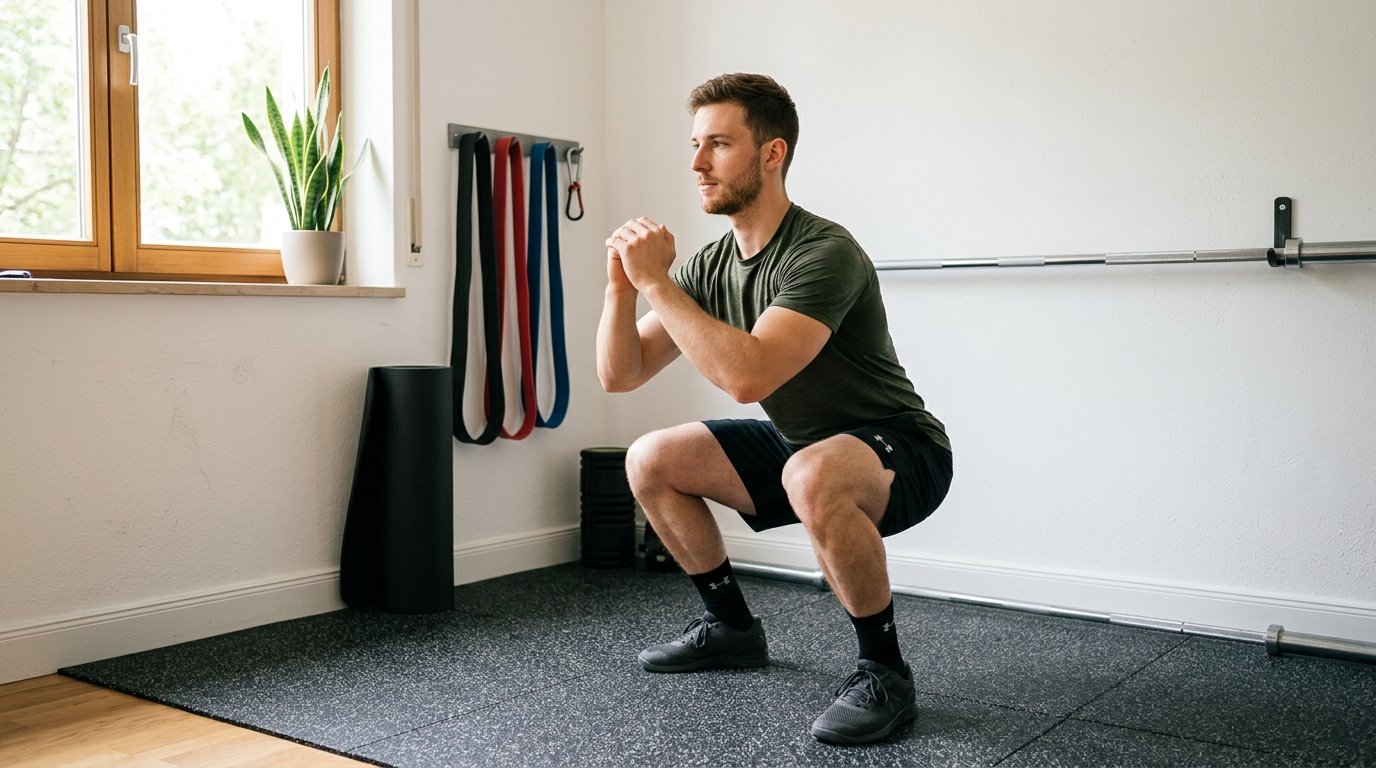
Instead of memorizing a long exercise list, learn four movement patterns. Nearly every useful strength exercise is a variation of one of these, and once you can do all four with decent form, you already have a workout routine for beginners at home or at the gym.
Push
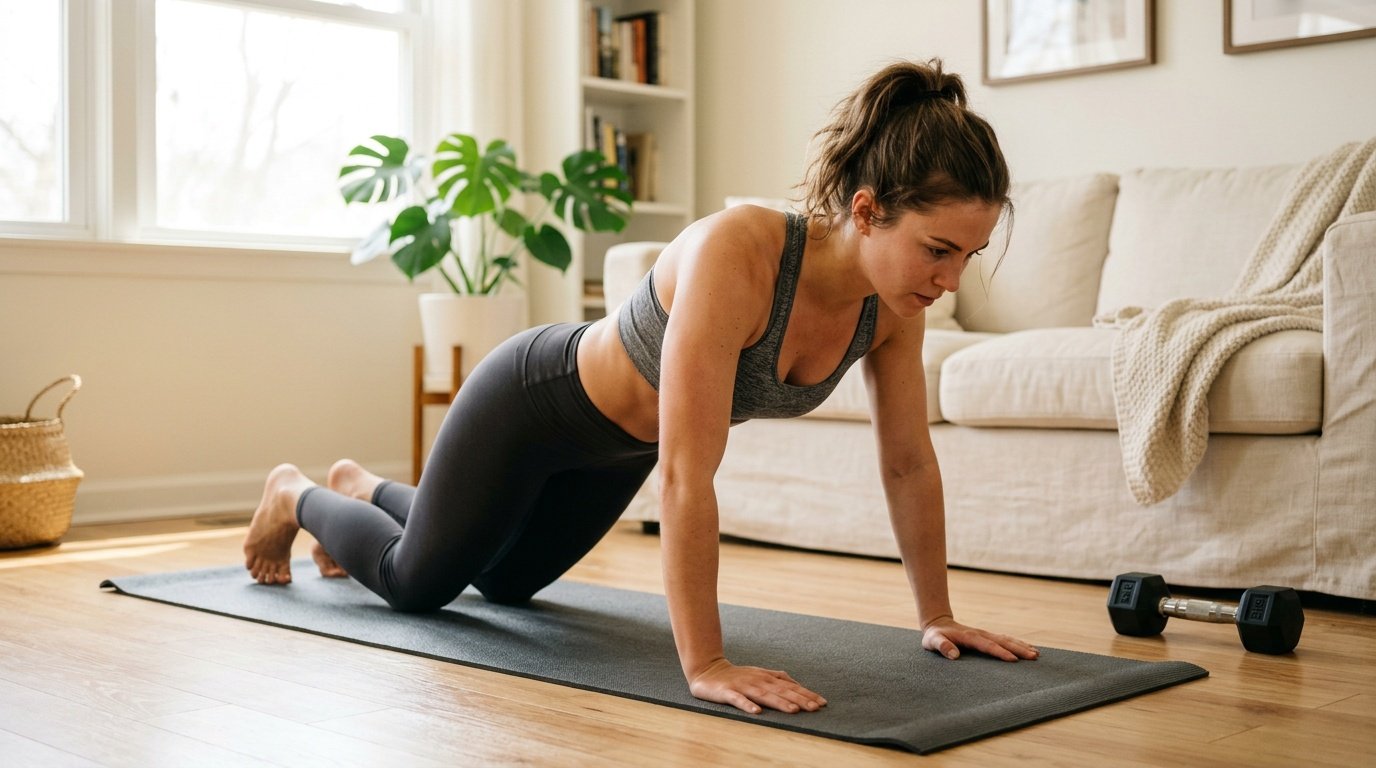
Any motion that moves weight away from your body: a push-up, a dumbbell chest press, an overhead press. Builds chest, shoulders, and triceps.
Pull
The opposite motion, pulling weight toward you: a row, an assisted pull-up, a resistance band pull-apart. Builds back and biceps, and matters most for posture since most daily life is push-dominant.
Squat or Hinge
Squats bend mainly at the knee (a bodyweight squat, a goblet squat). Hinges bend mainly at the hip (a Romanian deadlift, a glute bridge). Together they cover the entire lower body.
Carry or Core
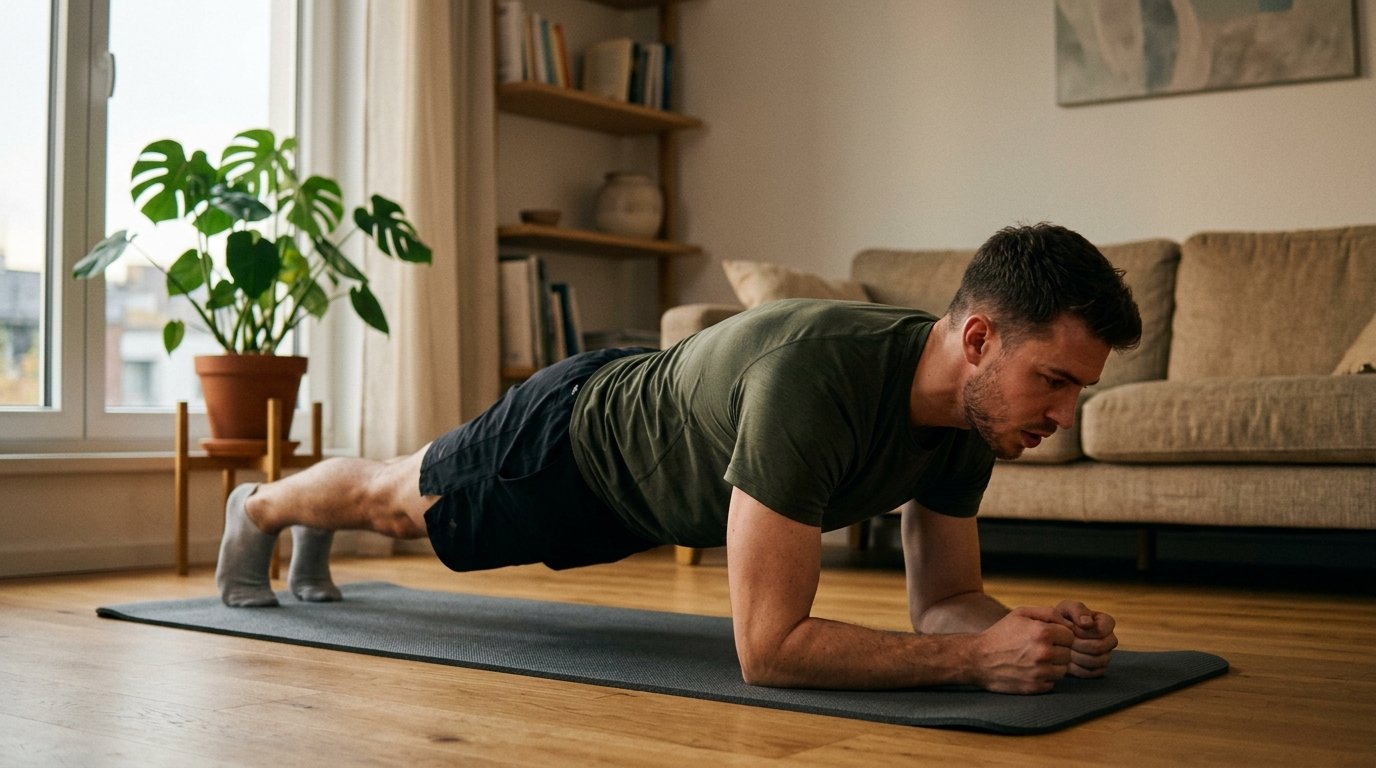
A plank, a dead bug, or simply carrying a loaded bag for a distance. This trains the muscles that stabilize your spine during everything else on this list.
A full body workout routine for beginners picks one movement from each category per session. That's four exercises. Not twelve, not twenty. Four, done properly, beats twelve done badly almost every time.
A Full-Body Workout Routine for Beginners You Can Start This Week
Here's a specific three-day version, spaced with a rest day between sessions so your muscles actually recover and rebuild, which is when the strength gain happens, not during the workout itself.
| Day | Focus | Exercises | Sets x Reps |
|---|---|---|---|
| Monday | Full body | Bodyweight squat, push-up (knees if needed), bent-over dumbbell row, plank | 2-3 x 8-12 |
| Tuesday | Rest or walk | 20-30 minute walk, light stretching | - |
| Wednesday | Full body | Glute bridge, dumbbell shoulder press, assisted or band-assisted pull, dead bug | 2-3 x 8-12 |
| Thursday | Rest or walk | 20-30 minute walk, light stretching | - |
| Friday | Full body | Goblet squat, incline push-up, dumbbell row, side plank (each side) | 2-3 x 8-12 |
| Sat / Sun | Full rest | Recovery, sleep, light activity if desired | - |
Source: CDC, Physical Activity Guidelines for Americans
Sets, Reps, and Rest Explained
A "set" is one block of repeated reps. "2-3 x 8-12" means two to three sets of eight to twelve repetitions per exercise. Rest 60 to 90 seconds between sets, long enough to catch your breath, short enough to keep the session moving. This rep range sits in the sweet spot for beginners: enough load to challenge the muscle, not so much that form breaks down before you've built the control to maintain it.
Warm-Up and Cooldown, Kept Simple
Five minutes of brisk walking or light marching in place before you start raises your body temperature and prepares your joints for load, which is enough for a beginner session at this intensity. Skip the long static stretching routines before lifting; save those for after, when your muscles are already warm and stretching won't temporarily reduce the strength output you need for the workout itself. After the session, two or three minutes of easy stretching for the muscles you just worked is plenty. This doesn't need to be complicated to be effective. It just needs to happen before you skip it in favor of jumping straight into the first exercise cold.

Strength Training for Beginners: How Much Weight Should You Actually Lift?
This is the question that stalls more people than any other, and the honest answer disappoints people expecting a formula. Mayo Clinic recommends choosing a weight heavy enough to tire the muscle by the last few repetitions of a set, not a weight matched to a chart. If you can breeze through twelve reps with no effort on the last two, the weight is too light. If you're straining and losing form by rep six, it's too heavy.
A practical way to apply this: pick a starting weight, do a set of ten. If the last two or three reps genuinely challenge you but your form holds, that's roughly right. If it wasn't, adjust up or down next set. Nobody gets this exactly right on the first try, and that's fine, since the goal in week one is learning the movement, not maximizing load.
Progression for strength workout routine for beginners follows a simple rule: once you can complete every set at the top of your rep range with good form for two sessions in a row, add 5 to 10 percent more weight or move to a harder exercise variation. Small, boring, repeated increases are what actually build strength over months, not dramatic jumps that lead to injury or burnout.
If you're in your late teens or twenties and this is your first real attempt at structured exercise, one thing works in your favor: your body adapts to new stimulus faster than it will a decade from now. That's not permission to skip the basics, it's a reason not to overthink the entry point. A twenty-two-year-old starting with a light dumbbell set and honest form will out-progress a twenty-two-year-old who starts heavy, gets hurt in week two, and stops. Starting conservative isn't the slow option here, it's the option that actually compounds.
No Equipment? A Bodyweight Workout Routine That Still Builds Real Strength
You don't need a home gym to start. A bodyweight workout routine for beginners built from the same four-movement framework works just as well for the first several months, since your own body weight is more than enough resistance when you're new to structured training.
- Push: Wall push-up, then knee push-up, then full push-up as you progress
- Pull: Doorframe row (feet planted, leaning back, pulling yourself up using a sturdy doorframe or table edge) or towel rows against furniture
- Squat/Hinge: Bodyweight squat, single-leg glute bridge
- Carry/Core: Plank, marching plank, standing march with knee raises
The no-equipment version isn't a lesser version of the routine. It's the same stimulus delivered differently. The National Institute on Aging's exercise guidance notes that bodyweight strength exercises produce meaningful gains in muscle function even without external load, particularly for anyone new to structured movement. When bodyweight squats eventually feel easy for three sets of fifteen, that's your cue to add resistance, whether that's a resistance band, a couple of filled water jugs, or an actual dumbbell set.

How to Know You're Actually Progressing
The scale is a bad early indicator. Weight fluctuates with water, sodium, sleep, and hormones, and a beginner building muscle while losing fat can see the number barely move for weeks despite real progress. Better markers exist.
Track the same three or four things every session: the weight or resistance used, the number of clean reps completed, and how the last rep of each set felt. A workout routine for beginners at home written on a phone note is enough. If, after three weeks, you can do more reps at the same weight, or the same reps at a heavier weight, that's your proof it's working, regardless of what the scale says. That gap between "the scale hasn't moved" and "I did four more push-ups than I could three weeks ago" is where most people quit right before the visible change shows up.
Here's what that looks like in practice. Say your first push-up set on day one is three knee push-ups before your form breaks down. By week three, most beginners following a consistent full body workout routine for beginners can do six to eight with the same form. That's roughly a doubling in output, and it happened with zero visible change on a bathroom scale. Other non-scale markers worth tracking: how many flights of stairs you climb before feeling winded, how heavy your grocery bags feel on the walk from the car, whether you can get up off the floor without using your hands for support. These are the changes that show up first, weeks before anything visible in the mirror.
Common Mistakes That Stall Beginner Progress
A few patterns show up constantly in people who start strong and then plateau or quit.
- Skipping rest days entirely. Muscle doesn't get stronger during the workout, it gets stronger during recovery. The Cleveland Clinic explains that delayed onset muscle soreness typically peaks 24 to 72 hours after a new type of exercise, which is your body actively rebuilding tissue. Training through that on the same muscle group without adequate recovery blunts the adaptation you're working for.
- Chasing intensity over consistency. A brutal, one-off workout that leaves you unable to move for a week is worse than four moderate sessions spread across the same period. The American Heart Association frames consistent, moderate activity as the foundation, with intensity something to build toward gradually.
- No plan for missed sessions. Life interrupts routines. The people who stick with a simple workout routine for beginners aren't the ones who never miss a day, they're the ones who treat a missed Tuesday as a non-event and just show up Wednesday.
- Copying an advanced program. A five-day split designed for someone with two years of training history assumes a recovery capacity a beginner doesn't have yet. Fewer exercises done consistently beat a longer list done inconsistently.
- Treating every session like a test. Some days the same weight feels heavier than last time. Sleep, stress, hydration, and even the time of day all affect performance session to session. A single off day doesn't mean the routine stopped working, it means you're human. Judge progress across weeks, not within any one session.
- Ignoring form to chase reps. Rushing a squat or letting your lower back round on a hinge movement to squeeze out one more rep trades short-term ego for a higher injury risk. A slower, controlled rep with full range of motion builds more strength than a rushed one anyway, even though it looks less impressive.
Structured movement three days a week, following this exact pattern, is a workout routine for beginners at home you can actually sustain into month three and beyond, which is the point where results stop being theoretical and start showing up in how your clothes fit and how stairs feel. If a session gets skipped, the plan doesn't reset. You just pick up on the next scheduled day, same routine, same rep targets, and let the consistency accumulate instead of demanding perfection from week one.
Ready to see the technique in motion? This short video walks through how to ease into a new routine without overdoing it in week one.
Frequently Asked Questions
How many days a week should a beginner work out?
Three non-consecutive days a week is the sweet spot for most beginners. It's enough to build a habit and see progress, while leaving adequate recovery time between sessions for the same muscle groups.
Do I need gym equipment to start a workout routine?
No. A bodyweight workout routine for beginners using push-ups, squats, glute bridges, and planks builds real strength for the first several months. Add resistance bands or dumbbells once bodyweight versions feel manageable.
How long should a beginner's workout be?
Twenty-five to forty minutes is typical for a full-body session with four exercises at two to three sets each. Longer isn't automatically better for someone new to structured training.
Is it normal to be sore after starting a new routine?
Yes. Mild to moderate soreness in the day or two after a new exercise is a normal adaptation response, not a sign of damage. Sharp or joint-level pain is different and worth checking with a healthcare professional.
How soon will I see results from a beginner workout routine?
Strength gains often show up in the first two to four weeks, before visible physical changes. Give a consistent routine at least six to eight weeks before judging whether it's working.
References
- CDC — Physical Activity Guidelines for Adults
- Mayo Clinic — Strength Training: Get Stronger, Leaner, Healthier, 2026
- National Institute on Aging — Exercise and Physical Activity
- Cleveland Clinic — Delayed Onset Muscle Soreness
- American Heart Association — Fitness Basics
- Mayo Clinic — Mayo Clinic Minute: How to Jump-Start Your Workout