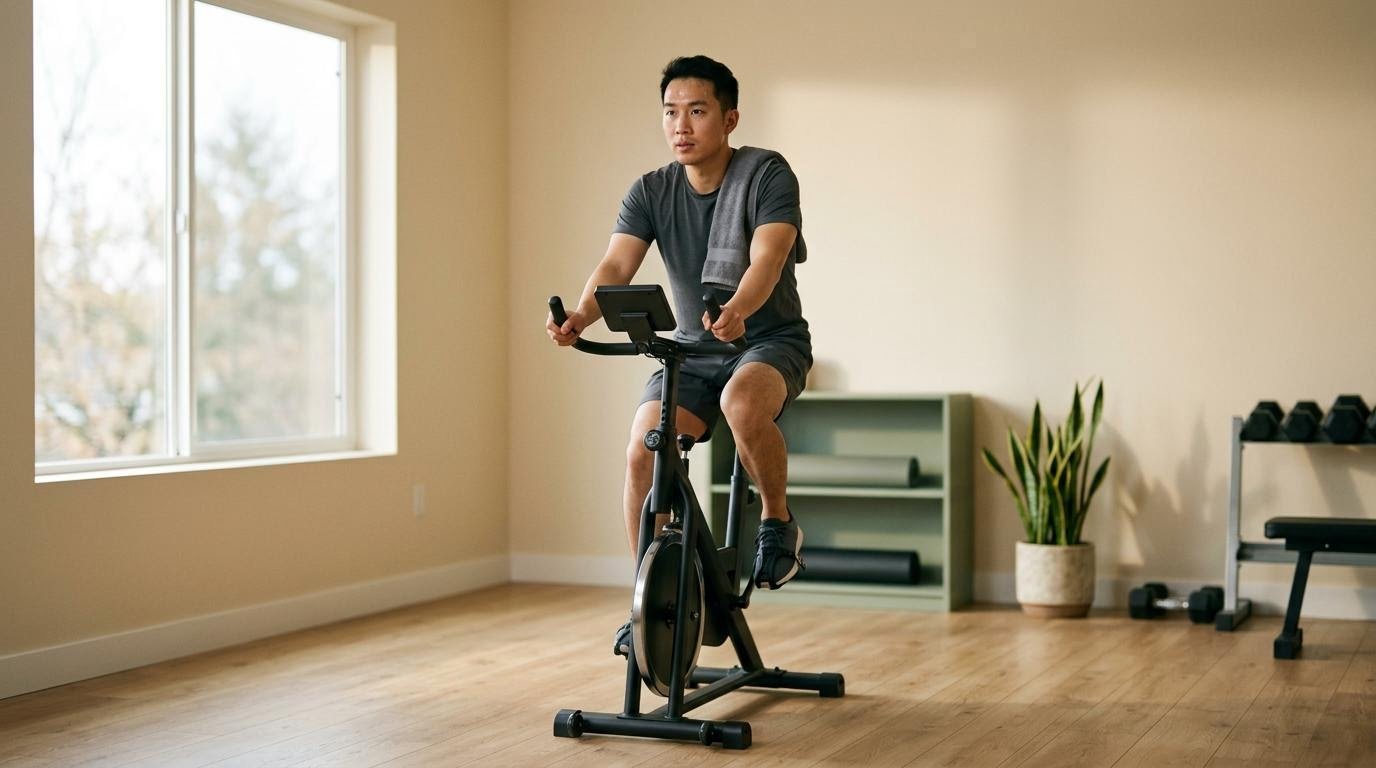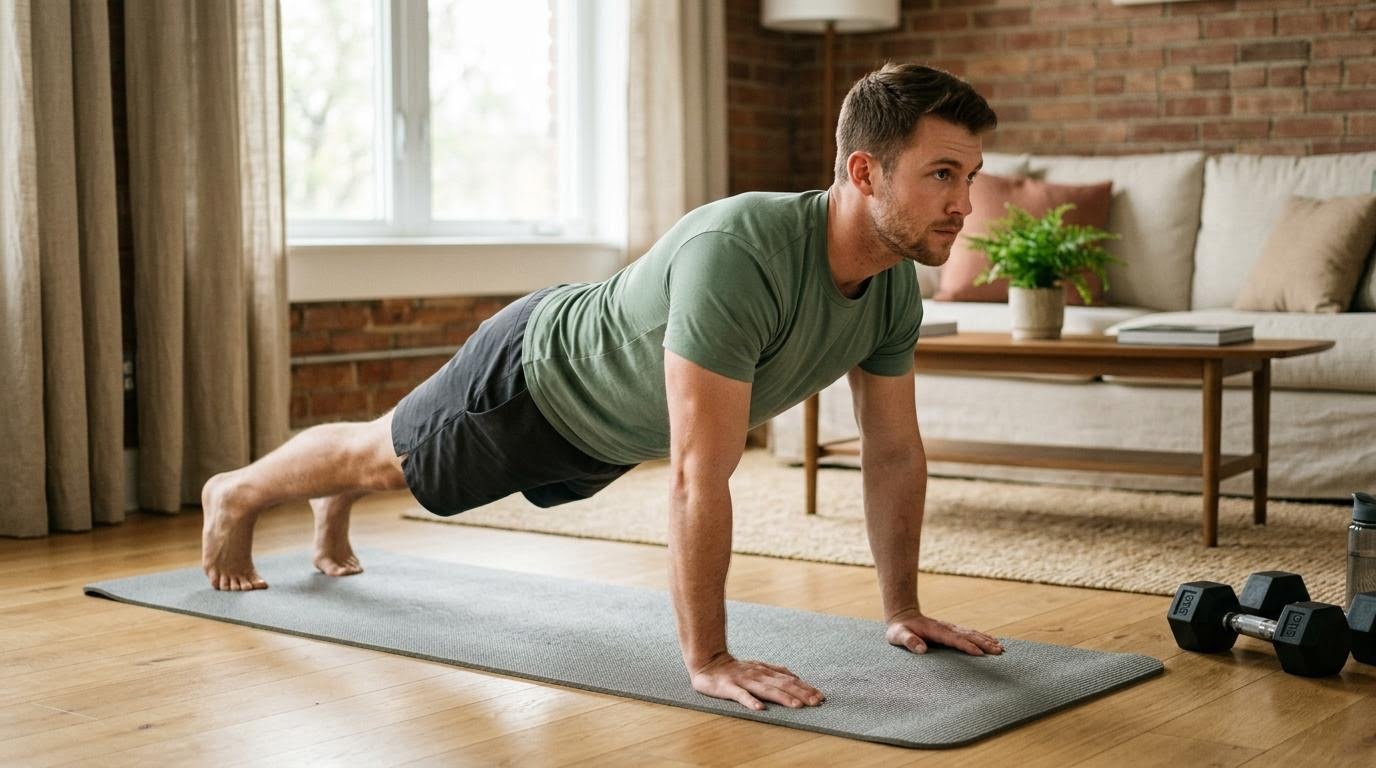


You've decided to start moving more, and then you open a fitness app and get hit with 45-minute HIIT videos, gym memberships, and workout routines built for people who've already been training for years. That's the wrong door. Beginner cardio exercises aren't a watered-down version of real training, they're the actual starting point that works, and most people quit before they find it because they started somewhere harder. This guide gives you a real 6-move circuit, the heart-rate math that tells you whether it's working, and a 4-week plan that doesn't ask you to be someone you're not yet.
If you've already tried simple cardio workouts at home to boost your energy and bounced off them because the pace felt wrong, the problem usually wasn't the concept. It was starting at someone else's intensity instead of your own.
Why Beginner Cardio Exercises Feel Impossible When You Start Too Hard
Most people who try cardio for the first time pick a routine built for someone who already exercises. They watch a 45-minute HIIT video, survive maybe fifteen minutes of it wrecked, and quietly decide cardio just isn't for them. That's not a fitness problem. It's a sequencing problem, and it's fixable in about a week.
The standard target most adults are told to aim for is 150 minutes of moderate-intensity aerobic activity a week, and the CDC's current physical activity guidelines spell out that this doesn't have to happen in one sitting, five 30-minute sessions or smaller chunks spread across the week both count toward the same total. That framing alone changes what "starting cardio" actually means. It's not a 45-minute commitment. It can be twelve.
Harvard Health Publishing made a similar point in a 2022 piece on rethinking how people approach their weekly aerobic target: breaking the 150-minute goal into smaller daily segments, even two or three 10-minute stretches, makes the whole requirement feel far less overwhelming without changing what your body actually gets out of it (Harvard Health Publishing, 2022). Here's the part that doesn't get said enough: your cardiovascular system doesn't know or care whether a 30-minute total came from one long session or three short ones. It responds to the demand you place on it, not the clock. That's the non-obvious piece most beginner guides skip. A short, honest-effort session beats a long session where you spend most of it recovering mentally from how hard the first ten minutes felt.
None of this means longer sessions are wrong later. It means the on-ramp for beginner cardio exercises should be small enough that you actually finish it, five days in a row, before it grows into anything bigger.
The 6-Move Beginner Cardio Circuit That Boosts Energy in 12 Minutes
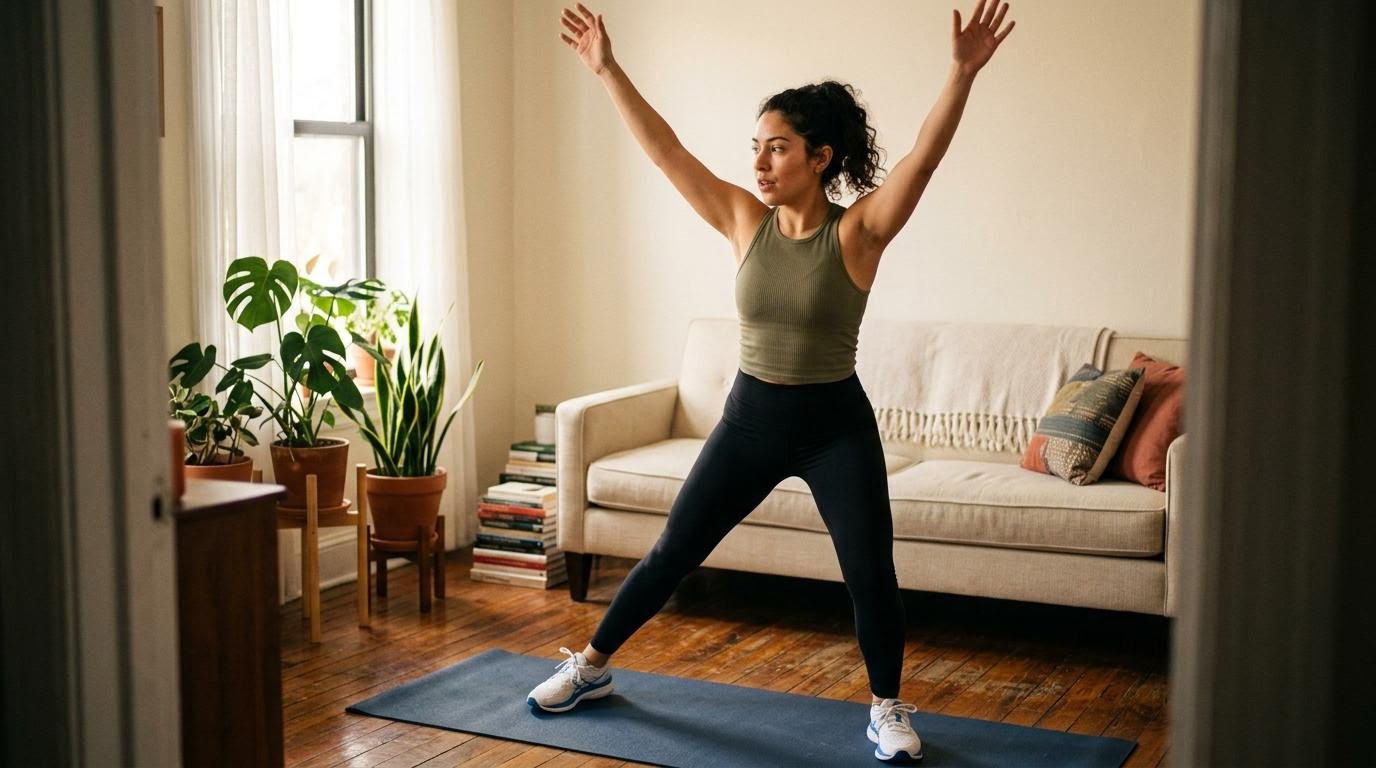
This circuit needs zero equipment and about six feet of floor space. Do each move for 40 seconds, rest for 20, and cycle through all six once for a 6-minute round. Two rounds gets you to roughly 12 minutes, including a short warm-up walk before you start.
Move 1: March-in-Place With Arm Reaches
Lift your knees to hip height, alternating sides, and reach the opposite arm overhead with each lift. This is your warm-up move and your fallback if any later move feels like too much, too soon.
Move 2: Step-Out Jacks
A low-impact version of a jumping jack. Step one foot out to the side while raising both arms overhead, then step it back and switch sides. Same cardio demand as a full jack, none of the joint impact.
Move 3: Standing Knee Drives
Drive one knee up toward your chest with control, then switch. This is where your heart rate typically starts climbing out of warm-up territory.
Move 4: Squat-to-Reach
Lower into a bodyweight squat, then stand and reach both arms overhead as you rise. It quietly adds a strength element to a cardio-dominant circuit, which matters more for long-term joint health than most beginner routines admit.
Move 5: Standing Mountain Climbers
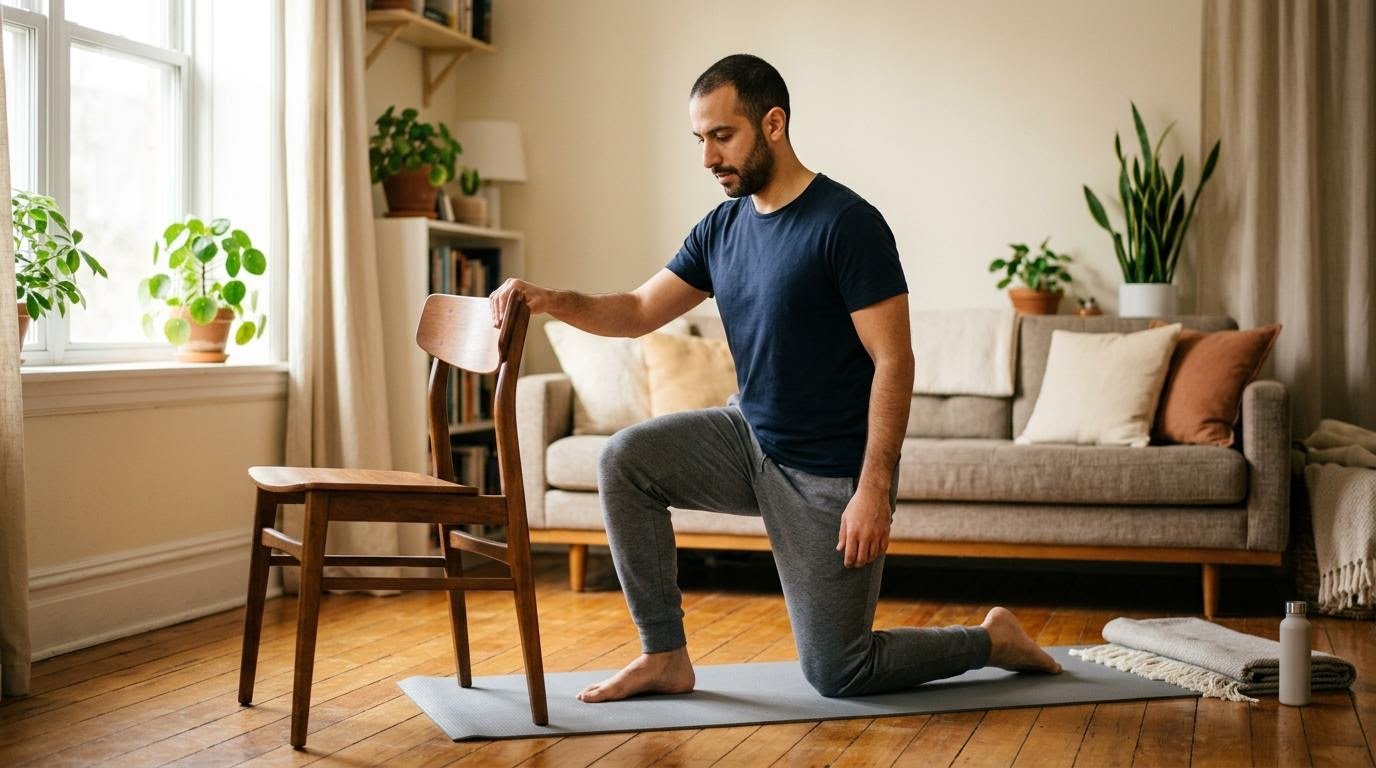
Place your hands on a countertop or sturdy chair at hip height and drive your knees up one at a time, as if doing a floor mountain climber standing up. No wrist loading, same cardiovascular demand.
Move 6: Side-to-Side Step Touches
Step your right foot out, tap your left foot beside it, then reverse. Add a light arm swing for extra heart-rate lift. This is the move most people can hold a full conversation through, which is exactly the point.
Breathe out on the effort phase of each move and in as you reset. Beginners who hold their breath through effort tend to feel more winded than their actual heart rate would suggest, and a steady breathing rhythm keeps a 40-second window feeling manageable instead of frantic.
Don't worry about hitting a perfect tempo on your first attempt. A few seconds of imperfect footwork while you switch between moves is completely normal and won't undercut the circuit's benefit. What actually matters is whether you finish all six moves for both rounds, not whether move three looked identical to the demo in your head. If your phone timer is set to repeat automatically, you can keep your eyes on your form instead of watching the clock, which tends to make the whole twelve minutes feel shorter than it is.
How to Modify Every Move for Bad Knees, Low Fitness, or a Bad Day
Nobody's first day should look like their thirtieth. If any move above feels wrong for your body, here's exactly how to change it, not skip it.
If Your Knees Are the Concern
Slow the tempo on the knee drives and mountain climbers, and stop raising your knee above hip height. Step-out jacks and squat-to-reach stay mostly unchanged since they're already low-impact. If a squat causes discomfort past 90 degrees, only go as deep as feels stable.
If Impact of Any Kind Bothers Your Joints
Every move in this circuit already keeps one foot on the ground, that's intentional. According to Mayo Clinic's guidance on gauging exercise intensity, moderate-intensity effort is defined by how hard the activity feels and what your breathing is doing, not by how much force your joints absorb: at a moderate level, your breathing quickens but you're not out of breath, and you can talk to someone without being able to sing. That definition applies just as well to low-impact movement as it does to jumping.
If You're Starting From a Very Low Fitness Baseline
Do one round instead of two for your first week. Six minutes of consistent movement beats twelve minutes you dread and quit halfway through. Physical activity is safe for almost everyone, and the health benefits of regular movement show up independent of whether it produces visible fitness changes right away, which is worth remembering on the days progress feels invisible (National Institute of Diabetes and Digestive and Kidney Diseases).
Warming Up Before You Start
Skip static stretching before this circuit and save it for afterward. Instead, spend 60 to 90 seconds on the march-in-place move at a gentle pace before your first working interval. A cold muscle pushed straight into full effort is where most avoidable strains happen, and a short warm-up costs you almost nothing against a twelve-minute session. If you're exercising first thing in the morning, expect the warm-up to feel slightly stiffer than it would in the afternoon, that's normal and not a sign you should push harder to compensate.
Health disclaimer: If you have a heart condition, a joint injury, are pregnant, or haven't exercised in an extended period, talk with a doctor before starting this or any new exercise routine. Stop immediately if you feel chest pain, dizziness, or sharp joint pain, and seek medical attention.
What Your Heart Rate Is Actually Telling You During These Beginner Cardio Exercises
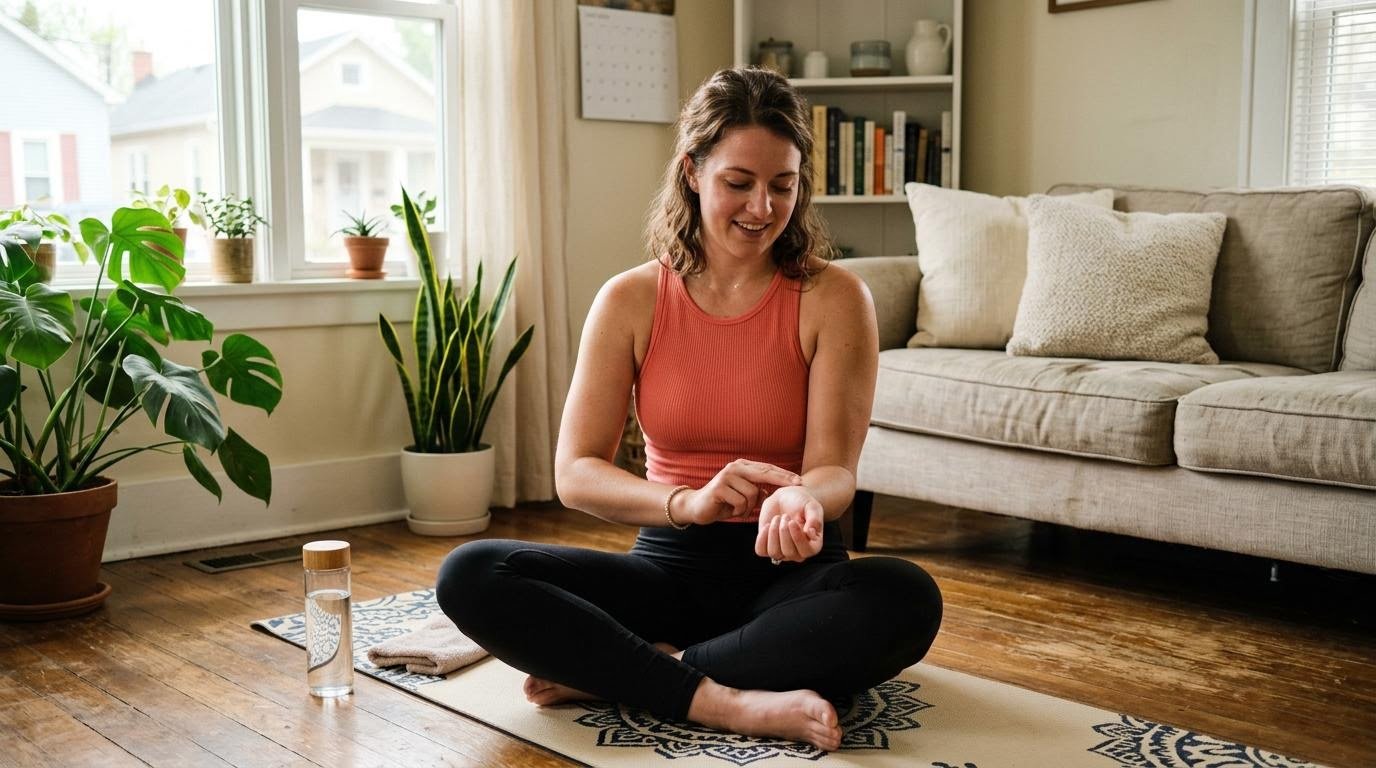
You don't need a chest strap or a smartwatch to know if this circuit is working. According to the American Heart Association's target heart rate chart, moderate-intensity exercise sits at roughly 50 to 70 percent of your maximum heart rate, with maximum estimated as 220 minus your age. For most beginners in their 20s, that puts the working zone somewhere around 100 to 133 beats per minute. If you'd rather skip the math mid-workout, use the talk test instead: if you can hold a full conversation without pausing for breath, you're not working hard enough yet. If you can barely get out a few words, back off. Somewhere in between, breathing hard but still able to answer a question, is exactly where good cardio exercises for beginners should sit.
| Intensity Level | Talk Test | % of Max Heart Rate | Where in This Circuit |
|---|---|---|---|
| Light | Full conversation, easy | Under 50% | Warm-up marching, rest intervals |
| Moderate | Can talk, not sing | 50-70% | Step-out jacks, squat-to-reach, step touches |
| Vigorous | A few words at most | 70-85% | Knee drives and mountain climbers, second round |
Source: American Heart Association, 2024; Mayo Clinic, 2023

Your Realistic 4-Week Plan for Turning Beginner Cardio Exercises Into a Habit
Consistency beats intensity for the entire first month. Here's what a sustainable buildup actually looks like, not the accelerated version fitness marketing tends to sell.
Weeks 1 to 2
Three sessions a week, one round of the circuit each time, about 6 minutes of work per session. Rest days aren't optional here, they're when your body actually adapts to the new demand. If a session feels noticeably easier by day five, that's a sign of progress, not a reason to add a second round early.
Weeks 3 to 4
Move to four sessions a week and add the second round, bringing each session to the full 12 minutes. This is usually the point where beginners notice they're less winded by the second round than they were by the first round back in week one, which is the marker that actually matters.
Signs You're Ready for a Third Round
Somewhere around week five or six, some beginners notice they finish both rounds and could realistically keep going. That's a genuine readiness signal, not something to force on a schedule. Other useful markers include your resting heart rate the morning after a session feeling normal rather than still elevated, and recovering between intervals faster than you did a few weeks earlier. Any one of these means it's a reasonable time to add a third round or look at a slightly higher-intensity variation, not a reason to skip ahead before you've actually earned it.
Setting the Target Before You Start, Not Halfway Through
Before you commit to a specific weekly number, it helps to get your fitness targets clear before you even start, since a vague goal like "do more cardio" gives you nothing to check yourself against three weeks in. A written target, three sessions this week, six minutes each, is something you can actually measure against a calendar.
If you've had a longer break from movement altogether, whether from illness, travel, or just life, resist the urge to jump back in at week-four intensity. Restart closer to week one and rebuild from there. Your plan should reflect where you are right now, not where you were three months ago.

The Mistakes That Quietly Stall Beginner Cardio Progress
A handful of patterns show up again and again with people new to cardio, and most are fixable in a single session once you notice them.
Skipping the rest intervals because they feel like wasted time. They're not. The 20-second rest is what lets you keep decent form on the next interval instead of degrading into sloppy movement that's both less effective and more likely to cause a strain.
Doing cardio every single day with no rest day. More isn't automatically better, especially for a beginner's joints and connective tissue, which adapt more slowly than cardiovascular fitness does. Three to five sessions a week with at least one full rest day is the sustainable range, not seven.
Treating cardio as the whole plan. Cardio strengthens your heart and lungs, but it skips the muscle-strengthening work that protects your joints long-term. That's part of why the squat-to-reach move is in this circuit at all, it's cardio wearing a strength-training disguise.
Quitting after a single missed week. A missed week doesn't erase two weeks of consistency. It resets your momentum, not your fitness. Start back at one round if you need to.
Comparing your week one to someone else's month three. Social fitness content rarely shows the beginning. Your only useful comparison is your own session from two weeks ago, not a stranger's highlight reel.
Judging progress by the scale instead of the session itself. A cardio circuit like this one isn't primarily a weight-loss tool, it's a cardiovascular fitness tool, and the two move on different timelines. Better markers for these six weeks are how many rounds you complete, how quickly your breathing settles after a set, and whether the same moves that winded you in week one feel routine by week four. The scale can stay flat for reasons that have nothing to do with whether your heart and lungs are adapting.
A quick note on equipment, since it comes up once beginners get a few weeks in: none of it is necessary for this circuit to keep working. If you eventually want more resistance, a single pair of light dumbbells extends the squat-to-reach and knee-drive moves without changing anything else about the routine. That's a month-two decision, not a day-one requirement.
Dr. Xiaoke Liu of Mayo Clinic Health System covers what makes an exercise choice sustainable for someone starting from any fitness level in this short explainer.
Twelve minutes, six moves, zero equipment, and a progression plan that doesn't require you to be a different person by week two. That's the whole system behind these beginner cardio exercises. The hardest part was never the workout itself, it was believing that anything under fifteen minutes could count. It counts, and it's the version most people actually finish.
Frequently Asked Questions
How many days a week should a beginner do cardio exercises?
Start with three sessions a week for the first two weeks, then build to four to five sessions by week three or four. The CDC's weekly target is 150 minutes of moderate-intensity activity, and this pace gets you there gradually without overloading a body that isn't conditioned yet.
Do beginner cardio exercises need any equipment?
No. Every move in this circuit uses only bodyweight and about six feet of floor space. A sturdy chair or countertop helps with the standing mountain climber modification, but it isn't required.
How long until beginner cardio exercises start feeling easier?
Most beginners notice a real difference by the end of week two, usually as less breathlessness during the second round rather than as a dramatic overall change. That timeline lines up with how quickly the cardiovascular system starts adapting to a new, repeated demand.
Is it safe to do beginner cardio exercises every day?
Not recommended for a true beginner. Three to five sessions a week with at least one full rest day lets your joints and connective tissue adapt at roughly the same pace as your cardiovascular fitness, which meaningfully lowers injury risk.
What's the difference between low-impact and high-impact cardio for beginners?
Low-impact cardio keeps at least one foot on the ground at all times, like the step-out jacks and step touches in this circuit. High-impact cardio includes jumping or both feet leaving the ground at once. Low-impact versions raise your heart rate just as effectively while putting far less stress on your joints, which makes them the smarter starting point for most beginners.
References
- Centers for Disease Control and Prevention — Adult Activity: An Overview, 2023
- Harvard Health Publishing — Rethinking Cardio Exercise, 2022
- Mayo Clinic — Exercise Intensity: How to Measure It, 2023
- American Heart Association — Target Heart Rates Chart, 2024
- National Institute of Diabetes and Digestive and Kidney Diseases (NIDDK) — Staying Active at Any Size