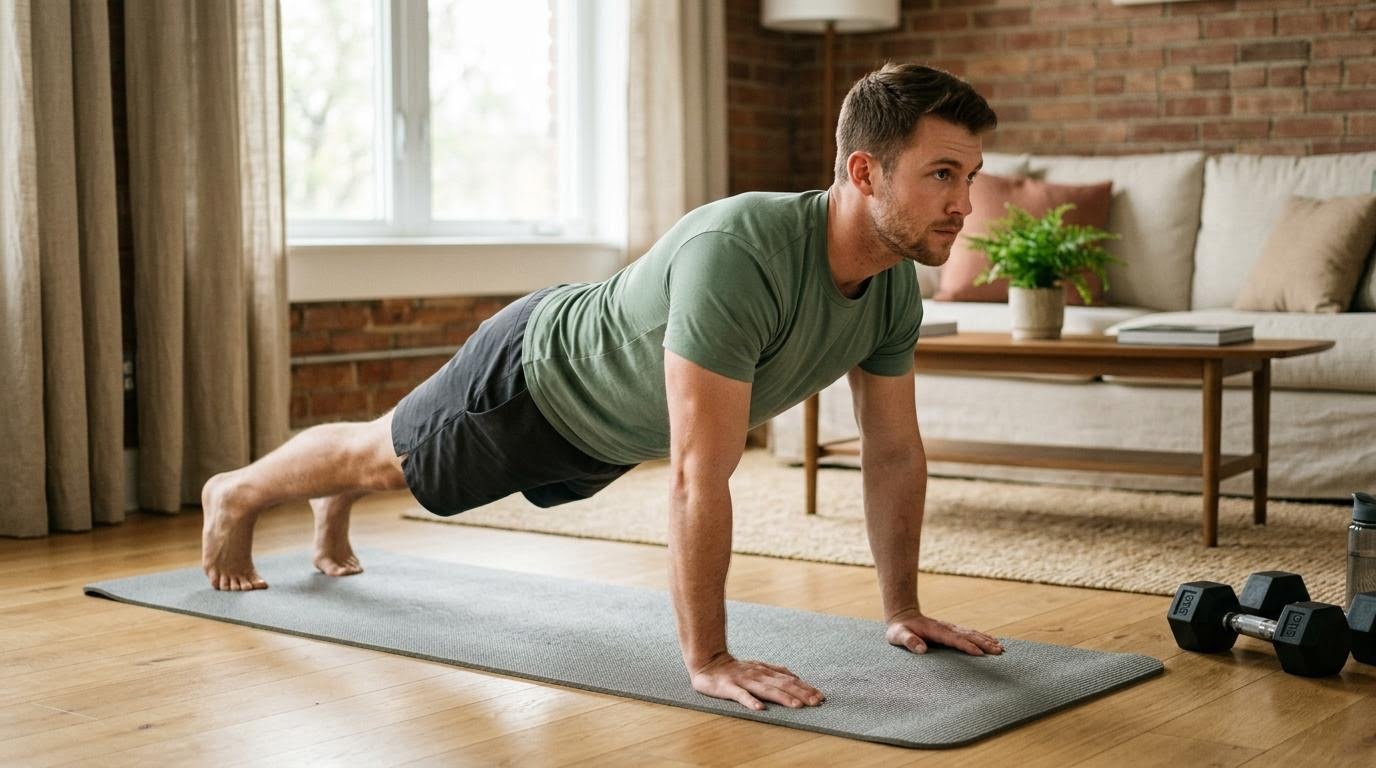


Your flight lands, the hotel gym turns out to be two treadmills and a broken rowing machine, and the trip you've been looking forward to for months is already threatening the routine you worked hard to build. This is exactly the problem the right travel workout equipment solves. Not a full home gym stuffed into a suitcase, just a handful of items small enough to disappear into a carry-on and useful enough to replace an entire gym floor.
Most articles on this topic either recommend gear that's too bulky to actually pack or skip equipment entirely and tell you to "just do bodyweight exercises." Both miss the point. The right small set of tools makes a hotel-room workout feel like a real session instead of a consolation prize, and this guide covers exactly which items earn their space, which ones you can leave at home, and how to structure a routine around them so the gear doesn't just sit unused at the bottom of a suitcase.
Why the Right Travel Workout Equipment Matters More Than a Hotel Gym
There's a reason frequent travelers who stay consistent with fitness rarely rely on hotel gyms as their main plan. Hotel gyms vary wildly in quality, sometimes closed for maintenance, sometimes a single treadmill facing a wall, and betting your whole routine on one being adequate is a gamble you lose more often than you'd expect. The American Heart Association notes that staying active while traveling, whether through structured exercise or simply exploring on foot, helps combat jet lag and keeps energy levels steady through a trip's demands.
Packable equipment sidesteps the hotel-gym gamble entirely. A resistance band or a jump rope takes up less room than a pair of shoes and works regardless of what's downstairs. That reliability matters more than most people give it credit for, since the biggest threat to a travel fitness routine isn't lack of willpower, it's the moment you discover there's nowhere to work out and quietly decide the trip is an exception.
There's also a physiological reason small, portable resistance tools hold up well against a real gym session. According to the CDC's Physical Activity Guidelines for Americans, adults need muscle-strengthening activity that works all major muscle groups at least two days a week, alongside 150 minutes of moderate aerobic activity. Nothing in that guideline requires a barbell rack. A resistance band pulling against your body weight satisfies the same muscle-strengthening requirement a gym machine does.
The 5 Pieces of Travel Workout Equipment Actually Worth Packing
Every item on this list has to earn its place in a suitcase. If it doesn't fold flat, weigh next to nothing, and work multiple muscle groups, it didn't make the cut.
Resistance Bands: The Single Most Versatile Item
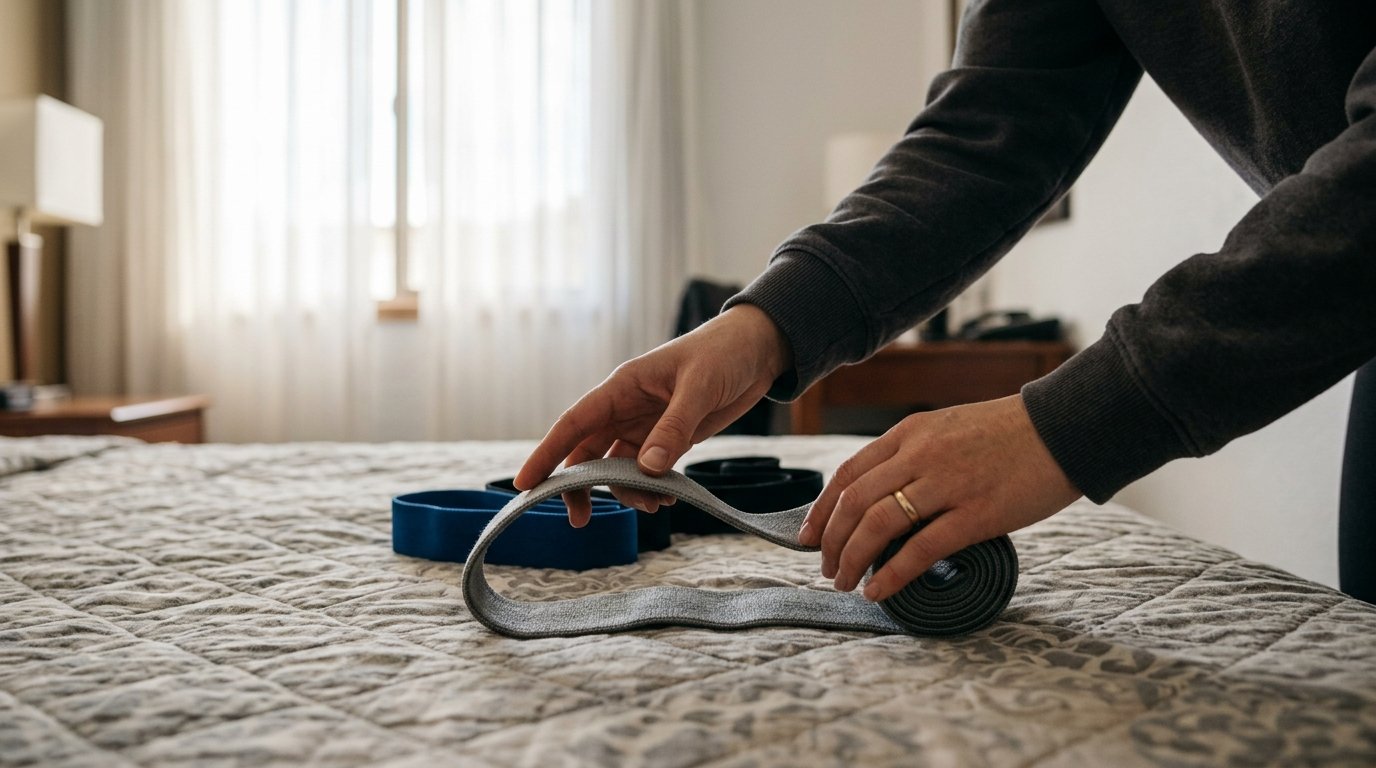
If you pack exactly one piece of travel workout equipment, make it a set of resistance bands. They weigh a few ounces, roll up smaller than a pair of socks, and cover pushing, pulling, and leg movements that bodyweight exercise alone can't fully replicate. The Cleveland Clinic points out that resistance bands work regardless of fitness level, offering the same fundamental strength-training stimulus as free weights by adding external resistance your muscles have to work against.
Bring a set with two or three tension levels rather than a single band. A light band handles shoulder and arm work where you have less natural leverage, while a heavier band covers squats, deadlift patterns, and rows where bigger muscle groups need more resistance to feel challenged.
A Suspension Trainer or Doorway Anchor
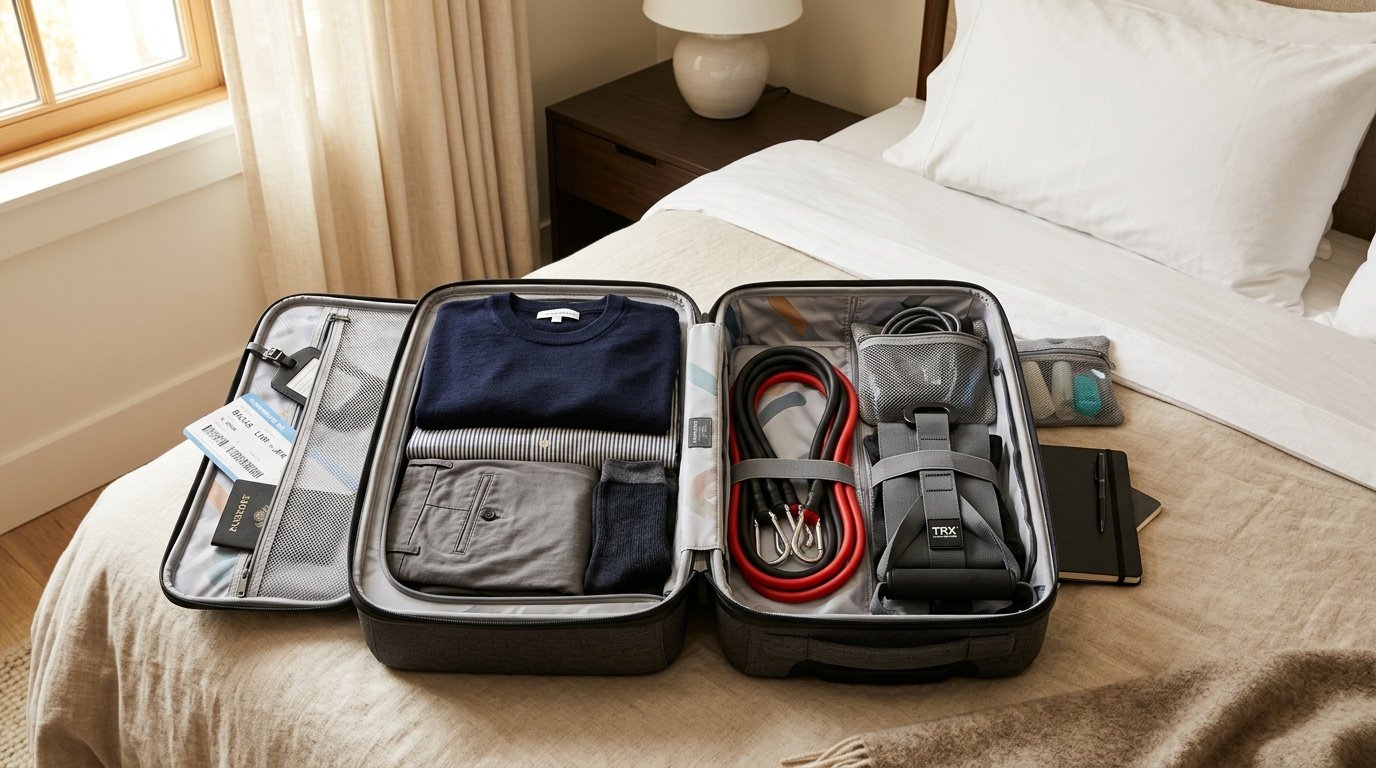
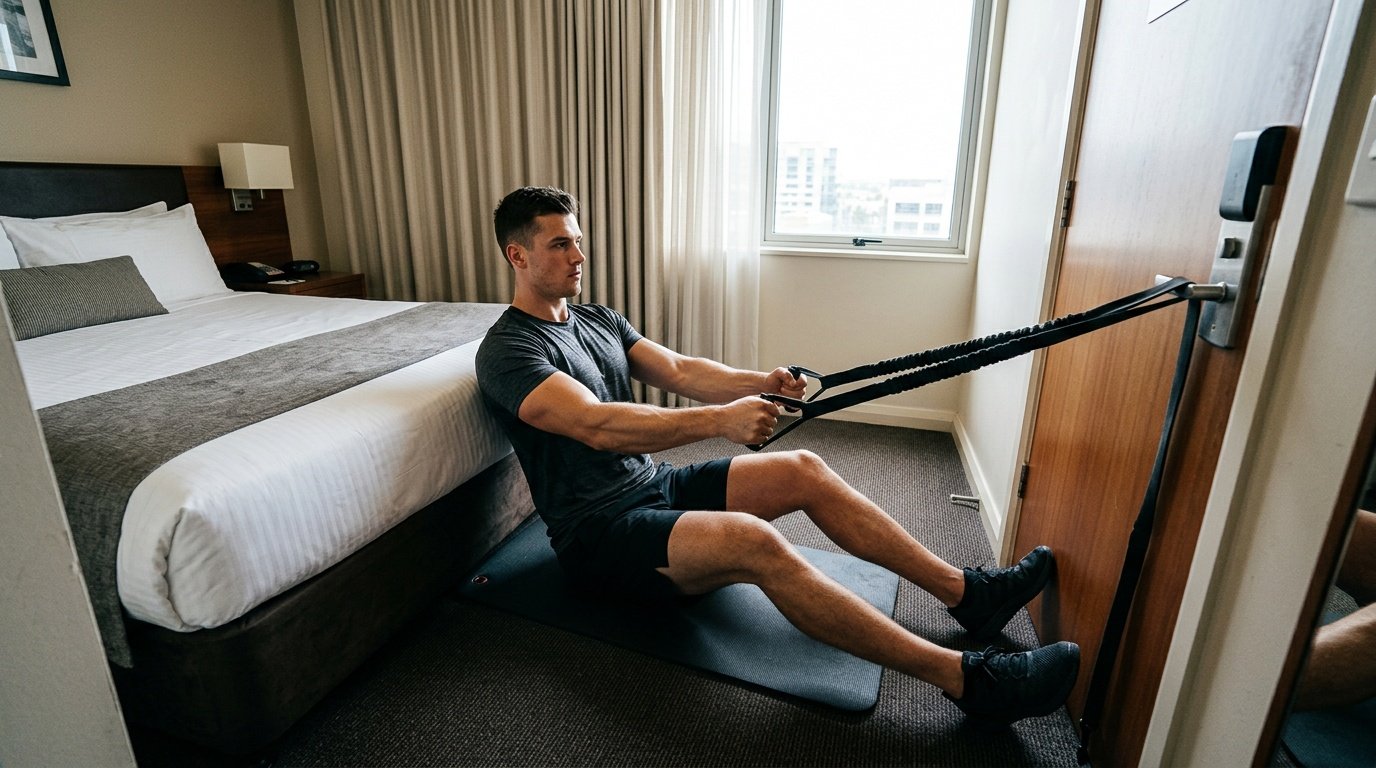
A compact suspension trainer, the kind that anchors over a door, adds rows, presses, and core work that resistance bands alone can't replicate as cleanly. It packs down to roughly the size of a water bottle and turns any hotel room door into functional gym equipment. It's not essential the way a resistance band is, but for anyone who travels often enough to justify the extra half-pound in a suitcase, it closes the gap between "hotel room workout" and "real strength session" more than almost anything else on this list.
Three more items round out a genuinely useful travel kit, each optional depending on how much space you have:
- A lightweight jump rope. Folds into a jacket pocket and is the single best way to get real cardiovascular effort into a small hotel room without waking the guests below you. Ten minutes of interval jumping raises your heart rate as effectively as a treadmill session.
- Fabric sliding discs or gliders. Two flat discs that slide under your feet or hands on hard flooring, useful for core work, lunges, and hamstring curls that would otherwise need a gym machine. They weigh almost nothing and stack flat against a laptop in a bag.
- A small resistance loop for glutes and hips. Separate from your main band set, a short fabric or rubber loop worn just above the knees adds targeted glute and hip work to squats and bridges, closing a gap that a full-length band sometimes leaves.
None of these three are strictly necessary if space is tight. A resistance band and a bit of floor space still covers the essentials. But for someone who travels often enough to treat fitness as non-negotiable, this five-item kit weighs under a pound combined and fits into a single packing cube.
Building a Full-Body Circuit With Nothing But What Fits in a Carry-On
The goal of travel workout equipment isn't to replicate your home gym exactly, it's to hit every major muscle group with what's small enough to pack. A well-built circuit does that in under 20 minutes.
Structure a full-body circuit around movement patterns, not muscles: a push (resistance band chest press or push-ups), a pull (band rows or suspension trainer rows), a squat pattern (band squats or bodyweight squats), a hinge pattern (band deadlifts or glute bridges), and core work (planks or band-resisted rotations). Five movement patterns, one exercise each, covers the entire body in a single short circuit.
Run each move for 40 seconds, rest 20, and cycle through the full circuit two to three times depending on how much time you have that day. This structure scales cleanly whether you have 15 minutes before a meeting or 40 minutes before you have to check out. The same interval structure powers this 15-minute no-equipment cardio circuit, worth keeping in your back pocket for hotel rooms too small even for a resistance band.
| Equipment | Packed size | Muscle groups it covers well |
|---|---|---|
| Resistance bands (set of 2-3) | Fits in a shoe | Chest, back, shoulders, glutes, legs |
| Suspension trainer | Size of a water bottle | Back, core, full-body pulling strength |
| Jump rope | Fits in a jacket pocket | Cardiovascular fitness, calves, coordination |
| Bodyweight only | Zero packed space | Legs, chest, core; limited upper-back pulling work |
Source: Mayo Clinic strength training guidance
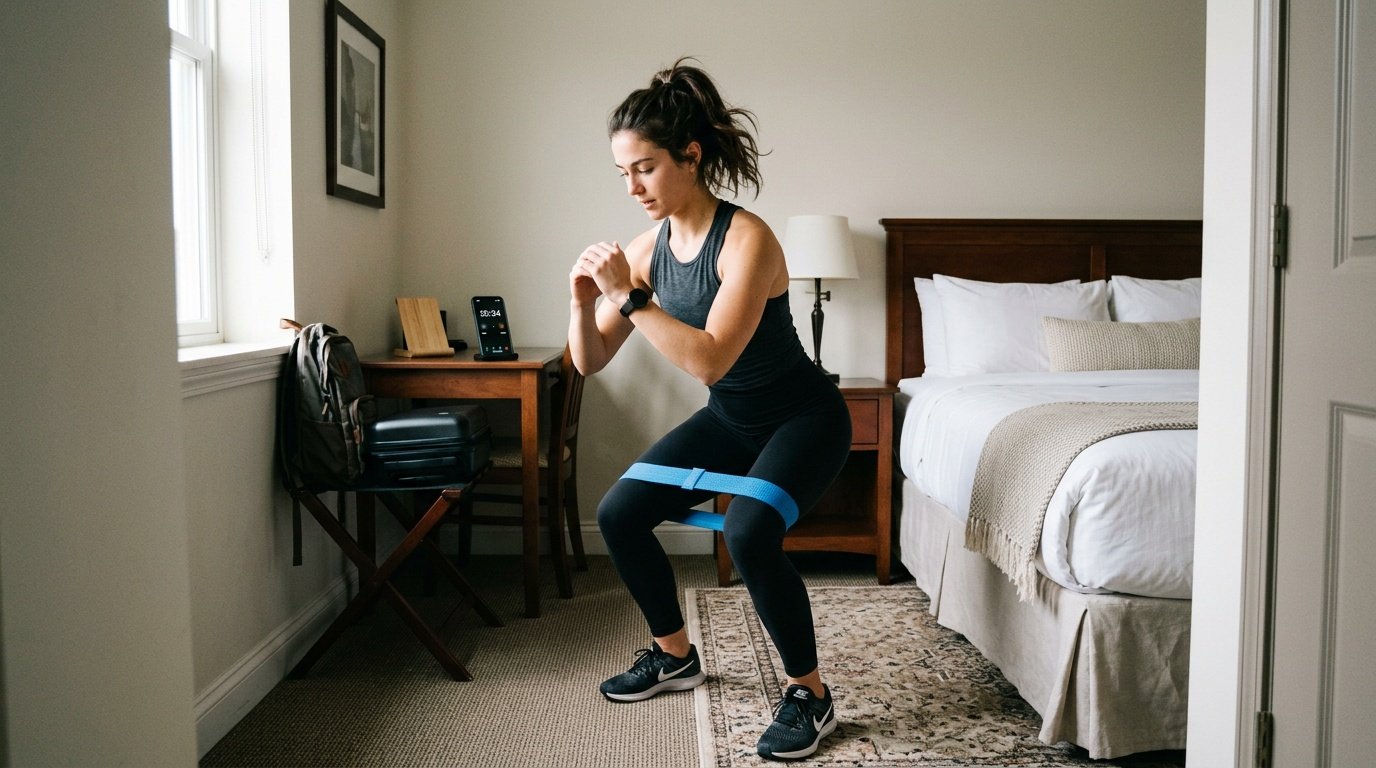
A 20-Minute Travel Workout Routine You Can Run in Any Hotel Room
Here's a complete session that uses only a resistance band and floor space roughly the size of a yoga mat.
- Warm-up (3 minutes): bodyweight squats, arm circles, and light marching in place to raise your heart rate before adding resistance.
- Band chest press x 40 seconds, rest 20 seconds: anchor the band behind you and press forward, working chest and shoulders.
- Band rows x 40 seconds, rest 20 seconds: anchor the band around a door handle or your own foot, pull toward your ribs.
- Band squats x 40 seconds, rest 20 seconds: band around your thighs, just above the knee, squat while keeping tension outward.
- Glute bridges x 40 seconds, rest 20 seconds: band above the knees, drive hips upward, squeeze at the top.
- Plank x 40 seconds, rest 20 seconds: core hold, straight body line from shoulders to heels.
Repeat the full circuit two to three times. By the third round, most people notice the same fatigue and heart rate they'd get from a proper gym session, just achieved with equipment that fit in a side pocket.
Health disclaimer: This routine is general fitness information, not personalized medical advice. If you're new to resistance training, managing a joint or heart condition, pregnant, or recovering from injury, talk to a doctor before starting a new travel workout routine, and stop any exercise that causes sharp or persistent pain.
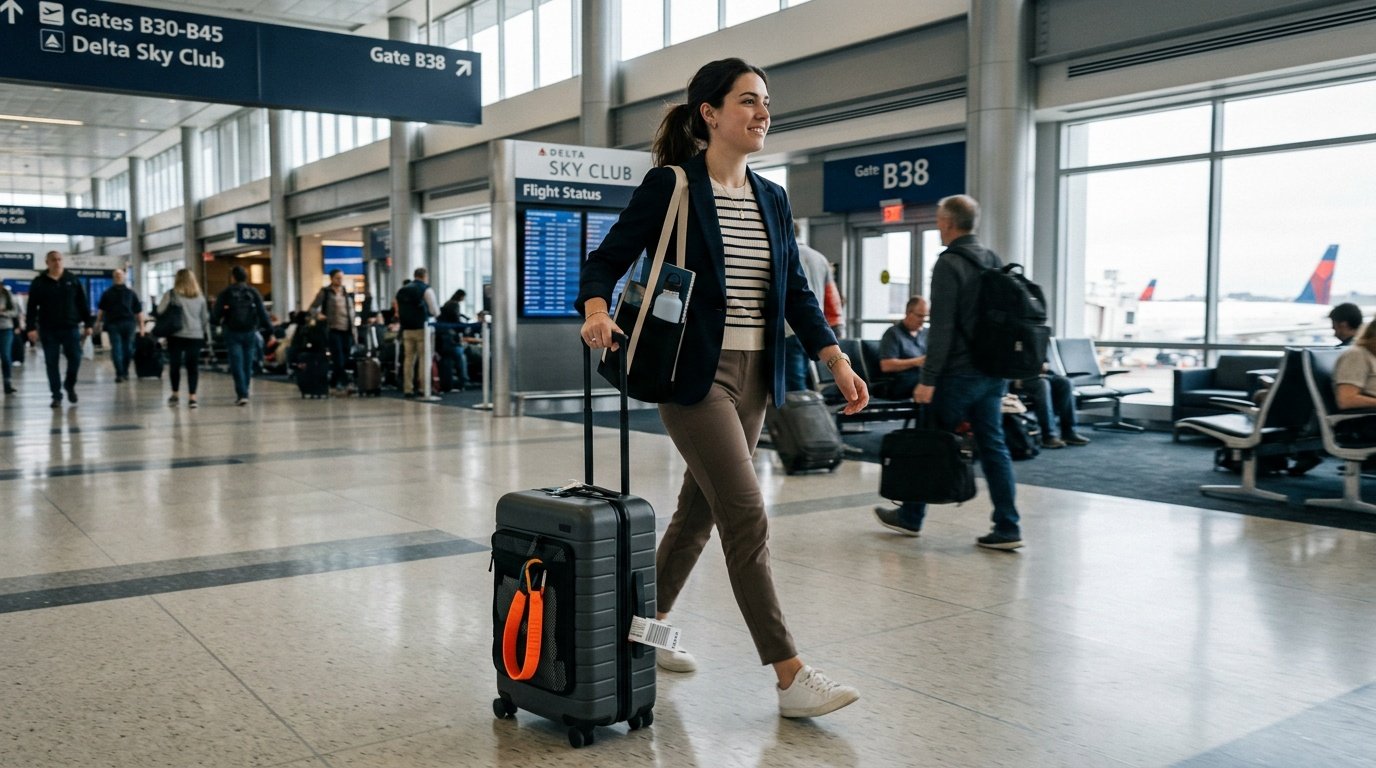
A Real Trip, Real Gear: What a Week Abroad Actually Looks Like
Picture a nine-day work trip across three cities, each hotel different, none of them guaranteed to have a usable gym. Someone packing for that trip with just a resistance band set and a jump rope, both fitting into a single shoe, can realistically run the full 20-minute circuit described above in every hotel room on the itinerary, regardless of what's downstairs. That's the entire value proposition of travel workout equipment in one scenario: the workout stops depending on what the hotel happens to offer.
Compare that to someone relying entirely on hotel gyms for the same trip. Two of the three hotels turn out to have a single treadmill and no floor space for stretching, let alone strength work. The third has a proper gym, but by the time meetings wrap up it's closed for the night. The traveler with packed gear got in six sessions across nine days. The traveler without it got in one, and only because a colleague happened to know a 24-hour gym nearby.
This isn't a hypothetical edge case, it's the ordinary experience of business travel, and it's exactly why frequent travelers who stay consistent treat a resistance band as standard packing, the same category as a phone charger, not an optional extra reserved for people who are "serious" about fitness. Travel derails eating patterns just as easily as workout routines, and the same "plan the small, portable thing in advance" logic covered in this piece on fermented food and gut health applies just as well to what's in your carry-on as what's on your plate.
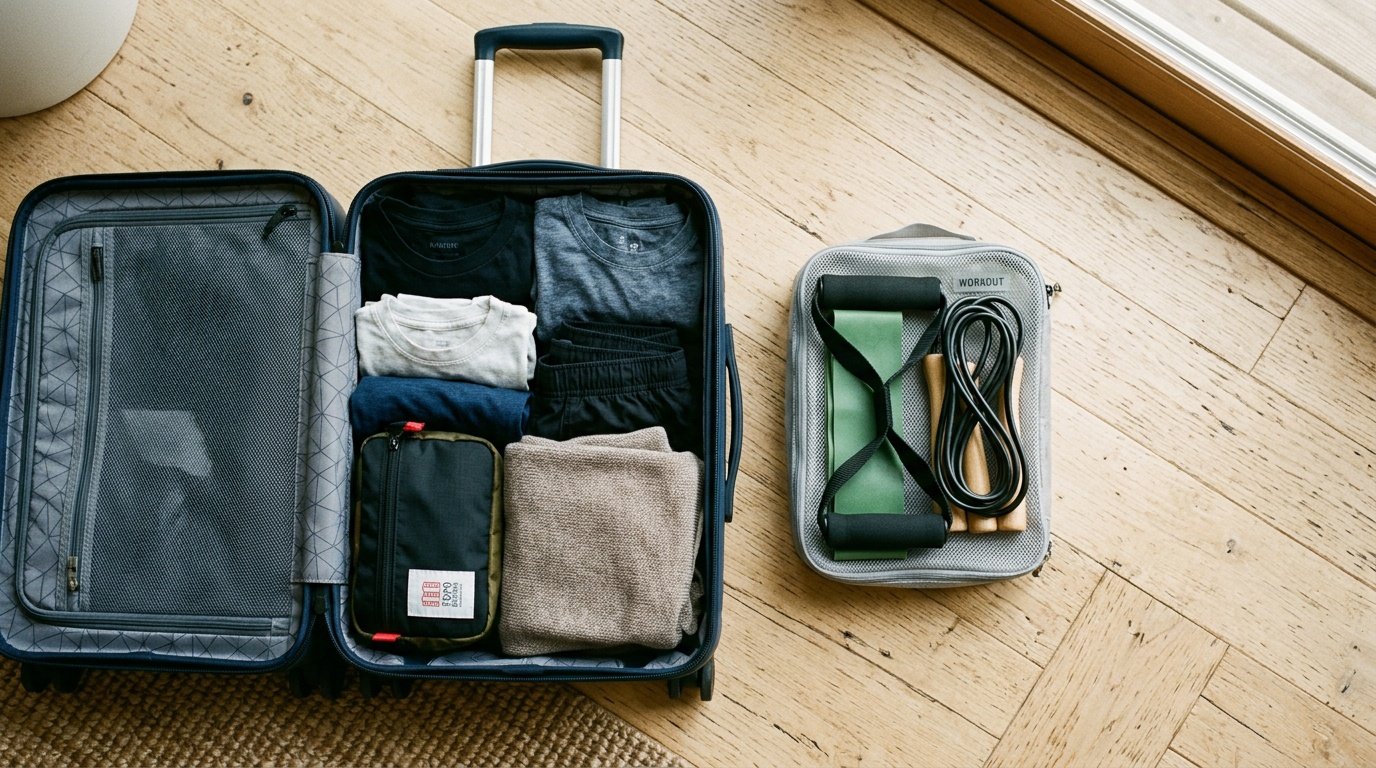
Packing Smart: Weight, Space, and What to Actually Skip
The temptation with travel workout equipment is to over-pack, bringing a full mini gym that ends up unused because it's too much to justify unpacking each night. Resist it. A resistance band set and, optionally, a suspension trainer covers nearly everything a hotel-room workout needs. Anything heavier than that, ankle weights, a full yoga mat, a portable step platform, adds weight and bulk that rarely gets used enough to justify the space.
Skip anything that requires charging, calibration, or a manual to set up. The entire point of travel workout equipment is removing friction, and gear that needs its own setup routine defeats that purpose before you've done a single rep. If your destination has a fitness center, treat your packed gear as the backup plan, not the primary one; if it doesn't, your bands and bodyweight routine become the whole plan, and that should feel like plenty rather than a downgrade.
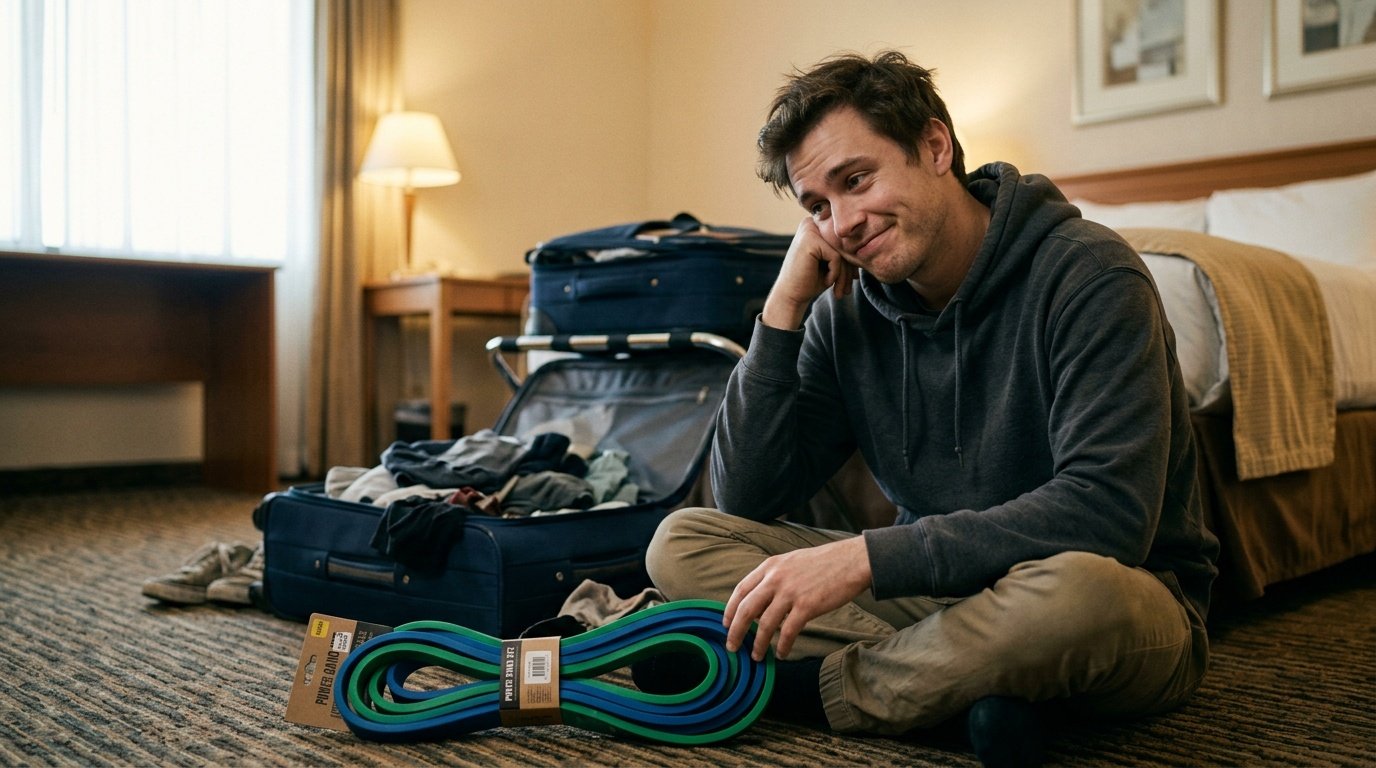
Mistakes That Make Travel Workout Gear a Waste of Suitcase Space
The gap between people who actually use their packed gear and people whose resistance bands sit untouched at the bottom of a suitcase usually comes down to a few avoidable habits.
Packing gear you've never used before the trip. A hotel room the night before an early meeting is the wrong place to learn how a suspension trainer anchors to a door. Test every piece of equipment at home first, so travel days aren't spent troubleshooting instead of training.
No actual plan for what to do with it. Equipment without a routine attached to it is dead weight. Decide your circuit before you pack, not after you've unrolled the band in a hotel room with no idea what comes next.
Treating one skipped day as permission to skip the whole trip. One missed session because of a delayed flight or a late dinner doesn't undo weeks of consistency. The travelers who stay fittest treat missed days as noise, not as evidence the whole system has failed.
Ignoring how a long flight changes your first workout. Muscles that have been folded into an economy seat for hours need a longer warm-up than usual, not a full-intensity circuit the moment you land. Give the first session after travel a few extra minutes of easy movement before adding resistance.
Choosing Gear That Matches How You Actually Travel
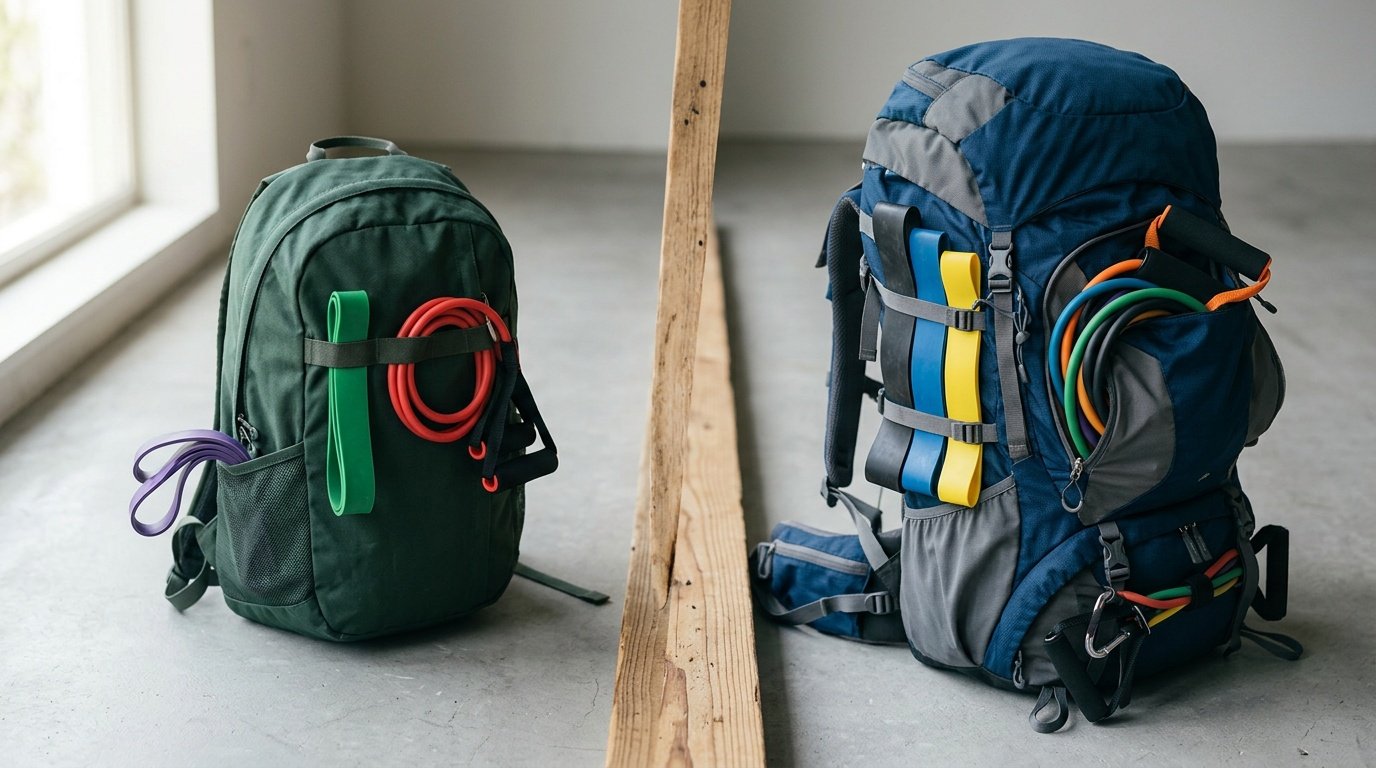
A weekend city trip, a two-week backpacking route, and a business trip with back-to-back meetings all call for a different version of "packable." For short trips, a single resistance band and a bodyweight circuit is genuinely enough; there's no reason to carry more. For longer trips or destinations where hotel gyms are unreliable, the small addition of a suspension trainer and a jump rope rounds out cardio and pulling strength without meaningfully adding to your bag's weight. If you're still deciding how to structure any of this once you're home between trips, this guide to simple workout routines for beginners covers the same movement patterns in a non-travel context.
The Harvard Health take on calisthenics is a useful mental model here: bodyweight training is a legitimate, well-rounded form of exercise on its own, not a downgrade from equipment-based training. Travel workout equipment doesn't replace that foundation, it just extends what you can do with it. Pack the version of that system that matches your actual trip, not the version built for someone else's itinerary.
The Mayo Clinic recommends gradually increasing resistance as exercises start to feel easier, whether that resistance comes from a heavier band, more repetitions, or a longer suspension-trainer lever. That same principle of progressive difficulty travels just as well as the equipment does, which means the routine you build for a three-day trip in month one should look noticeably harder by the time you're packing for a trip in month six.
Frequently Asked Questions
What's the single most useful piece of travel workout equipment to pack?
A set of resistance bands with two or three tension levels. They weigh almost nothing, pack into a shoe, and cover pushing, pulling, and leg exercises that bodyweight training alone can't fully replicate. If you only bring one item, this is it.
Can I get a real workout with travel workout equipment, or is it just better than nothing?
A well-built resistance band circuit produces genuine muscle fatigue and cardiovascular effort comparable to a gym session, not a watered-down substitute. The limiting factor isn't the equipment's effectiveness, it's whether you actually use it consistently.
How much travel workout equipment should I actually pack?
For most trips, a resistance band set is enough on its own. Add a compact suspension trainer only for longer trips or destinations where hotel gyms are unreliable. Anything beyond those two items usually goes unused and just adds weight.
Is bodyweight training alone enough, or do I need equipment at all?
Bodyweight training alone covers legs, chest, and core well, but has real gaps in upper-back pulling strength that are hard to close without some form of resistance. A single resistance band fills that gap without adding meaningful weight to a bag.
How do I fit a travel workout into a packed trip schedule?
Build the routine around a fixed 20-minute block, ideally the same time each day, rather than hoping a gap in the schedule appears. Treating it as a scheduled item rather than an optional extra is what separates people who stay consistent while traveling from people who don't.
References
- American Heart Association — Healthy Travel
- CDC — Physical Activity Guidelines for Adults, 2023
- Cleveland Clinic — Resistance Bands: Put Some Snap in Your Strength Training, 2022
- Mayo Clinic — Strength Training: Get Stronger, Leaner, Healthier
- Harvard Health Publishing — Calisthenics: An Effective, Low-Frills Way to Stay Fit, 2024