

You've probably tried to "get into" mental health practices before: downloaded an app, bought a journal, watched a video on morning routines, and quit within two weeks. That's not a willpower problem. Most advice about mental health practices describes the finished version, a person who meditates daily and never misses a walk, without saying anything about the messy middle where the habit either survives contact with a bad week or doesn't. This guide skips the finished version and starts with the part that actually determines whether any of this sticks.

Why "Mental Health Practices" Means More Than a Self-Care Checklist
Here's the thing: a candle and a bubble bath are coping tools, not practices. A coping tool is something you reach for after stress has already landed. A practice is something you do on a schedule regardless of how the day is going, which is exactly why it's harder to start and more useful once it's running. The difference matters because most people who "try mental health practices" and give up were actually trying coping tools on a schedule, which feels like a chore because it's solving the wrong problem.
Mayo Clinic's guidance on stress relief lists journaling, meditation, movement, and staying connected to other people among the most consistently effective options, not because any one of them is magic, but because they give your nervous system something concrete to do instead of asking it to simply feel calmer on command. That's the non-obvious part most guides skip: you're not choosing the "best" practice, you're choosing the one you'll actually repeat, since a mediocre technique done four times a week outperforms a perfect one done once.
If the idea of ranking your own mental health above your inbox still feels indulgent rather than structural, our piece on why prioritizing mental health changes everything makes the case for treating it as a decision, not a mood.
There's a second reason the checklist framing fails people: it treats every practice as interchangeable, when in reality the ones that stick are the ones that match how you actually experience stress. Someone whose stress shows up as racing thoughts usually gets more mileage out of journaling or a grounding exercise than a workout, while someone whose stress shows up as physical tension often needs movement more than reflection. Trying the wrong category first, then concluding "mental health practices don't work for me," is one of the more common and avoidable reasons people quit in week one.

The Real Cost of Waiting Until You're Already Overwhelmed
People delay starting mental health practices for a specific, understandable reason: things don't feel bad enough yet to justify the effort. That math looks reasonable until you check what it's actually costing.
According to the National Institute of Mental Health, self-care that includes regular movement, consistent sleep, and daily gratitude can measurably lower stress and improve energy, and the agency specifically flags that symptoms lasting two weeks or longer, disrupted sleep, appetite changes, or trouble functioning at work or school, are the signal to bring in a professional rather than pushing through alone. Two weeks is a short runway. Most people who eventually seek help have been managing symptoms for months before that, which means the habits that could have shortened the runway never got built in time.
Picture someone starting their first full-time job. They tell themselves they'll "figure out the self-care thing" once the schedule settles. It rarely settles on its own timeline. A year later, the same person is juggling a heavier workload with an anxiety pattern that's had twelve more months to entrench itself, and less unstructured time to address it than they had on day one. The bill for deferring doesn't disappear, it compounds and gets handed to a version of you with fewer resources to pay it.
Start With the Two-Minute Version, Not the Ideal One
Most people design the routine they'd run on a perfect day: twenty minutes of journaling, a full workout, a proper meditation session. Then the first genuinely hard week arrives, that version collapses, and the whole habit gets written off as something that "doesn't work for me." It wasn't the habit. It was the version.
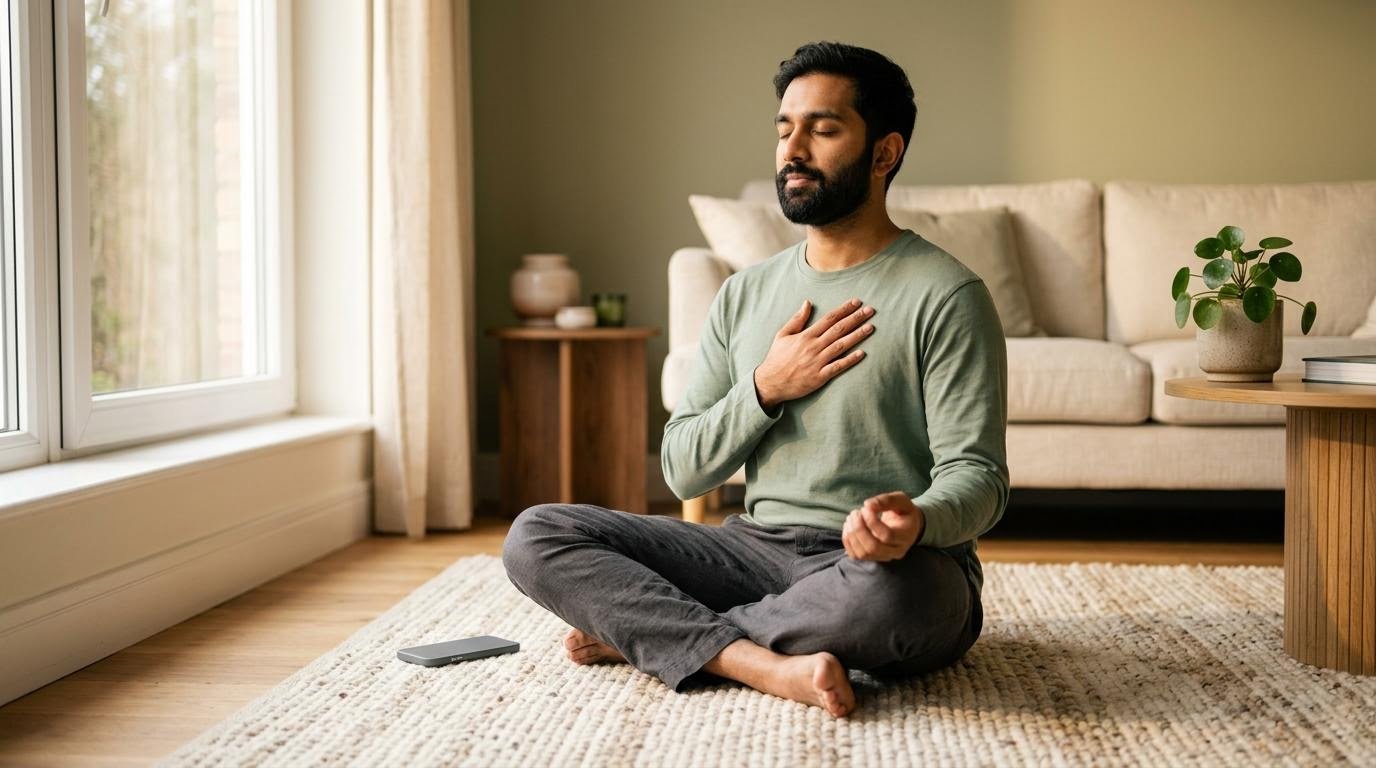
Design the floor instead. What's the smallest version of this practice you could still do on your actual worst day, not your best one? A two-minute breathing pause instead of a twenty-minute session. A single line in a notes app instead of a full journal entry. The Centers for Disease Control and Prevention frames this the same way: taking small, repeatable steps to manage stress daily has more staying power than one dramatic overhaul, and building physical activity up gradually toward roughly two and a half hours a week beats trying to hit that number from week one. Small and repeatable beats large and abandoned, every time.
mental health practices that survive real weeks are built around the floor version, not the ideal one, precisely because the floor is the only version that shows up when you actually need it.

Building Mental Health Practices Around a Cue You Already Have
The floor version still needs somewhere to live in your day, and "somewhere in my schedule" is where most new habits quietly die. Harvard Health Publishing's explanation of habit mechanics breaks every habit, good or bad, into three parts: a reminder that triggers it, the routine itself, and a reward that makes you want to repeat it. New mental health practices tend to fail at the reminder step specifically, because a habit with no fixed trigger has to be remembered fresh every single day, and memory is an unreliable foundation for anything you want to still be doing in three months.
Attach the practice to something that already happens automatically instead. If coffee brews every morning without you having to think about it, that two-minute window is a built-in reminder for a breathing exercise or a gratitude line. If you already brush your teeth at night, that's a ready-made cue to close the day with one sentence about what actually helped. You're not choosing whether to start each time, you're continuing something already in motion, which is the entire reason this approach survives weeks that a from-scratch routine wouldn't.
A specific example: a college student who wants to build a five-minute wind-down practice attaches it to the moment they plug in their phone charger each night, since that already happens without fail. Three weeks in, the phone-charging cue triggers the practice automatically, no willpower required, because the cue did the remembering instead of the person.
Rewards matter too, and this is the part people skip most often. A practice with no felt payoff, even a small one, extinguishes itself within a couple of weeks regardless of how good the cue is. The reward doesn't need to be dramatic: the physical release of a long exhale, the small satisfaction of a checked box, or five quiet minutes with a cup of coffee before the day gets loud are all sufficient rewards on their own. Picking a practice you find genuinely tolerable, rather than the one a wellness influencer insists is best, is what makes the reward step work at all.

Reactive Coping vs. Proactive Mental Health Practices, Compared
It helps to see the distinction laid out directly instead of in the abstract, since most people are mixing both without realizing it.
| Situation | Reactive Coping (After Stress Hits) | Proactive Mental Health Practices (On a Schedule) |
|---|---|---|
| A stressful email arrives | Scroll, vent, or ruminate for the rest of the afternoon | A rehearsed breathing pattern brings you back within minutes |
| A bad week starts | Nothing changes until symptoms are already disruptive | Existing sleep, movement, and check-in habits absorb some of the load |
| Motivation dips | The whole routine gets skipped entirely | The two-minute floor version still happens |
Source: Centers for Disease Control and Prevention, guidance on managing stress
Our deeper breakdown of stress management activities for adults covers a wider menu of specific techniques if you want more options for the "proactive" column above.

A 7-Day Starter Routine (and a Daily Mental Health Checklist You Can Reuse)
Rather than a list of forty possible techniques, here's a specific seven-day starting sequence built around the floor-version and cue-attachment principles above. Run it as written for one week before customizing anything, since the point of week one isn't optimization, it's finding out which pieces actually survive your real schedule.
- Day 1: Pick one existing daily cue (coffee, teeth brushing, commute) and attach a two-minute breathing pause to it.
- Day 2: Add one line of written gratitude to the same cue window. The CDC specifically calls out daily gratitude practice as one of the more reliably effective, low-cost stress tools available.
- Day 3: Take a ten-minute walk at a fixed time, even if it's short. Movement doesn't need to be a workout to count toward the practice.
- Day 4: Notice one physical sign of stress (tight shoulders, shallow breathing) without trying to fix it, just naming it.
- Day 5: Reach out to one person you trust, even briefly. Connection is one of the five stress-reduction categories Mayo Clinic lists alongside movement and journaling.
- Day 6: Repeat days 1 through 3 without adding anything new. Consistency matters more than variety this early.
- Day 7: Write one line reviewing what worked and what didn't. This becomes the seed of your own daily mental health checklist.
If you want something to keep on your phone or pinned above a desk, that same seven-item structure doubles as a simple mental health checklist pdf you can rebuild in any notes app: cue, breath, gratitude line, movement, body check, connection, weekly review. A printable mental health checklist built from your own week one is more useful than a generic downloaded version, since it's already calibrated to cues that exist in your actual schedule rather than someone else's.

When Self-Directed Mental Health Practices Aren't Enough
None of the above is designed to replace professional support when stress or symptoms have moved past what self-directed habits can reach. Cleveland Clinic draws a clear line between adaptive coping, active strategies like problem-solving and reaching out for support, and maladaptive coping, avoidance patterns that provide short-term relief but tend to compound the underlying stress over time. Building good mental health practices is meant to strengthen the adaptive side of that line, not to replace a licensed professional when the maladaptive side starts winning.
There's a specific signal worth watching for: if your usual practices have stopped making a noticeable dent, if sleep, appetite, or your ability to function at school or work has been disrupted for two weeks or more, or if you're withdrawing from people you'd normally lean on, that's the point to involve a healthcare provider rather than adding a fifth technique to the pile. If your stress specifically feels constant and hard to shake even with a routine in place, our guide on stress management activities that actually hold up under real pressure covers techniques built for exactly that level of load, alongside a clearer sense of when it's time to bring in more support.
Health disclaimer: The strategies in this article are general wellness guidance, not a substitute for diagnosis or treatment from a licensed mental health professional. If you're experiencing persistent symptoms of anxiety, depression, or any thoughts of self-harm, reach out to a healthcare provider, or in the US, call or text 988 to reach the Suicide and Crisis Lifeline.
A licensed clinical psychologist at NIMH walks through the GREAT framework, a set of practical mental health practices for managing everyday stress and anxiety.
None of this requires overhauling your week starting tomorrow. Good mental health practices start with one two-minute version attached to something you already do, repeated on the days it feels pointless as much as the days it feels obvious. That's the whole mechanism. Everything else, the checklist, the seven-day plan, the professional-support signal, is scaffolding around that one repeated decision.
Frequently Asked Questions
What are examples of good mental health practices to start with?
A short daily breathing pause, a one-line gratitude note, a ten-minute walk, and checking in with one trusted person are all realistic starting points. The specific technique matters less than picking one you'll actually repeat on a schedule rather than only reaching for during a hard moment.
How long does it take to build a mental health habit?
Most people notice a new habit starting to feel automatic within two to three weeks of consistent practice, though the physical relief from a single session, like a breathing exercise, can be immediate. Give a new habit a genuine two to three weeks before deciding whether it's working, since early repetitions are mostly your nervous system learning the pattern.
What if I don't have time for a full self-care routine?
Build the smallest version you could still do on your worst day rather than the version you'd run on your best one. A two-minute breathing pause attached to something you already do daily, like making coffee, counts as a real mental health practice and is more sustainable than a twenty-minute routine you skip most days.
Are mental health practices the same as therapy?
No. Self-directed practices like journaling, movement, and breathing exercises are genuinely useful for everyday, situational stress, but they work best as a supporting layer alongside professional care rather than a replacement for it when symptoms are more persistent or disruptive.
What's a simple daily mental health checklist I can use?
A workable daily mental health checklist can be as short as seven items: a fixed cue, a breathing pause, a gratitude line, ten minutes of movement, a quick body check for tension, one moment of connection with someone you trust, and a weekly one-line review. Build it around cues already in your schedule rather than copying someone else's routine exactly.
When should I see a professional instead of just building habits?
If your usual practices have stopped helping, or if sleep, appetite, or your ability to function at work or school has been disrupted for two weeks or more, that's the signal to bring in a licensed mental health professional rather than adding another self-help technique to the pile.
References
- National Institute of Mental Health — Caring for Your Mental Health, 2026
- Centers for Disease Control and Prevention — Managing Stress, 2026
- Mayo Clinic — Stress Relievers: Tips to Tame Stress, 2023
- Harvard Health Publishing — Trade Bad Habits for Good Ones, 2016
- Cleveland Clinic — Stressed Out? Use These 14 Healthy Coping Mechanisms, 2024