


The childhood obesity rate in America just hit a number public health researchers have been dreading for years: roughly 1 in 5 U.S. children and adolescents now have obesity, and the trend line has kept climbing since the late 1980s. Every parenting forum has a theory about why. Genetics, school lunches, fast food chains, video games. The research keeps circling back to a less comfortable answer: the home environment a child grows up in, built and controlled almost entirely by parents, is the single strongest lever available. That's not a guilt trip. It's the opposite. Genetics you can't touch. School policy you can't touch. What's in the pantry, what's modeled at the dinner table, and how bedtime actually works on a Tuesday night? That's yours.
This isn't about blame. It's about where the leverage actually sits, and what a realistic starting point looks like for a parent who wants to change direction without turning every meal into a negotiation. The uncomfortable part isn't that parents caused this on their own, since genetics, income, and neighborhood safety all play a documented role too. The uncomfortable part is that of the factors any single household can actually change, almost all of them run directly through the adults in the house.

Just How High Is the Childhood Obesity Rate in America Right Now
The most recent complete data from the CDC's national survey period covering 2017 through March 2020 put childhood obesity at 19.7% among U.S. youth aged 2 to 19, which works out to roughly 14.7 million kids. Break it down by age and the picture sharpens: 12.7% among 2 to 5 year olds, 20.7% among 6 to 11 year olds, and 22.2% among adolescents 12 to 19. The rate doesn't just rise with age, it nearly doubles between preschool and the teen years, which tells you something important: obesity risk compounds the longer unhealthy patterns stay in place uncorrected.
The number that gets skipped in most headlines is the income breakdown, and it's the one most relevant to a "parents are driving it" conversation. Obesity prevalence was 11.5% among kids in households above 350% of the federal poverty level, 21.2% among kids between 130% and 350% of the FPL, and 25.8% among kids at or below 130% of the FPL. That's not proof that lower-income parents care less. It's proof that the resources parents have access to (time, grocery budget, safe outdoor space, working hours that allow for a sit-down dinner) shape outcomes as much as any individual choice does. Leverage and blame are two different things, and conflating them is where a lot of well-meaning articles on this topic go wrong.

What the Research Actually Says About Parents' Role
Parental influence on a child's weight runs through three separate channels, and none of them require lecturing a kid about calories. The first is genetic and biological, which parents don't control. The second is the household food and activity environment, which parents build almost entirely. The third is direct behavioral modeling, meaning kids watch what adults actually do far more than they listen to what adults say.
Research from the National Heart, Lung, and Blood Institute at NIH is direct about this split: genetic risk exists, but it doesn't explain the increase in childhood obesity seen over recent decades on its own, since genes haven't changed that fast. What NHLBI points to instead is that most parents do have meaningful control over the risk factors that actually move the needle, and, critically, that childhood obesity is reversible when those factors shift. That reversibility point rarely makes it into panic-driven headlines, and it's arguably the most useful sentence in the entire body of research on this topic.

The Home Environment Shapes a Child's Weight Before School Ever Does
Picture a parent working a closing shift that ends at 7pm, picking a child up from an after-school program, and getting home at 7:45. The fastest dinner option isn't a moral failure, it's a drive-through, because a from-scratch meal isn't realistically on the table that night. This is the scenario that pure "just cook more" advice tends to ignore, and it's exactly why leverage matters more than willpower framing.
What's in the pantry ends up in the body
Kids eat what's available and visible, not what's theoretically healthiest. A pantry stocked with fruit at eye level and chips on a high shelf changes default behavior without a single conversation about nutrition. The CDC's guidance on early nutrition makes a point that's easy to underestimate: once a child is past toddlerhood, they increasingly eat whatever the rest of the household eats. There's no separate "kid meal" track that stays healthy while adults eat differently. The household diet is the kid diet, full stop.
Modeling matters more than lecturing
A child who watches a parent order a salad while telling the child to "eat your vegetables" is absorbing a contradiction, not a lesson. Consistency between what a parent eats and what a parent asks a child to eat does more long-term work than any single conversation about health. This is uncomfortable to hear if a parent's own eating habits are inconsistent, but it's also the most actionable insight in this entire topic: fixing the household default fixes the child's default, usually without a single direct instruction.
Grocery shopping is where the decision actually gets made
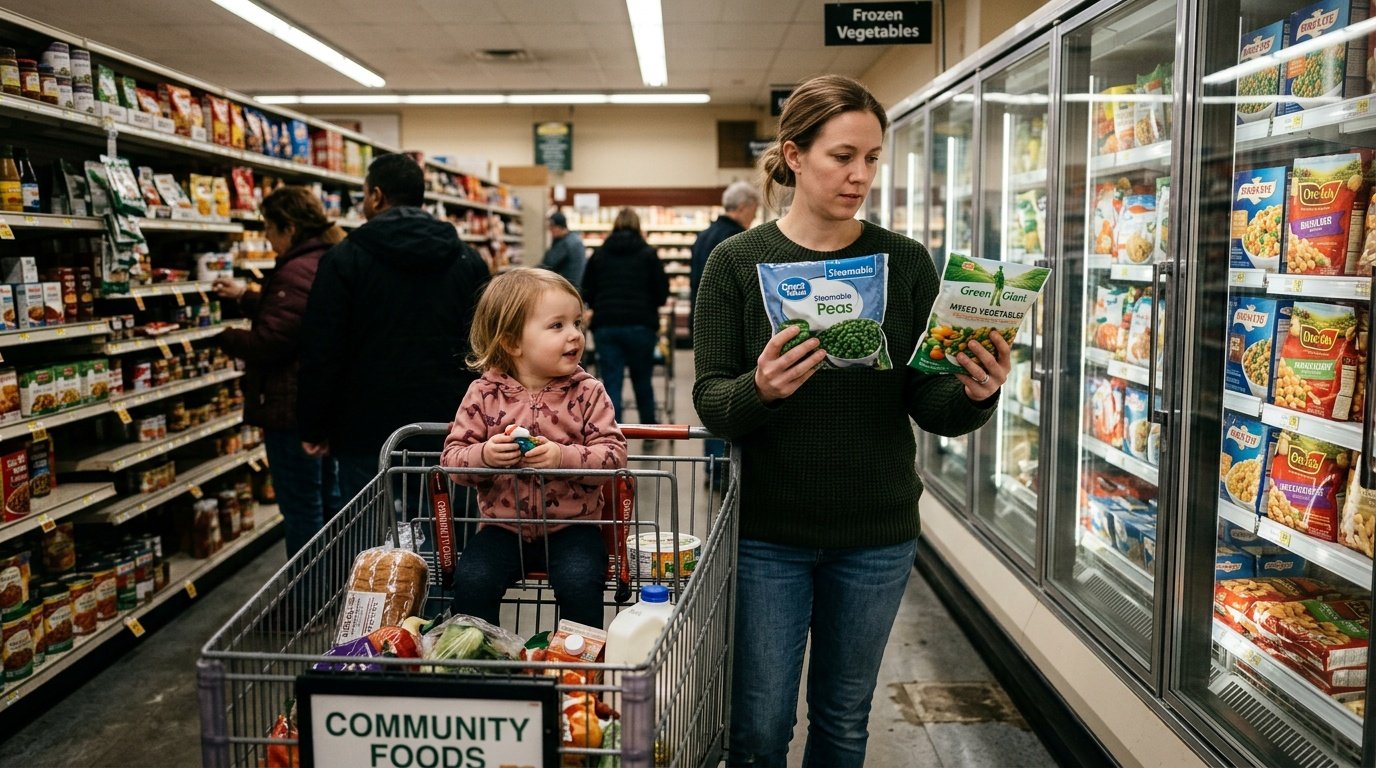
By the time a kid is standing in front of an open fridge deciding what to eat, the real decision already happened days earlier, at checkout. Whatever came home in the grocery bags is the entire menu of options available for the week. This is one of the few points in the whole cycle where a parent makes a single decision that governs dozens of smaller decisions downstream, without needing to supervise every snack choice in real time. Bringing a child along for a portion of the shopping and letting them pick one new fruit or vegetable each trip builds buy-in without turning grocery shopping into a lecture about nutrition labels.

Screen Time, Sleep, and the Habits Parents Actually Control
Two of the most underrated levers in this conversation aren't about food at all: screen time and sleep. Both sit almost entirely inside a household's control, and both have a documented relationship with weight.
The screen-time and sedentary link
Time spent on a screen is time not spent moving, and it's also frequently time spent eating without noticing how much. The mechanism isn't mysterious: distracted eating in front of a screen makes it easier to eat past the point of fullness, and marketing exposure during that screen time nudges preferences toward low-nutrient, high-calorie food. A household screen-time rule, even a loose one like no devices during meals, addresses both problems at once without turning into a food fight.
Sleep's underrated role in appetite regulation
Short sleep duration in children is associated with a higher likelihood of overweight and obesity, and the mechanism runs through appetite-regulating hormones that get disrupted when sleep is cut short. A consistent bedtime is one of the few interventions here that costs nothing, requires no grocery budget, and is entirely within a parent's control on any given night. It's also one of the most consistently skipped pieces of advice, probably because it doesn't feel like it's "about" weight at all.

Family Meals: The Single Habit With the Most Evidence Behind It
If there's one habit worth prioritizing over every other item on this list, it's the shared family meal, not because of any single nutrient but because of the structure it imposes. Regular family meals correlate with more exposure to a variety of foods, less television during eating, and a food environment a parent actually controls rather than one dictated by whatever's fastest. The American Heart Association's guidance for children's diets reinforces the same point from the physical activity side: kids aged 6 to 17 need at least 60 minutes of activity daily, and that target is far easier to hit inside a household routine that already treats movement and mealtimes as non-negotiable structure, rather than as something squeezed in around a chaotic schedule.
| Factor | What the Data Shows | Who Controls It |
|---|---|---|
| Obesity prevalence, ages 2-5 | 12.7% (2017-March 2020) | Household food environment |
| Obesity prevalence, ages 12-19 | 22.2% (2017-March 2020) | Accumulated household patterns |
| Recommended daily activity, ages 6-17 | At least 60 minutes | Family routine and scheduling |
Source: Centers for Disease Control and Prevention; American Heart Association
Why This Isn't About Blame, It's About Leverage
Systemic factors are real and shouldn't be waved away: food deserts limit fresh produce access, unsafe neighborhoods limit outdoor play, and irregular work schedules limit time for cooking. Pediatric researchers writing in Harvard Health's coverage of the American Academy of Pediatrics' updated obesity guidelines explicitly note that prenatal factors, genetics, systemic racism, and embedded socioeconomic conditions all play a documented role alongside household habits. Simply put, obesity is complicated, and any framing that reduces it to pure parental willpower is oversimplifying a genuinely multi-factor problem.
That complexity doesn't cancel out parental leverage, it contextualizes it. A parent working within real constraints of money, time, and neighborhood safety still has more influence over the household's food and screen environment than any outside institution does. The goal isn't perfection against an impossible standard, it's identifying the two or three levers that are actually available in a specific household and using them consistently.
Take a family living in a neighborhood where the nearest grocery store with fresh produce is a 25-minute drive, and the nearest food option on foot is a gas station. The available levers there look different from a family with a farmers market two blocks away, but they still exist: frozen vegetables hold most of their nutrient value and don't require a special trip, a consistent bedtime costs nothing regardless of zip code, and a "no screens at the table" rule works the same in a small apartment as it does in a large house. The specific tactics shift with circumstance. The underlying principle, that the household environment shapes the child's environment, holds across every income bracket.

A Realistic Starting Plan for Parents Who Want to Turn This Around
Trying to fix diet, screen time, sleep, and activity simultaneously is a recipe for burnout by week two. A more durable approach picks one or two changes and holds them steady before adding more.
Small structural changes that actually stick
- Move the fruit to the front of the fridge and the chips to a cabinet that requires asking.
- Set a "no screens at the table" rule and apply it to every adult in the house, not just the kids.
- Pick one consistent family dinner night per week before trying for seven.
- Lock in a fixed bedtime, seven nights a week, before touching anything else on the list.
- Build in outdoor or active play immediately after school, before homework and screen time compete for the same hour.
For parents rebuilding a household routine from the ground up, GenZiest's guide to a realistic seven-day healthy lifestyle routine walks through the same sequencing logic, one anchor habit at a time instead of an all-at-once overhaul.
What to avoid: diet talk and restriction
Putting a child on an explicit diet, commenting on their body size, or restricting food as punishment tends to backfire, often producing disordered eating patterns that are harder to treat than the original weight concern. The goal is a healthier household default, not a child who's aware they're being monitored. That distinction matters more than almost anything else in this article.
Track progress the right way, or don't track it at all
A bathroom scale in a child's daily view does more harm than good, and it isn't even the right measurement tool for a growing body. Pediatricians track BMI-for-age percentile over time, not a static number, because a healthy child's weight is supposed to increase as they grow. If a parent wants a sense of whether household changes are working, the honest answer is that it usually shows up first in energy levels, sleep quality, and how winded a kid gets during normal play, weeks before it would show up on any scale. Chasing a number at home tends to create anxiety around food for children without giving parents any information a pediatrician's growth chart wouldn't already provide more accurately.

When to Loop In a Pediatrician or Specialist
A pediatrician should be part of this conversation if a child's growth curve shows a sharp upward shift on their BMI-for-age percentile, if there's a family history of type 2 diabetes or early cardiovascular disease, or if a parent has tried consistent household changes for several months without any shift in the child's trajectory. None of that means a parent has failed. It means the situation warrants a clinical read that a household routine alone can't provide, and pediatricians are trained to separate normal growth variation from a genuine trend worth addressing directly.
Health disclaimer: This article offers general information about childhood obesity trends and household habits, and isn't a substitute for individualized medical advice. Never restrict a child's food intake, put a child on a weight-loss diet, or make changes to a child's activity level without first talking to a pediatrician, especially if there's a family history of diabetes, heart disease, or disordered eating.
The childhood obesity rate in America isn't going to move because of a single new school policy or a supplement marketed to parents. It moves, slowly and unevenly, one household at a time, through the pantry, the bedtime routine, and the example set at the dinner table. That's a heavier responsibility than most parents signed up for, but it's also the most direct form of control anyone in this conversation actually has.
Building a healthier household starts with the same handful of anchor habits covered throughout GenZiest's broader library of healthy lifestyle habits guides, and pairs naturally with a closer look at the benefits of daily exercise for kids specifically, since movement and food patterns tend to reinforce each other once both are in place.
Here's a short CDC video on the community and household factors behind the broader obesity trend.
Frequently Asked Questions
What is the childhood obesity rate in America right now?
The most recent complete CDC data (2017 through March 2020) puts it at 19.7% of children and adolescents aged 2 to 19, or roughly 14.7 million kids. The rate rises with age, from 12.7% among 2 to 5 year olds to 22.2% among 12 to 19 year olds.
Are parents really responsible for childhood obesity?
Not solely, and not in a blame sense. Genetics, income, neighborhood safety, and food access all play documented roles. But among the factors a household can actually change, the home food environment, screen habits, and sleep schedule sit almost entirely within parental control, which is why they're the most useful place to focus.
What's the single biggest change a parent can make at home?
Consistency in the household food environment, meaning what's stocked, what's modeled by adults, and whether meals happen together, tends to have more measurable impact than any single dietary rule aimed at the child specifically.
Does screen time really cause childhood obesity?
Screen time itself isn't the direct cause, but it's strongly linked through reduced physical activity, distracted eating, food marketing exposure, and disrupted sleep when screens are used close to bedtime. Reducing it addresses several risk factors at once.
When should a parent talk to a pediatrician about their child's weight?
If a child's BMI-for-age percentile shows a sharp upward shift, if there's a family history of type 2 diabetes or early heart disease, or if consistent household changes haven't produced any shift after several months, it's time for a clinical conversation rather than continuing to adjust things alone.
References
- Centers for Disease Control and Prevention — Childhood Obesity Facts
- National Heart, Lung, and Blood Institute, NIH — Overweight and Obesity: Childhood Obesity
- Centers for Disease Control and Prevention — Good Nutrition Starts Early, 2026
- American Heart Association — Dietary Recommendations for Healthy Children
- Harvard Health Publishing — New Pediatric Guidelines on Obesity in Children and Teens, 2023
- Centers for Disease Control and Prevention — The Obesity Epidemic, 2011