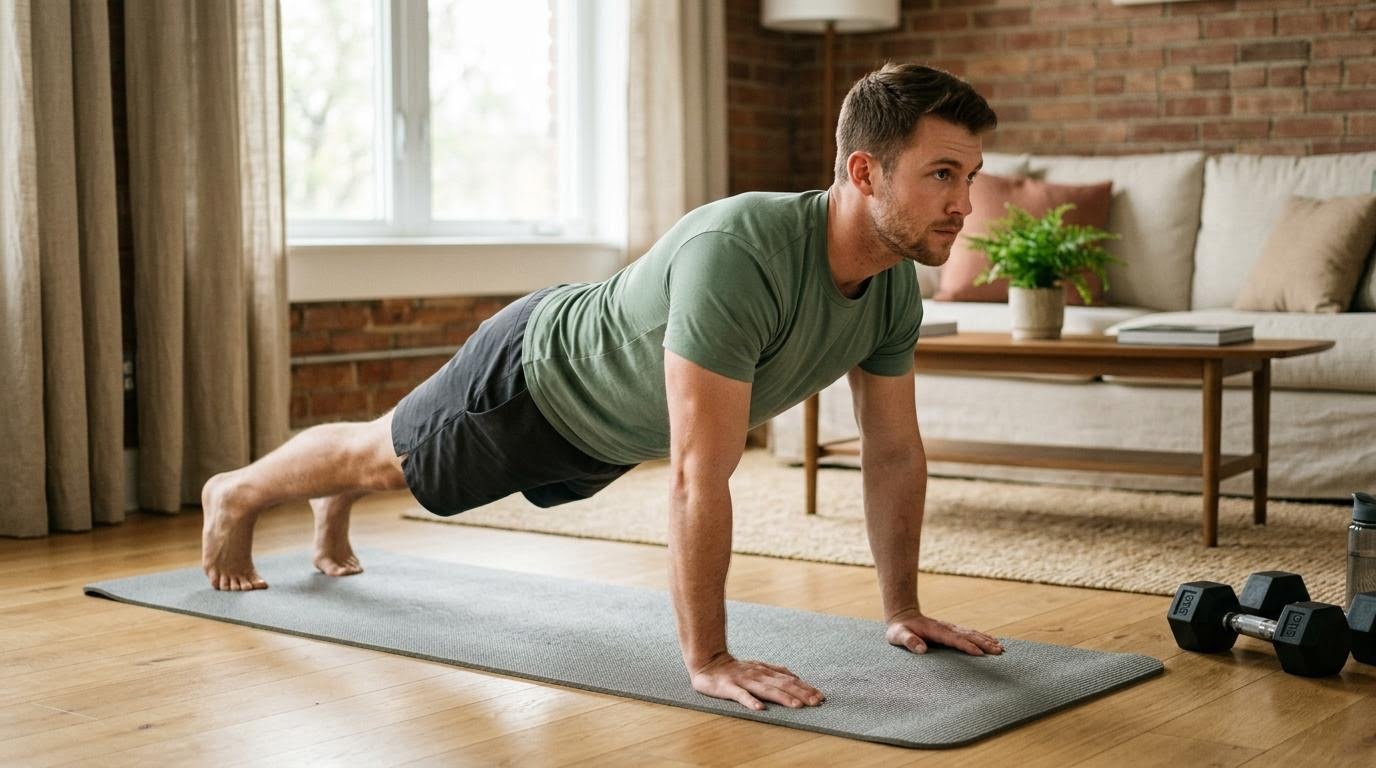


Twenty minutes on a cleared patch of living room floor can do more for your heart than an hour of half-effort cardio at the gym, provided those twenty minutes are actually hard. Intense cardio workouts at home work on a simple mechanism: your cardiovascular system adapts to how much demand you place on it, not to whether that demand happens on a treadmill or a rug. This guide walks through a genuine 20-minute, equipment-free circuit built around real intensity markers, how to read your own effort without a heart rate strap, how to scale the moves to your joints and starting fitness, and a four-week plan that gets you there without wrecking your knees in week one.
I know the skepticism. Bodyweight moves in a bedroom feel like the diet version of a real workout, something you settle for when a gym membership or a rack of dumbbells isn't in the picture. That instinct gets the physiology backwards. Your heart doesn't know or care what equipment is nearby. It responds to how fast and how hard you're asking it to move blood, and a well-built bodyweight circuit can push that demand just as high as a spin class, sometimes higher, because there's no machine pacing you down to a comfortable cadence.

Why Intense Cardio Workouts at Home Actually Raise Your Fitness Ceiling
The case against home cardio usually comes down to one assumption: that intensity requires external resistance, an incline setting, or a spin bike's flywheel. It doesn't. A Harvard Health review of high-intensity interval training notes that HIIT features short bursts of hard effort, usually one to four minutes, interspersed with lower-intensity recovery, and that the format itself, not the equipment used to deliver it, is what drives the cardiovascular adaptation. Squat jumps, high knees, and mountain climbers recruit large muscle groups at speed, which spikes oxygen demand almost as fast as sprinting does.
There's also a practical argument that gets overlooked. The CDC's current physical activity guidelines set the weekly target at 150 minutes of moderate-intensity activity or 75 minutes of vigorous-intensity activity, and explicitly note that this doesn't need to happen in a single block or a gym setting. A genuinely hard 20-minute home circuit, done three to five times a week, clears that vigorous-intensity threshold in less total time than a moderate-paced hour on a treadmill would take to reach the same weekly minutes.
None of this means equipment is useless. It means the absence of a kettlebell isn't the obstacle most beginners assume it is. A single brutal barbell session that leaves you too sore to move for four days produces less total monthly fitness than four honest, equipment-free sessions a week. Your cardiovascular system responds to the pattern you repeat, not to how impressive any single workout looked on paper. Picture someone with a twenty-minute gap between a class and a shift, no time to drive anywhere. That gap is enough for a real session, not a smaller version of one.
Breathing matters more here than most beginners expect. Exhale sharply on the effort phase of each move, the jump, the knee drive, the lunge, then inhale as you reset. Holding your breath through effort is a common habit that spikes perceived difficulty without improving performance, and it tends to leave people more winded than their actual heart rate would justify.

The 20-Minute Intense Cardio Workouts at Home Circuit (Zero Equipment)
Do each move for 40 seconds, rest 15 seconds, then move to the next. Two full rounds of all six moves lands you at roughly 20 minutes including a short warm-up. No jump rope, no bands, no weights. Your own bodyweight and about six feet of clear floor.
Move 1: High-Knee March-In-Place
Lift your knees to hip height, alternating sides, pumping your arms as you go. This is your warm-up move and your fallback if anything later feels too intense. Keep your landing soft and your core braced.
Move 2: Squat Jack
Lower into a shallow squat, then jump both feet out to the sides as your arms sweep overhead, before jumping them back in. This is your first genuine intensity spike, and where your heart rate should start climbing out of warm-up territory.
Move 3: Standing Knee Drives
Drive one knee up toward your chest with control, then switch sides fast. Add a slight hop between switches once your balance feels steady. This is a pure heart-rate driver with almost no impact.
Move 4: Reverse Lunge to Knee Drive
Step back into a reverse lunge, then drive through your front heel to bring your back knee up toward your chest in one fluid motion. This combines a strength component with cardio, which does more for your total conditioning than it sounds like it should.
Move 5: Mountain Climbers
From a plank position, drive your knees toward your chest one at a time at a fast, controlled pace, keeping your hips level. This is usually the hardest move in the circuit and the one that separates a genuinely intense session from a moderate one.
Move 6: Squat Jump
Lower into a bodyweight squat, then explode upward into a jump, landing softly with bent knees. If jumping isn't right for your knees today, pulse at the bottom of the squat instead, small controlled up-and-down movements that keep tension without impact.
Two rounds, six moves each, 40 seconds on and 15 off. If you only have a phone timer, set it to repeat and don't overthink the transitions between moves, a few seconds of imperfect footwork while you switch is completely fine.
If you want a gentler on-ramp to alternate with on lighter days, this 15-minute beginner cardio routine uses a similar structure at a lower intensity ceiling, useful for a recovery day between two hard sessions.

How to Tell You're Actually Working at "Intense" Without a Heart Rate Monitor
You don't need a chest strap or an expensive watch to know if this circuit is doing its job. The American Heart Association's target heart rate chart puts moderate-intensity exercise at roughly 50 to 70 percent of your estimated maximum heart rate (220 minus your age), and vigorous-intensity work at 70 to 85 percent. For most people in their 20s, that's a working zone somewhere around 100 to 165 beats per minute depending on which move in the circuit you're on.
There's a simpler check that doesn't require math mid-workout: the talk test. If you can hold a full conversation without pausing for breath, you're not working hard enough yet. If you can't manage more than a few words at a time, you've crossed into vigorous territory. Somewhere in between, breathing hard but still able to answer a short question, is where intense cardio workouts at home should sit for most of the working intervals in this circuit.
| Intensity Level | Talk Test | % of Max Heart Rate | Where in This Circuit |
|---|---|---|---|
| Light | Full conversation, easy | Under 50% | Warm-up marching, rest intervals |
| Moderate | Talk in short sentences | 50-70% | Squat jacks, reverse lunges |
| Vigorous | A few words at most | 70-85% | Knee drives, mountain climbers, squat jumps |
Source: American Heart Association, 2024
A non-obvious wrinkle worth knowing: your heart rate during the 15-second rest interval matters almost as much as your peak during the work interval. If your heart rate is still near its peak by the time the next interval starts, you're not resting, you're just doing a longer continuous set. That's not automatically bad, but it changes which energy system you're primarily training, and it's worth noticing rather than treating every interval as identical.
Scaling This Routine to Your Joints, Age, and Starting Fitness
Nobody's first attempt should look like their thirtieth. Here's exactly how to adjust without skipping a move entirely.
If Your Knees Are the Concern
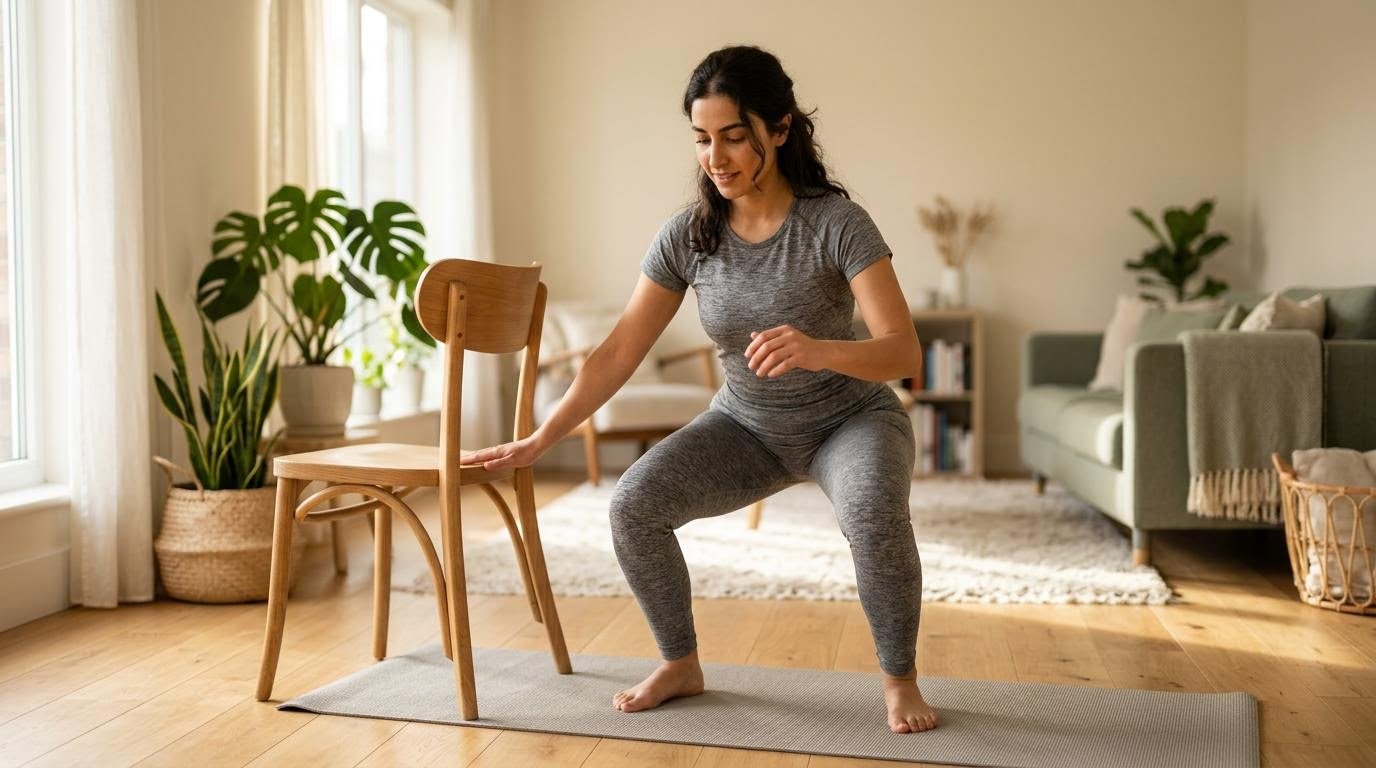
Replace the squat jump with the squat pulse variation and slow the knee drives to a lower tempo without raising your knee above hip height. The squat jacks and reverse lunge already keep at least one foot in contact with the ground for most of the movement, so they need little modification.
If Any Kind of Impact Bothers Your Joints
Keep at least one foot on the floor at all times across every move instead of adding a hop or jump. The Mayo Clinic's guidance on measuring exercise intensity notes that intensity is defined by effort and heart rate response, not by how much force your joints absorb, so a low-impact version isn't a lesser workout, it's a different route to the same physiological demand.
If You're Starting From a Very Low Fitness Baseline
Do one round instead of two for the first week. Ten minutes of consistent movement with good form beats twenty minutes you dread and abandon by move four. According to Cleveland Clinic's guidance on high-intensity interval training, HIIT is a broad concept, not a rigid regimen, and what counts as "high intensity" is genuinely relative to where your own fitness starts, not a fixed bar everyone has to clear on day one.
Health disclaimer: If you have a heart condition, joint injury, are pregnant, or haven't exercised in an extended period, talk with a doctor before starting this or any new high-intensity routine. Stop immediately if you feel chest pain, dizziness, or sharp joint pain, and seek medical attention.
Watch a certified exercise physiologist from Cleveland Clinic answer common questions about who HIIT is and isn't appropriate for below.
Your Realistic 4-Week Plan for Intense Cardio Workouts at Home
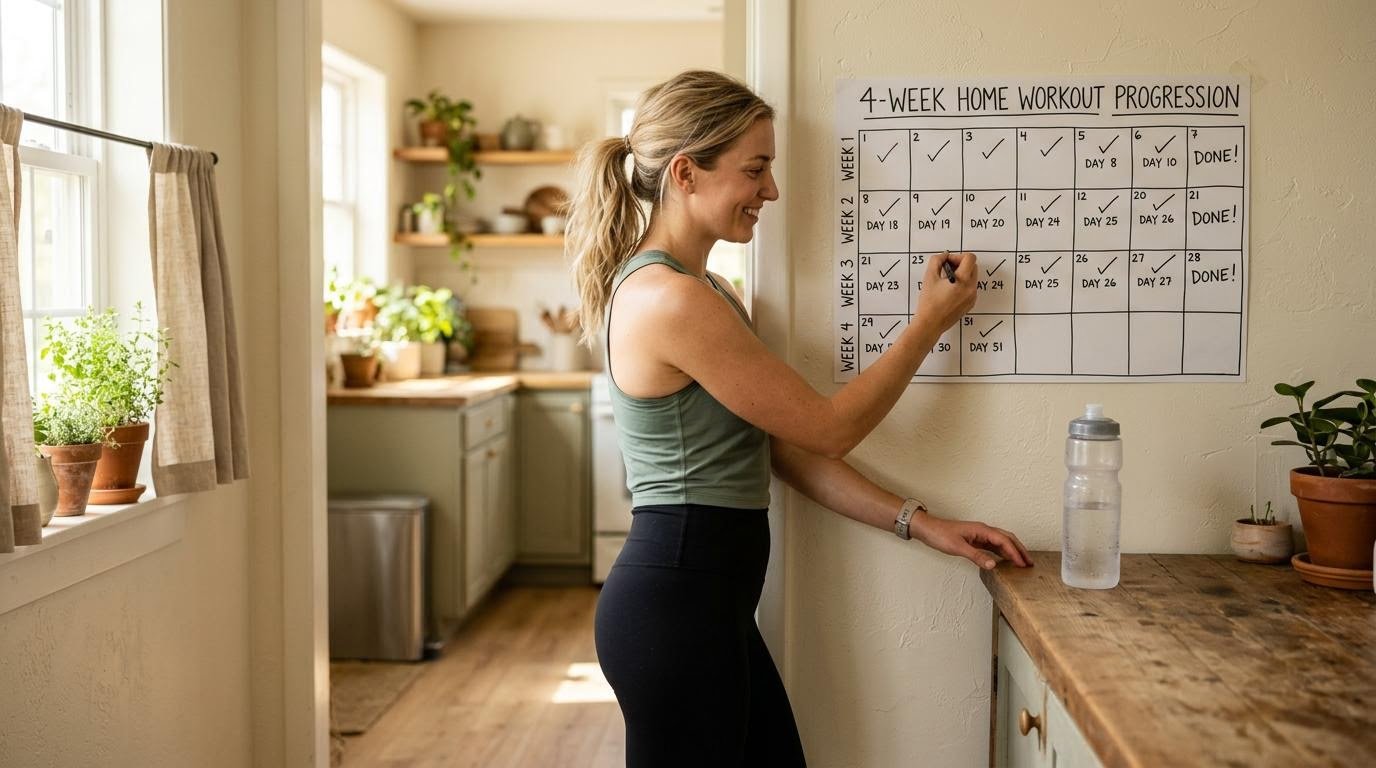
Consistency beats intensity for the first month, full stop. Here's what a sustainable buildup actually looks like, not the inflated version fitness marketing tends to sell.
Weeks 1 to 2
Three sessions a week, one round of the circuit each time, about 10 minutes of work. Rest days aren't optional here, they're when your body actually adapts to the new demand. If a session feels noticeably easier by day five, that's a sign to hold steady, not a reason to add a second round yet.
Weeks 3 to 4
Move to four or five sessions a week and add the second round, bringing each session to the full 20 minutes. This is usually the point where beginners notice they're less winded by round two than they were by round one in week one, which is the actual marker of progress, not a number on a scale.
Signs You're Ready for More
You finish both rounds and could realistically do a third. Your resting heart rate the morning after a session feels normal, not still raised. You're recovering between intervals faster than you were three weeks ago. Any of these mean it's time to add a third round or explore a slightly harder variation, not before.
A missed week doesn't erase four weeks of consistency, even though it can feel that way. If a busy stretch knocks out your routine for five or six days, drop back to one round for your first session back rather than jumping straight into where you left off. Most of what feels "lost" after a short break is a temporary dip in movement confidence, not an actual reset of your cardiovascular gains.
The Mistakes That Quietly Cancel Out an Intense Home Cardio Session
A handful of patterns show up constantly in people who start strong on home cardio and then plateau or quit within a month. Most of them are fixable in a single session.
Skipping the rest intervals because they feel like wasted time. They're not. The 15-second rest is what lets you keep real form on the next interval instead of degrading into sloppy movement that's both less effective and more likely to cause a strain.
Doing this circuit every single day with no rest day. More isn't automatically better, particularly for a beginner's joints and connective tissue, which adapt slower than cardiovascular fitness does. Three to five sessions a week with at least one full rest day is the sustainable range, not seven.
Treating no-equipment cardio as a lesser version of "real" training. This mindset quietly saps effort. If you go through the moves at half-speed because "it's just bodyweight anyway," you get roughly half the cardiovascular benefit. The moves in this circuit demand real effort to produce real adaptation, equipment or not.
A non-obvious insight worth sitting with: combining a strength element, like the reverse lunge to knee drive, into a cardio-dominant circuit isn't a compromise, it's efficient programming. It builds functional strength and coordination alongside cardiovascular conditioning, effectively letting one session do the job of two without a single piece of equipment entering your living room.
Comparing your week one to someone else's month three. Social media fitness content rarely shows the beginning. Someone posting a sweaty, high-intensity circuit likely has months of the exact progression outlined above behind them. Your only useful comparison is your own session from two weeks ago, not a stranger's highlight reel.
For a related equipment-free session that targets a slightly different set of movement patterns once this circuit feels manageable, these simple cardio workouts at home hit the same energy systems from a different angle, useful for keeping motivation high once the novelty of one routine wears off. And if you want a data-driven way to track output across sessions, this jump rope calorie calculator gives you a comparable calorie-burn benchmark you can rotate into the same weekly plan.
Twenty minutes, six moves, zero equipment, and a progression plan that doesn't ask you to become a different person by week two. That's the entire system behind intense cardio workouts at home done properly: the hardest part was never the workout itself, it's letting go of the idea that intensity needs a machine attached to it to count.
Frequently Asked Questions
Can you get an intense cardio workout at home without any equipment?
Yes. Movements like squat jumps, mountain climbers, and knee drives recruit large muscle groups at speed, which raises your heart rate and oxygen demand nearly as effectively as machine-based interval training, without a single piece of gear.
How long should an intense cardio workout at home last for beginners?
Start with one 8 to 10 minute round three times a week for the first two weeks, then build to a full 20 minutes, four to five times a week by week three or four. The CDC's weekly target is 150 minutes of moderate activity or 75 minutes of vigorous activity, and this pace reaches the vigorous target without overloading a body that isn't conditioned yet.
Is HIIT the same thing as intense cardio?
HIIT, or high-intensity interval training, is a specific structure: short bursts of hard effort alternated with recovery periods. Intense cardio is the broader category. The circuit in this guide is a HIIT-style intense cardio workout, but not every intense cardio session has to follow strict interval timing.
How many days a week should you do intense cardio workouts at home?
Three to five sessions a week with at least one full rest day is the sustainable range for most beginners. This allows your joints and connective tissue to adapt at roughly the same pace as your cardiovascular fitness, reducing injury risk compared with training every single day.
Can intense cardio workouts at home help you lose weight?
They contribute meaningfully to a calorie deficit, but weight loss ultimately depends on total energy balance, meaning nutrition matters at least as much as workout duration. A consistent intense circuit is a strong starting point, not a standalone weight-loss solution on its own.
Is intense cardio safe for beginners or people with health conditions?
It can be, with modifications. Low-impact variations of every move in this circuit exist specifically for that reason. Anyone with a heart condition, joint injury, or who is pregnant or returning from an extended break should talk with a doctor before starting, and should treat the talk test as a hard ceiling rather than a suggestion.
References
- Centers for Disease Control and Prevention — Physical Activity Guidelines for Adults, 2025
- American Heart Association — Target Heart Rates Chart, 2024
- Harvard Health Publishing — High-Intensity Exercise and Your Heart
- Mayo Clinic — Exercise Intensity: How to Measure It
- Cleveland Clinic — Think You Can't Do High-Intensity Interval Training? Think Again