
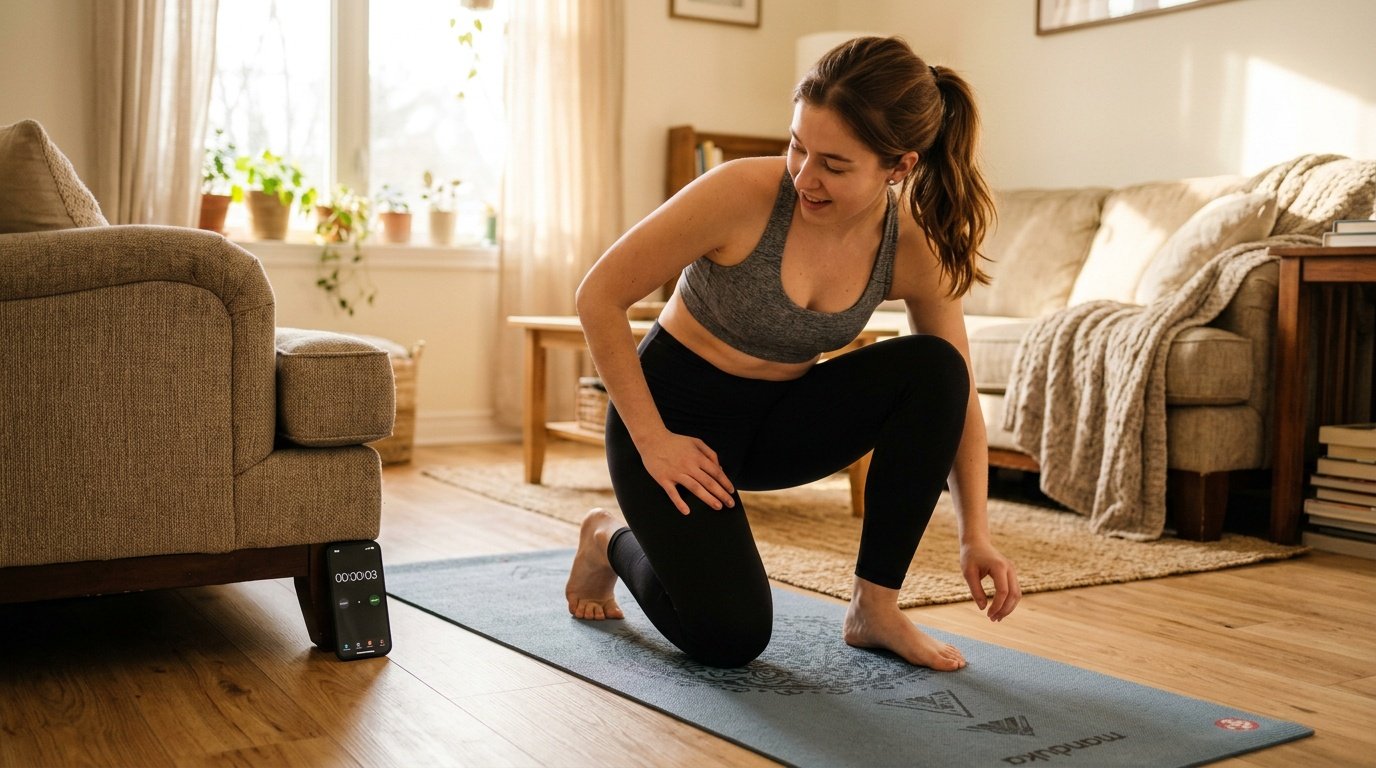
You've got ten minutes before the day takes over. That's the entire premise behind this at home workout for abs: no gym, no equipment, no thirty-minute block you keep promising yourself and never finding. Just seven moves, done on a patch of living room floor, built around a question worth answering honestly before you start: does a workout this short actually do anything, or is it just a way to feel productive for ten minutes?
Short answer: it strengthens your core, and that matters for posture, back health, and how every other exercise you do performs. What it won't do, no matter how consistently you show up, is single-handedly reveal a visible six-pack. That's not a marketing caveat. It's how fat loss actually works in the body, and understanding it up front will save you from quitting in week four when the mirror doesn't match the effort.
This guide walks through the exact routine, what each move is doing to your core muscles, how to scale it to your current fitness level, and the realistic four-week arc that gets you from "I did one round and I'm sore" to "this is just part of my morning now."
Why This At Home Workout For Abs Works In Just 10 Minutes
Most people assume a short workout is a compromise, something you settle for when the real routine doesn't fit. For core training specifically, that assumption is backwards. Unlike large muscle groups such as your legs or back, core muscles recover fast and respond well to frequent, brief sessions rather than occasional long ones. A Harvard Health Publishing overview of core training notes that core work can improve posture, ease everyday movements like bending and twisting, and reduce low back pain, all without requiring long sessions to deliver those benefits.
I know what you're thinking: if ten minutes worked, wouldn't everyone already be doing it instead of the endless "1000 crunches a day" videos? The honest answer is that most of those longer routines aren't more effective, they're just less efficient. Piling on more repetitions of the same movement pattern hits diminishing returns fast. What actually builds a stronger core is variety across the muscle groups that make up your midsection, done with intent, not volume for its own sake.
The other reason ten minutes works: it's the length of workout you'll actually finish. A core routine you skip because it feels too long produces zero adaptation. A core routine you complete four or five mornings a week, even a short one, compounds. Consistency is doing more of the heavy lifting here than intensity ever could.
The 10-Minute At Home Workout For Abs: Every Move Explained
Seven moves, 40 seconds of work, 15 seconds of rest, two full rounds. That's the entire structure, and it lands right around ten minutes including a brief warm-up. No equipment beyond a mat or a folded towel for comfort.
Move 1: Dead Bug
Lie on your back, arms reaching toward the ceiling, knees bent at 90 degrees above your hips. Slowly lower your right arm and left leg toward the floor without letting your lower back arch off the mat, then return to start and switch sides. This is your warm-up move and the one to fall back on if anything later feels too intense.
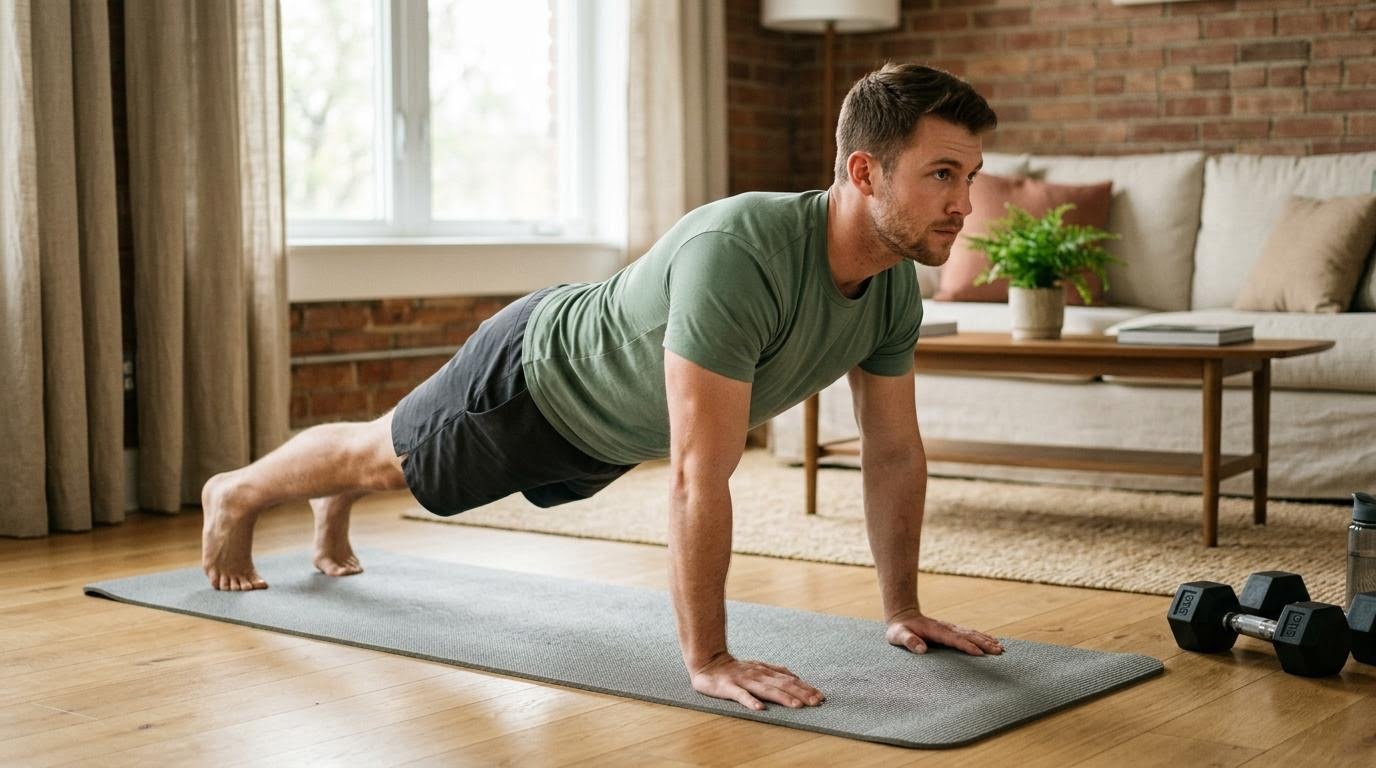
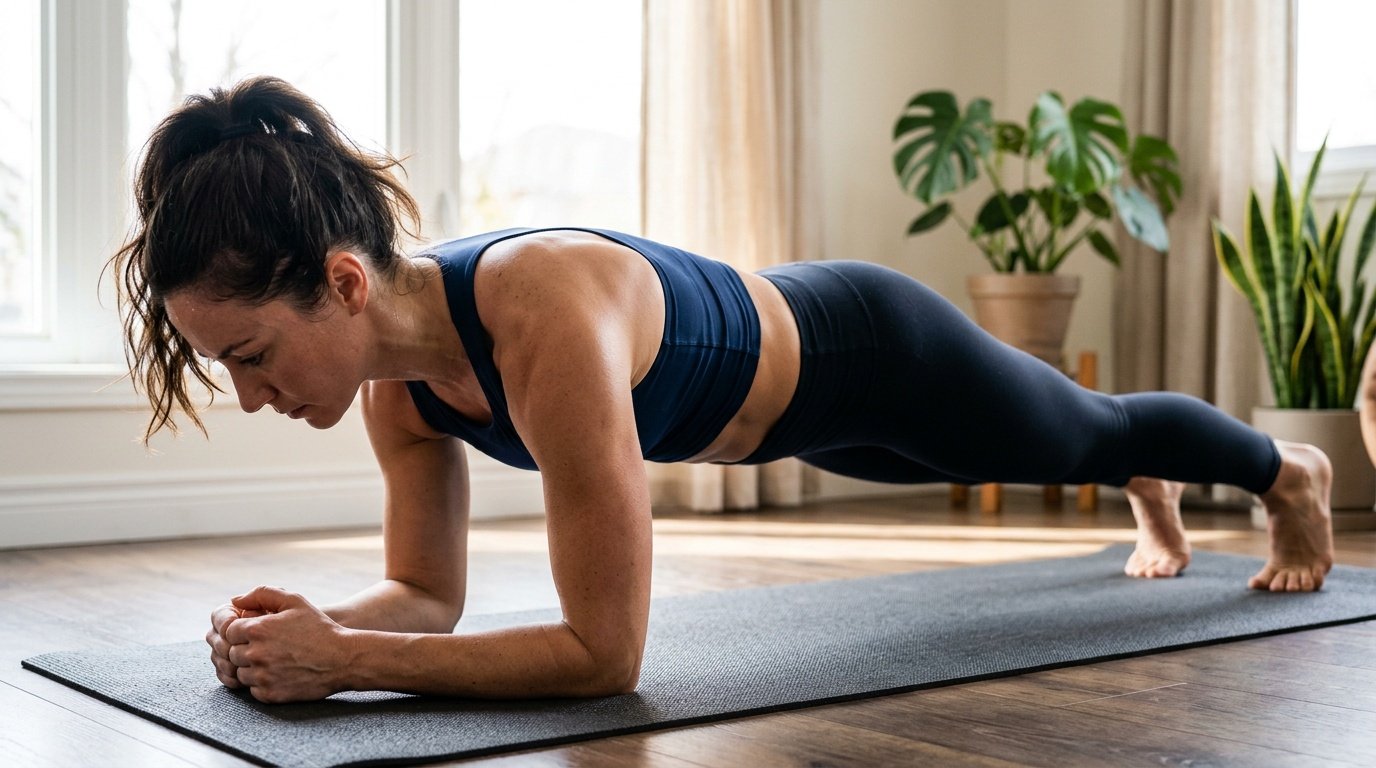
Move 2: Forearm Plank
Elbows under shoulders, body in a straight line from head to heels, core braced like someone's about to poke your stomach. Hold. If a full plank is too much on day one, drop to your knees and hold from there, the muscle engagement is nearly identical.
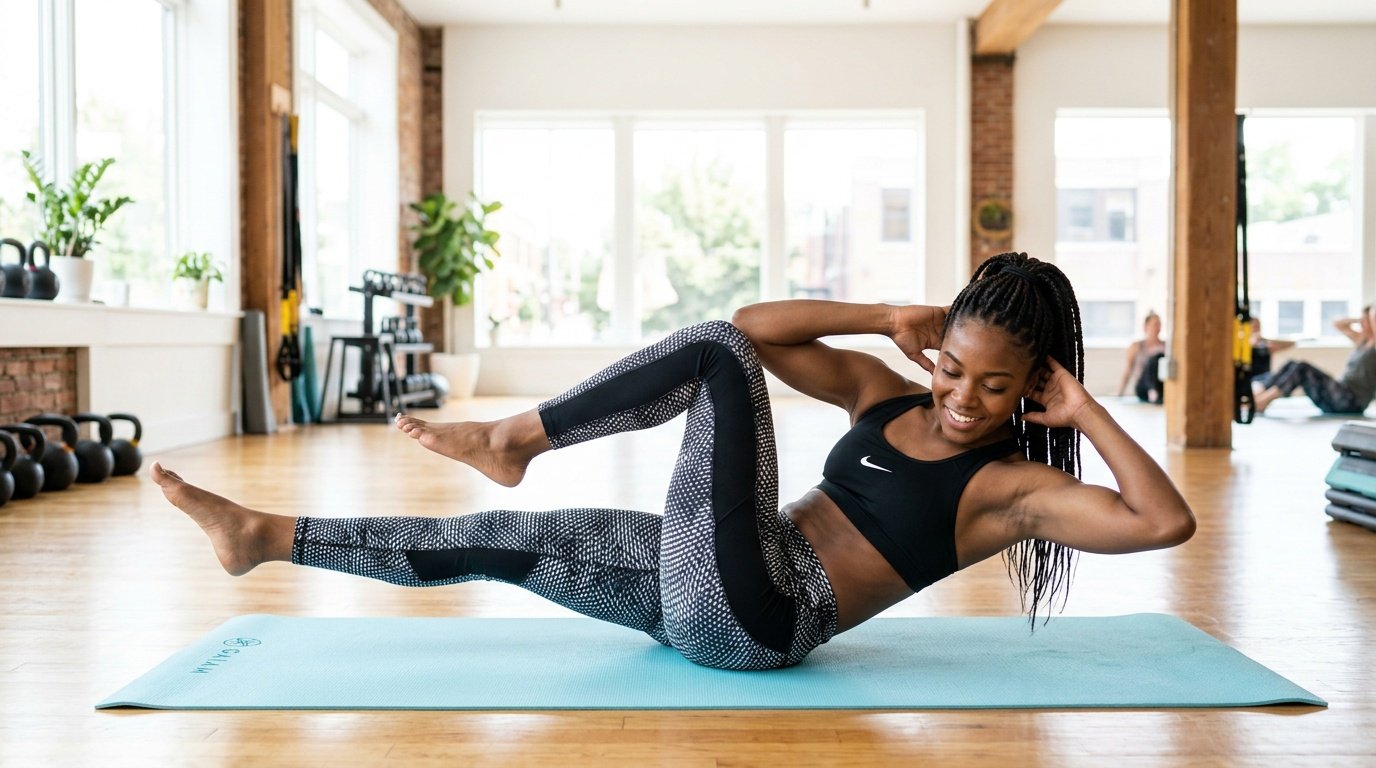
Move 3: Bicycle Crunch
Hands lightly behind your head, knees bent above your hips. Rotate to bring your right elbow toward your left knee while extending your right leg, then switch sides in a slow, controlled pedaling motion. Speed isn't the goal here, control is.
Move 4: Side Plank (Each Side)
Stack your feet, prop up on one forearm, lift your hips until your body forms a straight line. This targets your obliques, the muscles most home ab routines skip entirely because they only do front-facing moves.
Move 5: Reverse Crunch
Lying on your back, knees bent, use your lower abs to curl your hips slightly off the floor, bringing your knees toward your chest, then lower with control. Keep the movement small. A big, momentum-driven swing takes the work away from your abs and puts it into your hip flexors instead.
Move 6: Mountain Climbers
From a high plank position, drive your knees toward your chest one at a time at a controlled pace, faster if your fitness level allows it. This is the one move in the set that also nudges your heart rate up, giving you a small cardio component inside a strength-focused circuit.
Move 7: Hollow Body Hold
Lie on your back, press your lower back into the floor, and lift your shoulders and legs a few inches off the ground, arms reaching overhead. This is the hardest move in the set and the one most people need to scale first, more on that below.
Run through all seven, rest 15 seconds between moves, repeat the full circuit once more, and you're done. If your gym floor timer app supports intervals, set it and forget it. If not, a phone stopwatch and a bit of counting works fine.
What Your Abs Are Actually Doing During Each Move
Your midsection isn't one muscle, it's four working together: the rectus abdominis (the "six-pack" muscle running down the front), the internal and external obliques (the sides, responsible for rotation), and the transversus abdominis (the deep, corset-like muscle that stabilizes your spine before you even move). Most people only train the first one and wonder why their core still feels weak under load.
Dead bugs and hollow body holds hit the transversus abdominis hardest, since both demand that your lower back stay pressed to the floor while your limbs move independently, exactly the stabilizing job that muscle exists to do. Bicycle crunches and side planks work the obliques through rotation and lateral stability. Reverse crunches isolate the lower portion of the rectus abdominis, a region that's notoriously harder to engage with standard crunches alone. Mayo Clinic's guidance on core-strength exercises recommends focusing on the transversus abdominis specifically, the deep muscle you feel contract when you cough, because it's the one most beginner routines miss entirely.
This matters beyond aesthetics. A core that can only do front-loaded crunches has a real gap: it can't stabilize you during a twisting motion, an uneven step, or picking something up off the floor at an angle, all things your midsection handles constantly outside a workout. Training all four muscle groups, not just the visible one, is what makes a core actually functional rather than just photogenic.
How To Scale This Workout To Your Fitness Level And Any Joint Concerns
Nobody's first attempt should look like their fifteenth. Here's exactly how to adjust without skipping a move entirely.
If Your Lower Back Talks To You
Drop the hollow body hold and reverse crunch to a much smaller range of motion, or replace them with an extra round of dead bugs, which train the same stabilizing muscles with far less spinal load. Any sharp or shooting pain, as opposed to normal muscle fatigue, is a stop signal, not a push-through signal.
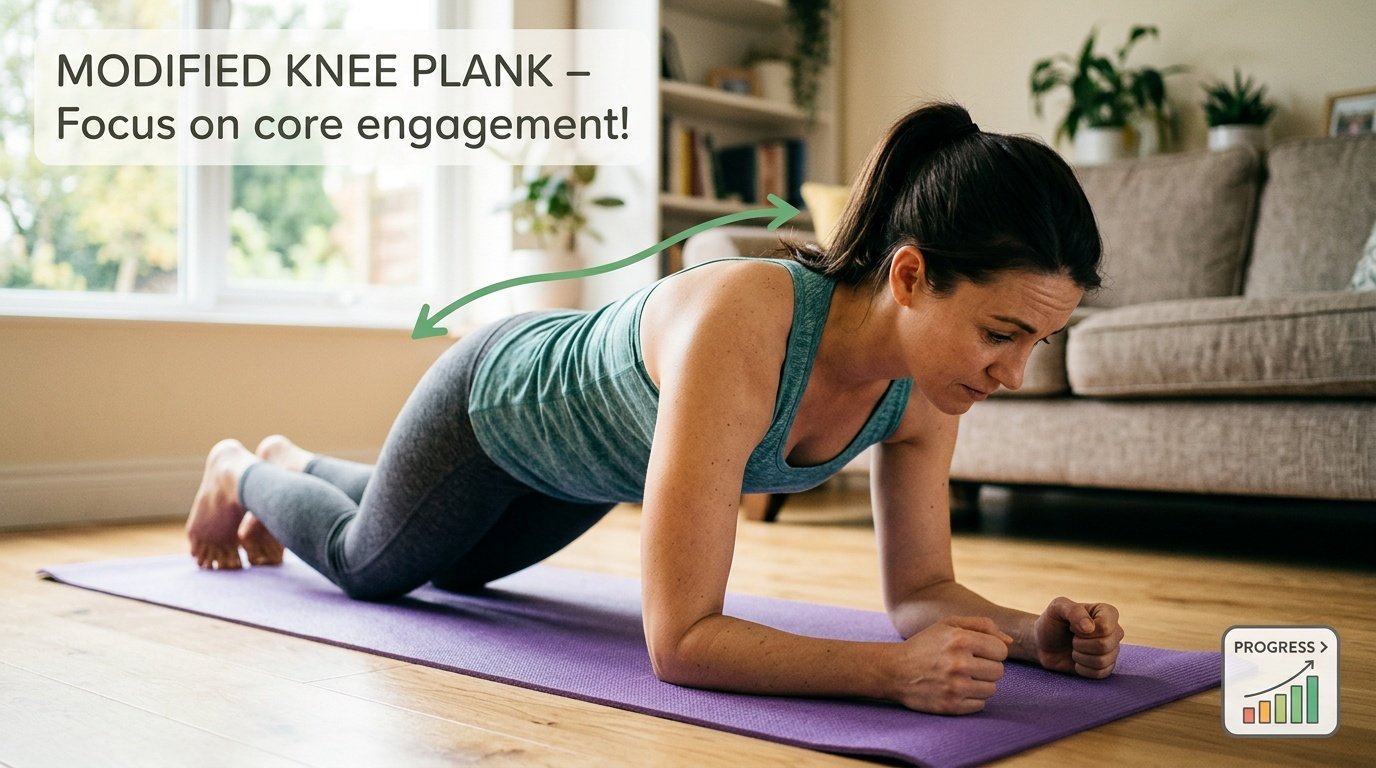
If Full Planks Feel Impossible Right Now
Drop to your knees for both the forearm plank and mountain climbers. The muscle activation barely changes; what changes is the amount of body weight your core has to stabilize, which is exactly the variable you want to reduce while you build capacity.
If You're Starting From Very Little Core Training At All
Do one round instead of two for your first week. Five minutes of clean, controlled movement beats ten minutes where your form falls apart by move five and you end up training bad habits instead of your abs.
If You Have A Diagnosed Back Condition, Are Pregnant, Or Recently Had Abdominal Surgery
Get individual clearance before starting any new core routine. This guide is general fitness information, not a substitute for guidance specific to your situation.
Health disclaimer: This routine is intended for generally healthy adults. If you're pregnant, recovering from an abdominal or back surgery, managing a diagnosed spinal condition, or haven't exercised in an extended period, talk with a doctor before starting this or any new exercise program. Stop immediately and seek medical attention if you feel sharp pain, dizziness, or chest discomfort during exercise.
Why You Won't See Your Abs From This Workout Alone (And What Actually Will)
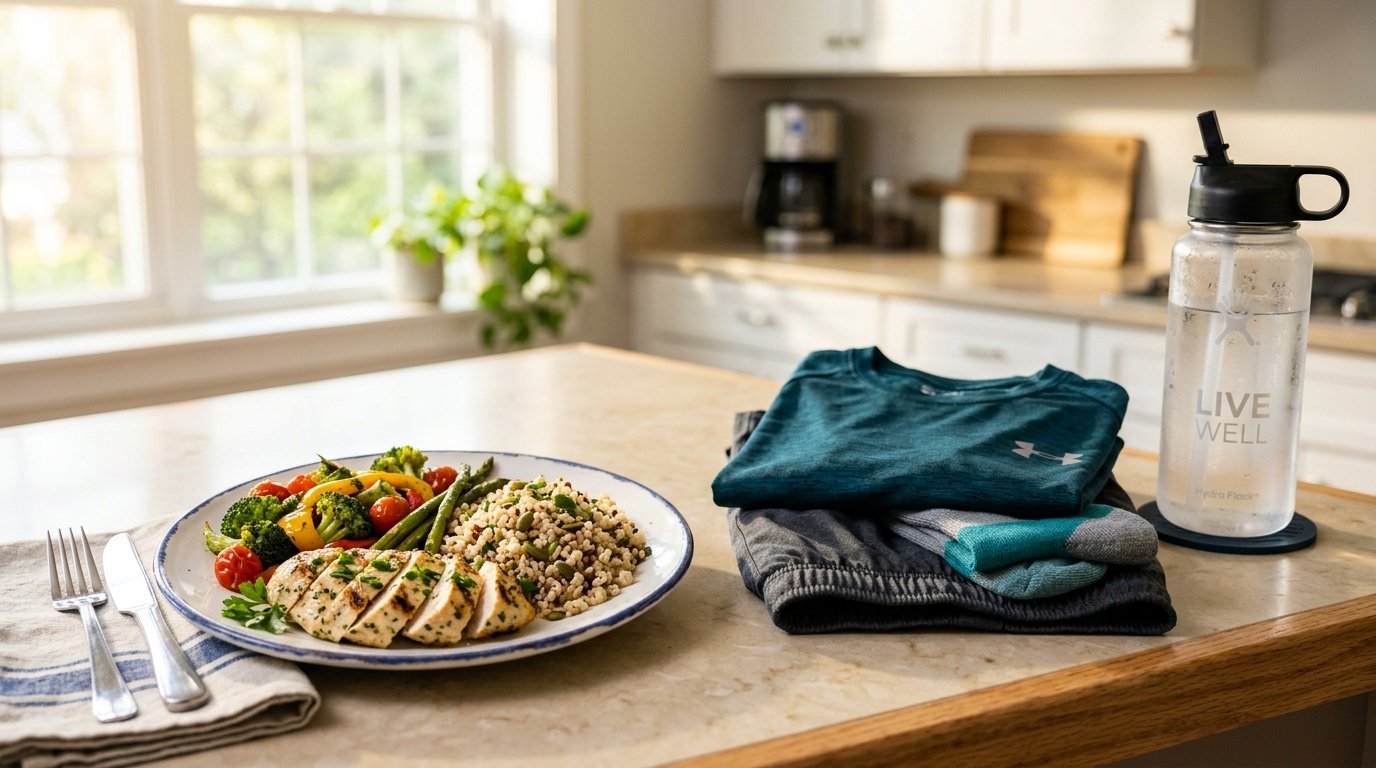
This is the part most ab-workout content skips, because it's less exciting than promising results. Doing crunches at a specific body part does not preferentially burn the fat sitting over that muscle, a concept researchers call spot reduction, and it has been tested directly. A study published in Medicine and Science in Sports and Exercise and archived on PubMed Central found that higher-intensity aerobic training reduced abdominal fat significantly in obese women over 16 weeks, while low-intensity training at the same total calorie burn did not, and neither intervention involved a single ab-specific exercise. The muscle work and the fat loss are two separate systems that don't talk to each other the way marketing implies.
Here's the practical version: this workout at home workout for abs routine builds the muscle. Visible definition on top of that muscle depends on your overall body fat percentage, which is driven by total calorie balance across your whole diet and activity level, not by which specific muscle you're training that day. Two people with an identical, strong core can look completely different at the waistline depending on their body fat percentage alone.
That's not a discouraging finding, it's a liberating one. It means you don't need to chase increasingly extreme ab routines hoping for a shortcut that doesn't exist. A strong, well-trained core plus a sustainable approach to overall nutrition and activity gets you further than any "advanced" ab circuit ever will on its own.
A Non-Obvious Insight: Planks Beat Crunches For Injury Risk, Not Just Results
Many trainers and physical therapists now favor planks over traditional crunches, not primarily because planks are more effective, but because repeated spinal flexion under load, the exact motion of a crunch, carries more cumulative strain on the lower back over time. Cleveland Clinic's overview of plank exercise benefits notes that planks strengthen the core while putting far less stress through the spine, which is part of why this routine leans on plank variations rather than building around endless crunch repetitions.
Your Realistic 4-Week Ab Workout Progression
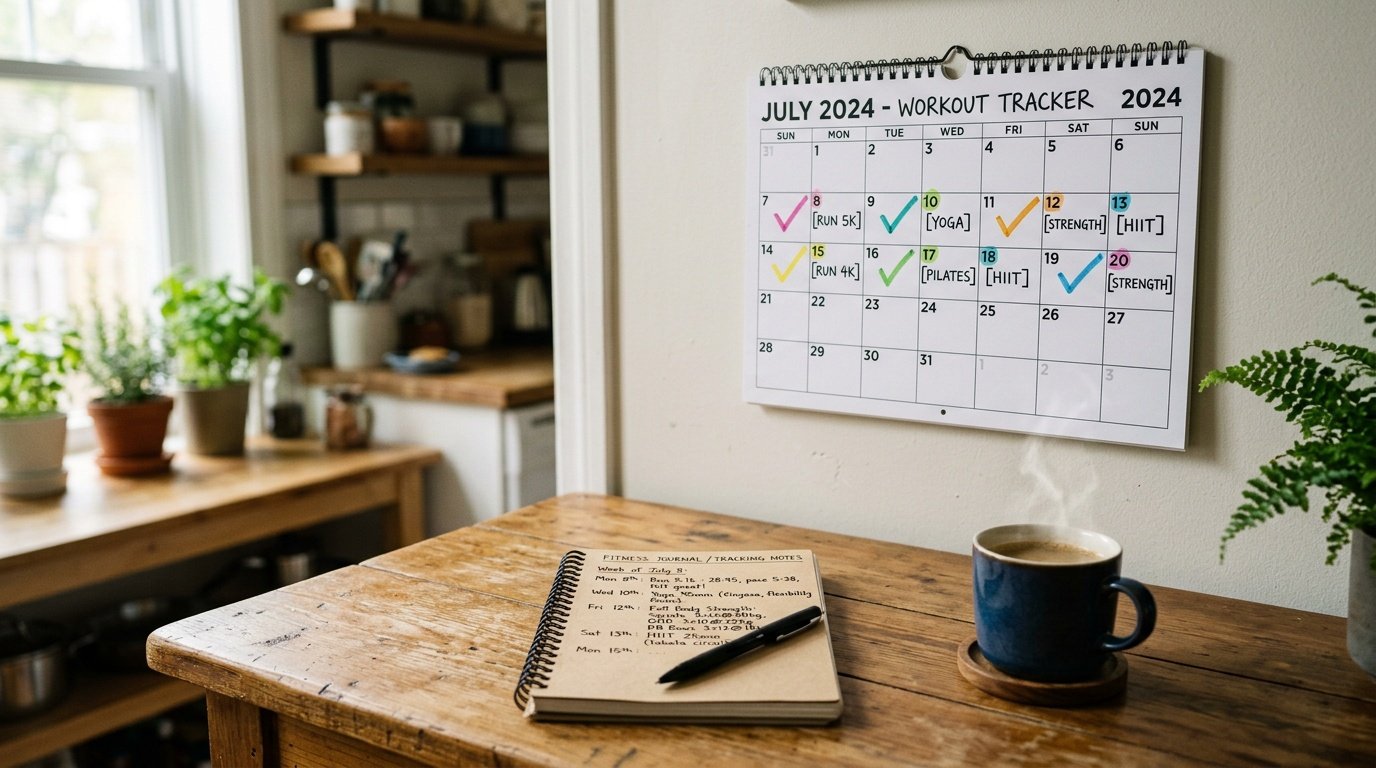
Consistency beats intensity for the first month, every time. Here's a buildup that won't leave you sidelined by week two. The CDC's Physical Activity Guidelines for Adults recommend muscle-strengthening activity on two or more days a week covering all major muscle groups, and this progression is built to comfortably clear that bar while staying realistic for someone starting from zero core training.
| Goal | Guideline | What This Looks Like |
|---|---|---|
| Build core strength | Muscle-strengthening activity on 2 or more days a week, all major muscle groups | This circuit, 3 to 5 mornings a week |
| Support fat loss for visible definition | 150 minutes a week of moderate-intensity aerobic activity | Brisk walking, cycling, or a home cardio session on non-ab days |
| Recover without losing momentum | Core muscles recover faster than large muscle groups and can generally train more frequently | Daily light core work is fine if intensity stays moderate |
Source: Centers for Disease Control and Prevention, Physical Activity Guidelines for Adults, 2025
Weeks 1 to 2
One round of the circuit, five days a week, roughly five minutes a session. Your goal isn't fitness gains yet, it's building the habit and learning correct form on every move before you add volume.
Weeks 3 to 4
Move to the full two rounds, still five days a week. Most people notice the hollow body hold and forearm plank feel noticeably more stable by the start of week four, that's your marker of real progress, not the mirror.
Signs You're Ready To Progress Further
You finish both rounds with clean form and feel like you could do a partial third. Your plank hold time has increased without your hips sagging. Everyday movements, carrying groceries, twisting to grab something in the back seat, feel noticeably more stable. Any of these means it's time to add resistance (a light dumbbell held during dead bugs, for instance) or extend hold times, not before.
The Mistakes That Quietly Stall Most People's Ab Training
A handful of patterns show up constantly in people who start strong and then plateau or quit within a month.
Chasing rep count instead of form. Once your lower back arches during a reverse crunch or your hips sag during a plank, the exercise stops training your abs and starts training compensation patterns instead. A shorter set with clean form beats a longer one with sloppy movement, every time.
Training abs every single day at full intensity with no easier days mixed in. Core muscles do recover faster than legs or back, but "faster" doesn't mean "instantly." Alternate a harder session with a lighter one, especially in your first month.
Expecting the scale or the mirror to move before the strength does. Strength gains in a new routine typically show up in the first two to three weeks, well before any visible change. If you're judging success only by appearance, you'll quit right before the part that actually mattered started working.
Ignoring the rest of your body. A strong core that sits on top of weak hips, glutes, or back muscles is still a fragile system. If you have room in your week, pairing this with a simple full-body strength routine for beginners builds a foundation this ab circuit alone can't provide.
Skipping the diet conversation entirely. Not because diet needs to be extreme, but because expecting a ten-minute ab workout to override an overall calorie surplus sets you up for disappointment that has nothing to do with whether the exercises themselves are working.
If you're newer to structured exercise altogether and want a broader starting point before narrowing in on core work specifically, setting a clear fitness target before you begin makes every routine after this one, including this one, easier to stick with. And if your schedule allows for a short cardio block on the mornings you skip this circuit, this 15-minute no-equipment cardio routine pairs naturally with the core work here without requiring a gym membership either.
Want a walkthrough of quick, no-equipment moves you can slot into a busy morning? This short segment covers exactly that kind of time-efficient exercise thinking.
Ten minutes, seven moves, zero equipment, and a four-week plan that doesn't demand you become a different person by day three. That's the whole system behind this at home workout for abs: the strength part is entirely within reach starting today. Whether you see it in the mirror depends on more than any single workout, ab-focused or otherwise, and now you know exactly what that "more" actually involves.
Frequently Asked Questions
Does a 10-minute at home workout for abs actually work?
Yes, for building core strength and muscular endurance. Ten minutes of focused, varied core work done consistently three to five times a week measurably strengthens the muscles of your midsection. What it won't do on its own is guarantee visible ab definition, since that depends on your overall body fat percentage as well.
How often should I do this ab workout to see results?
Three to five sessions a week is the sustainable range for most people. Core muscles recover faster than larger muscle groups like your legs, so near-daily light sessions are generally fine, but alternating a harder session with an easier one in your first month reduces the risk of overtraining and helps you stay consistent long-term.
Can I get visible abs from bodyweight ab exercises alone?
Bodyweight exercises build the muscle underneath, but visible definition depends on how much fat sits over that muscle, which is controlled by your total calorie balance and overall activity level, not by targeting the abs specifically. Combining this routine with regular aerobic activity and a sustainable eating pattern is what actually reveals the muscle you're building.
Do I need any equipment for an at home workout for abs?
No. Every move in this routine uses only your bodyweight and a small patch of floor. A mat or folded towel adds comfort for exercises done lying down, but isn't required to do the workout correctly.
Is it safe to do ab exercises every day?
For most healthy adults, light to moderate core work most days of the week is safe, since these muscles recover relatively quickly. That said, alternating intensity, and stopping immediately if you feel sharp pain rather than normal muscle fatigue, keeps the routine sustainable rather than something that leads to burnout or strain.
How long until I notice results from a daily core routine?
Strength and stability improvements are usually noticeable within two to three weeks, often before anything changes visibly. Give a consistent routine a full four to six weeks before judging whether it's working, and remember that visible definition is a separate, slower-moving variable tied to overall body composition.
References
- Centers for Disease Control and Prevention — Physical Activity Guidelines for Adults, 2025
- Harvard Health Publishing — How to Add Core Exercises to Your Workout Routine, 2023
- Mayo Clinic — Exercises to Improve Your Core Strength
- Irving BA, et al. — Effect of Exercise Training Intensity on Abdominal Visceral Fat and Body Composition, Medicine and Science in Sports and Exercise, 2008
- Cleveland Clinic — Plank Exercises: What They Do For Your Body, 2021