


You've probably had this exact thought at 11 p.m., staring at the ceiling: maybe I just need to talk to someone. And you'd be right, partially. Stress management psychotherapy — sitting down with a trained therapist to work through what's driving your stress response, not just white-knuckle through it — is one of the most evidence-backed tools available for chronic stress. But "one of the most effective tools" and "the only thing you need" are two very different claims, and conflating them is where a lot of people get stuck, spending months in weekly sessions while the physical toll of their stress (the tension headaches, the disrupted sleep, the shortened fuse) barely budges.
This isn't an argument against therapy. It's a more honest map of what it does well, what it structurally can't do on its own, and how to build the rest of the picture around it so you're not waiting on one intervention to fix a problem that usually has several moving parts.

What Stress Management Psychotherapy Actually Treats (and What It Doesn't)
Psychotherapy for stress is genuinely good at one specific job: changing how you interpret and respond to stressors, not eliminating the stressors themselves. A therapist trained in cognitive behavioral therapy will help you catch the automatic thought ("I'm going to get fired if I miss this deadline") before it snowballs into a full physiological stress cascade. That's real, measurable work. Mayo Clinic notes that CBT is structured around a limited number of sessions and focuses specifically on the relationship between thoughts, feelings, and behavior, which is exactly the loop that keeps chronic stress running on autopilot long after the original trigger has passed.
What it doesn't do, at least not directly, is change your workload, your commute, your caregiving responsibilities, or your bank balance. A therapist can help you carry those things differently. They generally can't remove them. That distinction matters because a lot of people walk into their first session expecting the stress itself to disappear, and when it doesn't, they assume therapy "isn't working" rather than recognizing they've hit the edge of what talk therapy alone was ever designed to do.
Here's the non-obvious part: the type of psychotherapy matters more than the fact that you're "doing therapy" in some general sense. CBT, psychodynamic therapy, and mindfulness-based approaches all fall under the same broad umbrella, but they target stress differently, and matching the approach to your specific stress pattern (racing thoughts versus physical tension versus avoidance behavior) changes how fast you'll notice results.
| Therapy approach | What it primarily targets | Typical structure |
|---|---|---|
| Cognitive Behavioral Therapy (CBT) | Distorted or catastrophic thought patterns | Structured, limited number of sessions, often includes homework |
| Mindfulness-Based Stress Reduction | Physical tension and reactivity in the moment | Group or individual, includes guided practice between sessions |
| Psychodynamic Therapy | Underlying patterns from past experience driving current stress | Open-ended, longer-term |
Source: National Institute of Mental Health, psychotherapy overview

How Talk Therapy Rewires Your Stress Response, Not Just Your Mood
Chronic stress isn't just a feeling. It's a physiological state. When your brain perceives a threat, real or not, it triggers the sympathetic nervous system, and your body prepares to fight or flee: heart rate up, breathing shallow, digestion paused. Harvard Health explains that when this response gets activated repeatedly over time, the effects compound, contributing to elevated blood pressure, arterial changes, and brain-level shifts linked to anxiety and depression. That's the part people underestimate. Chronic stress isn't just unpleasant, it's cumulative in a way that shows up in your bloodwork eventually.
This is where psychotherapy earns its place. It's not addressing your blood pressure directly, but it's addressing the upstream trigger: how often your nervous system gets pulled into that fight-or-flight state in the first place, and how long it takes to come back down once it's there. A therapist working on stress management will typically help you build what's sometimes called "distress tolerance," the capacity to notice a stress response starting and interrupt it before it fully hijacks your afternoon. Over 8 to 12 weeks, most people report the interruption happening faster and with less effort. That's not the stressor disappearing. That's your nervous system getting better practiced at coming back down.
I know what you're thinking: if it's just practice, can't I do that myself with an app? Sometimes, yes, for mild and situational stress. But a licensed therapist brings something an app structurally can't: real-time feedback on the specific thought patterns and behaviors that are unique to you, plus accountability that most self-directed tools lose within a few weeks. Neither replaces the other cleanly.
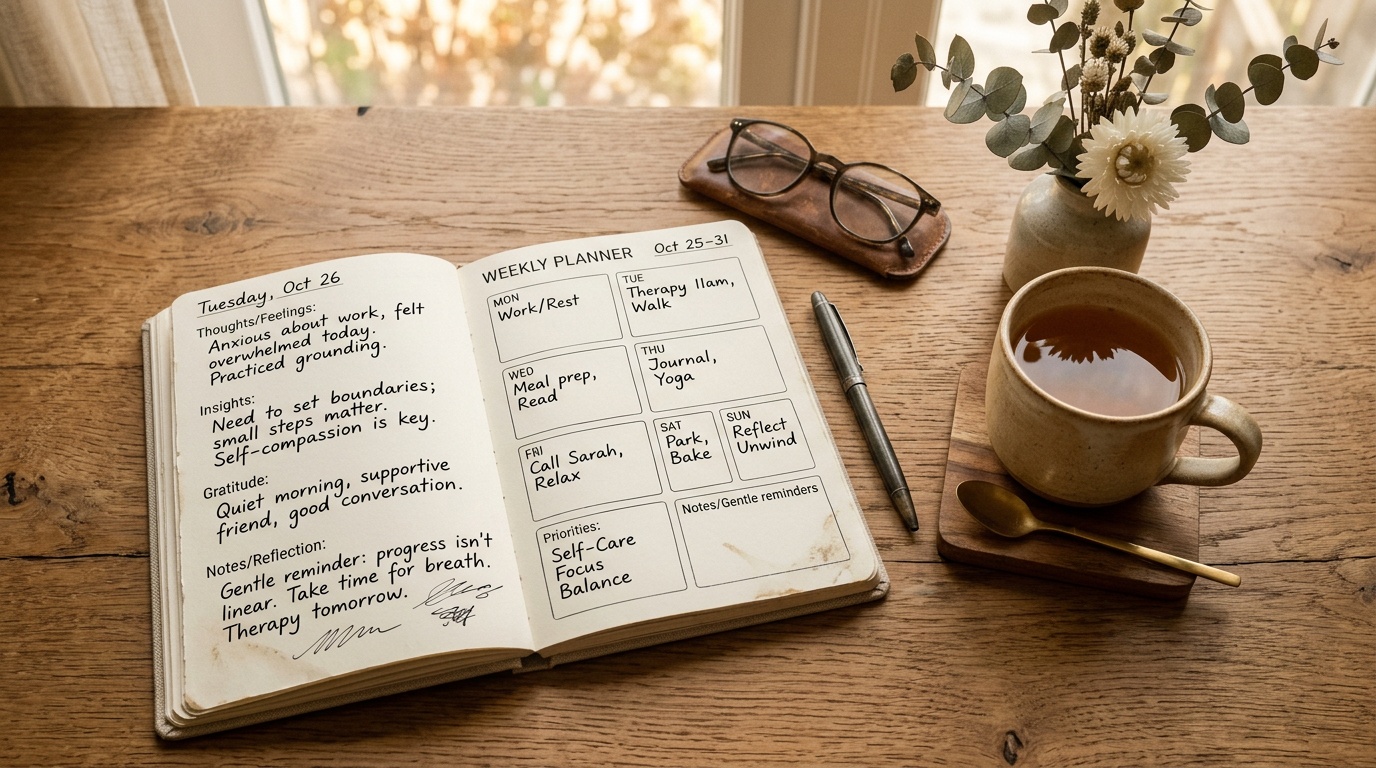
What a Typical Course of Stress Management Psychotherapy Looks Like
Most people picture therapy as an open-ended, indefinite thing. For stress-focused psychotherapy specifically, it's usually more bounded than that. A first session is almost entirely assessment: what's driving the stress, how long it's been going on, and whether there are other conditions (anxiety, depression, a sleep disorder) tangled up with it. From there, a CBT-oriented course often runs somewhere in the range of 8 to 20 sessions, with early sessions focused on identifying thought patterns and later sessions focused on practicing new responses in lower-stakes situations before applying them to the actual stressor.
The middle stretch, roughly weeks four through eight, is where most people either commit or quietly drop off. This is the point where the novelty has worn off, the "homework" between sessions (thought logs, breathing practice, scheduled worry time) starts to feel like one more obligation, and the stress hasn't fully resolved yet. It's also, according to the pattern most therapists describe anecdotally, the exact point where skipping sessions does the most damage to progress, because the skills haven't yet become automatic. If you're going to commit to this path, plan for that middle stretch to feel like the least rewarding part, because it usually is, right before it isn't.
By the later sessions, the work typically shifts from "managing a crisis" to "maintaining a new baseline," which includes talking through what happens after formal sessions end and how to catch a relapse into old stress patterns early.
Health disclaimer: This article discusses psychotherapy as a general approach and isn't a substitute for individualized care. If your stress is affecting your ability to function day to day, involves thoughts of self-harm, or coexists with another diagnosed condition, talk to a licensed mental health professional or your doctor before choosing or changing any treatment approach.

Where Psychotherapy Alone Runs Into Its Limits
This is the part most articles on this topic skip, and it's the part that actually answers the question in the title. Psychotherapy is a skills-and-insight intervention. It's excellent at changing your relationship to a stressor. It is not, on its own, a lifestyle intervention, a sleep intervention, or a physical-health intervention, and chronic stress touches all three.
Cleveland Clinic points out that stress management genuinely requires combining approaches like mindfulness, meditation, exercise, and relaxation techniques alongside professional support, specifically because stress affects the body as much as the mind. If you're sleeping five hours a night, skipping meals, or not moving your body at all, therapy will still help you think more clearly about your stressors, but it's working against a physiological deficit it wasn't designed to fix. This is the non-obvious insight worth sitting with: two people can attend the exact same number of CBT sessions with the same therapist and get very different results, and the difference often isn't the therapy itself, it's whether the rest of their daily structure was supporting or undermining the work happening in the room.
There's also a practical limit that rarely gets said out loud: access. Weekly sessions cost money and time that not everyone has consistently, and a stress-management plan that only works when you can afford 50 minutes a week and a copay isn't a complete plan for most people's actual lives.

Building the Rest of the Toolkit: What to Pair With Therapy
None of this means therapy is optional or interchangeable with anything else. It means it works better as one piece of a small, deliberate system rather than the entire system. The CDC's guidance on managing stress lists physical activity, consistent sleep, limiting alcohol, and staying connected to people who support you as concrete daily actions that reduce the baseline load your nervous system is carrying, separate from and alongside any formal treatment.
A few pairings that consistently make talk therapy more effective, not less necessary:
- Movement, even briefly. You don't need a structured workout plan. Twenty to thirty minutes of walking most days measurably lowers stress hormone activity and gives your body somewhere to put the physical charge that a stress response generates.
- A consistent sleep window. Going to bed and waking at roughly the same time does more for next-day stress resilience than most people expect, and it's one of the few levers you fully control.
- One person outside your therapist you can be honest with. Isolation amplifies stress. A therapist is one relationship; it isn't meant to be your only one.
- A specific, named coping skill for the moment stress spikes, not a vague intention to "handle it better." Box breathing, a five-minute walk, or a grounding technique your therapist taught you, used consistently, closes the gap between session-room insight and Tuesday-afternoon reality.
If burnout, sleep, or physical activity are the piece you're missing right now, our guide on simple stress management activities and our breakdown of stress reduction skills for social anxiety both go deeper into the specific techniques worth stacking alongside formal treatment.

Signs Your Stress Needs More Support Than You're Currently Getting
It's worth being direct about when "I should probably try therapy" needs to become "I need to actually book the appointment this week." If stress is interrupting sleep most nights, showing up as physical symptoms like chest tightness or stomach issues, making you snap at people you care about more than occasionally, or pushing you toward drinking, scrolling, or eating as the primary way you get through a day, that's past the point where self-management alone is likely to be enough. None of that means something is wrong with you. It means the load has outpaced your current coping capacity, which is exactly the situation psychotherapy is built to address.
The same applies in reverse. If you've been in stress management psychotherapy for several months and nothing has shifted at all, that's information too, not a sign to quit trying, but a sign to revisit the approach with your therapist, check whether an underlying condition like an anxiety disorder is going untreated, or add the daily-structure pieces above that might be working against the sessions.
Building a broader set of everyday mental health practices around your formal treatment, rather than treating one weekly session as the whole plan, is consistently what separates people who feel meaningfully better in three months from people who feel roughly the same.
So, is stress management psychotherapy all the relief you need? For a real subset of people, especially those whose stress is driven mostly by thought patterns and reactivity, it can get most of the way there on its own. For most people carrying chronic stress, it's the most important single piece, but it works best stacked with the sleep, movement, and connection pieces that no session alone can supply. Start with a licensed therapist if you haven't. Then build outward from there.
A Cleveland Clinic physician discusses how reducing stress translates into measurable health improvements.
Frequently Asked Questions
What's the difference between stress management and psychotherapy for stress?
Stress management is the broad category: any technique, from breathing exercises to exercise to sleep habits, that lowers your stress load. Psychotherapy for stress is one specific tool within that category, delivered by a licensed professional, that focuses specifically on the thought patterns and behaviors keeping your stress response activated.
How many therapy sessions does it typically take to feel less stressed?
Many people begin noticing changes in how quickly they recover from a stress spike within 6 to 8 sessions of a structured approach like CBT, though a full course often runs 8 to 20 sessions depending on how long the stress pattern has been established and whether other conditions are involved.
Can I do stress management psychotherapy online?
Yes. Telehealth therapy for stress is widely available and research generally shows comparable outcomes to in-person sessions for many people, though someone managing a severe crisis or complex co-occurring condition may be better served by in-person care initially.
Does insurance cover stress management therapy?
Many insurance plans cover psychotherapy when it's billed under a diagnosable condition such as an anxiety disorder or adjustment disorder, though coverage for stress management specifically, without a formal diagnosis, varies by plan. Check your specific benefits before booking, and ask a prospective therapist whether they accept your insurance directly.
What if therapy doesn't seem to be working for my stress?
Give a specific approach 6 to 8 sessions before judging it, since early sessions are largely assessment. If there's still no shift after that, it's reasonable to talk to your therapist about switching techniques, or to check whether an untreated condition or an unsupportive daily routine is limiting progress before assuming therapy itself isn't the right tool.
References
- National Institute of Mental Health — Psychotherapies
- Mayo Clinic — Cognitive Behavioral Therapy
- Harvard Health Publishing — Understanding the Stress Response, 2024
- Cleveland Clinic — Stress Management: Meditation, Relaxation, Health Benefits
- Centers for Disease Control and Prevention — Managing Stress