

Type fat burning exercises belly into a search bar and the results lean heavily on crunches. The medical research says otherwise. Your body, not your workout, decides where fat comes off, so the fat burning exercises belly fat responds to are the ones that raise your total energy use and protect your muscle, not the ones that make your abs burn. This guide sorts the moves that work from the moves that only feel like they should, then turns them into a week you can actually repeat.

Fat burning exercises belly fat responds to work on your whole body, not just your abs
Picture two people on the same Monday. One does 100 crunches before bed and calls it a belly-fat workout. The other walks briskly for 30 minutes, then does three sets of squats and rows. After a month, the second person has trained far more muscle, burned far more energy, and given the body a far stronger signal to shrink its fat stores overall. The first person has a stronger core and, quite possibly, the same waistline.
That gap is not an opinion. Cleveland Clinic's answer to the question of whether sit-ups burn belly fat is a flat no: sit-ups strengthen the core muscles but do not remove the fat sitting over them. Mayo Clinic says the same thing in different words, noting that crunches can strengthen and tone the abdominal muscles but will not get rid of belly fat on their own, and that visceral fat responds to the same diet and exercise strategies that reduce fat everywhere else.
Why spot reduction keeps fooling people
Crunches make the targeted muscle work hard, and hard-working muscle burns. That sensation feels like proof that fat is melting from the same spot. It is not. Fat is released from storage into the bloodstream and used for fuel wherever the body decides, and that decision follows total energy demand, not the location of your sore muscles.
None of this makes core work useless. Cleveland Clinic points out that a strong core can ease back pain and improve balance and posture. If you enjoy ab training, keep it. A short, honest routine like this 10-minute at-home abs workout builds the muscle that sits under the fat. Just do not expect it to be the thing that changes your waist measurement.
Use your waist, not the mirror, as the scorecard
Belly fat is a health marker, not only an appearance one. Mayo Clinic's guidance for women treats a waist measurement over 35 inches (89 centimeters) as a sign of excess belly fat and added health risk, and it adds that risk rises as the measurement grows rather than switching on at one line. A tape measure at the level of your navel, read at the same time of day, tells you more than a mirror under bathroom lighting. Write the number down before you start and check it every two weeks.

Moderate and hard cardio burn about the same belly fat when calories match
Here is the part most workout lists get wrong: the intensity war is mostly a distraction. In a study covered by Harvard Health Publishing, researchers compared people with abdominal obesity doing moderate, longer exercise against shorter, harder exercise. When both groups burned the same number of calories, they lost about the same amount of belly fat. The study, published in Annals of Internal Medicine, did find one difference: only the higher-intensity workout improved the body's ability to handle blood sugar.
For you, that translates into a practical rule. Choose the cardio style you will keep doing, because total work matters more than how dramatic the session feels. If you enjoy a long walk, walk. If you prefer a fast 20-minute session, do that. Add some harder efforts if your joints, heart, and schedule allow, because the blood sugar benefit is real, but do not abandon a sustainable habit for an intense one you will drop by week three.
What interval training actually looks like
Interval training alternates harder efforts with easier recovery. Mayo Clinic notes there is some evidence that high-intensity interval training can help reduce belly fat, which makes it a reasonable tool, not a requirement. This short Mayo Clinic Minute video explains the interval training idea in plain language:
A common beginner format is a brisk three-minute walk followed by one minute of a much faster walk or an easy jog, repeated five times after a five-minute warm-up. You should be able to speak in short sentences during the hard minute, not gasp single words. If that feels easy after a few weeks, lengthen the hard segment before you add speed.
How hard is hard enough: the talk test
You do not need a heart rate monitor to judge intensity. Use the talk test. During moderate effort you can hold a conversation, though you would struggle to sing. During hard effort you can manage only a few words before you need a breath. If you cannot speak at all, you have gone too far for a beginner session, and your pace is more likely to end the workout early than to help it. Aim for the effort level you can repeat three times a week, not the one that wins a single heroic session.
The upper end, and who it is for
Cleveland Clinic's article on sit-ups suggests aiming for 45 to 60 minutes of high-intensity cardio, such as running, jumping rope, or power-walking, on most days of the week. That is an upper-end target for people who are already fit, not a starting line. If you are new to exercise, the national minimums below are the safer place to begin, and you can build from there over several weeks.
Strength training belongs on any list of fat burning exercises belly fat needs
Cardio gets the credit for burning fat, but resistance work protects the part of your body that keeps the burn going. Harvard Health explains that strength training maintains and may even increase muscle mass, which people tend to lose with age, and that more muscle lifts your metabolic rate so you use more calories even at rest. The same article describes a Harvard T.H. Chan School of Public Health study in which healthy men who did 20 minutes of daily weight training gained less abdominal fat over time than men who spent the same time on aerobic exercise.
That finding comes from men and describes the age-related drift of belly fat, so treat it as a strong hint rather than a guarantee for every body. Mayo Clinic's belly fat guidance for women points the same direction, listing strength training among the approaches with evidence behind them. Together, the sources make a simple case: if your plan is all cardio, you are leaving a proven tool unused.
Five moves that cover the whole body
You do not need a gym membership to train every major muscle group. These five moves work with bodyweight and one pair of dumbbells:
- Squat or goblet squat: legs and hips, the biggest muscles you own.
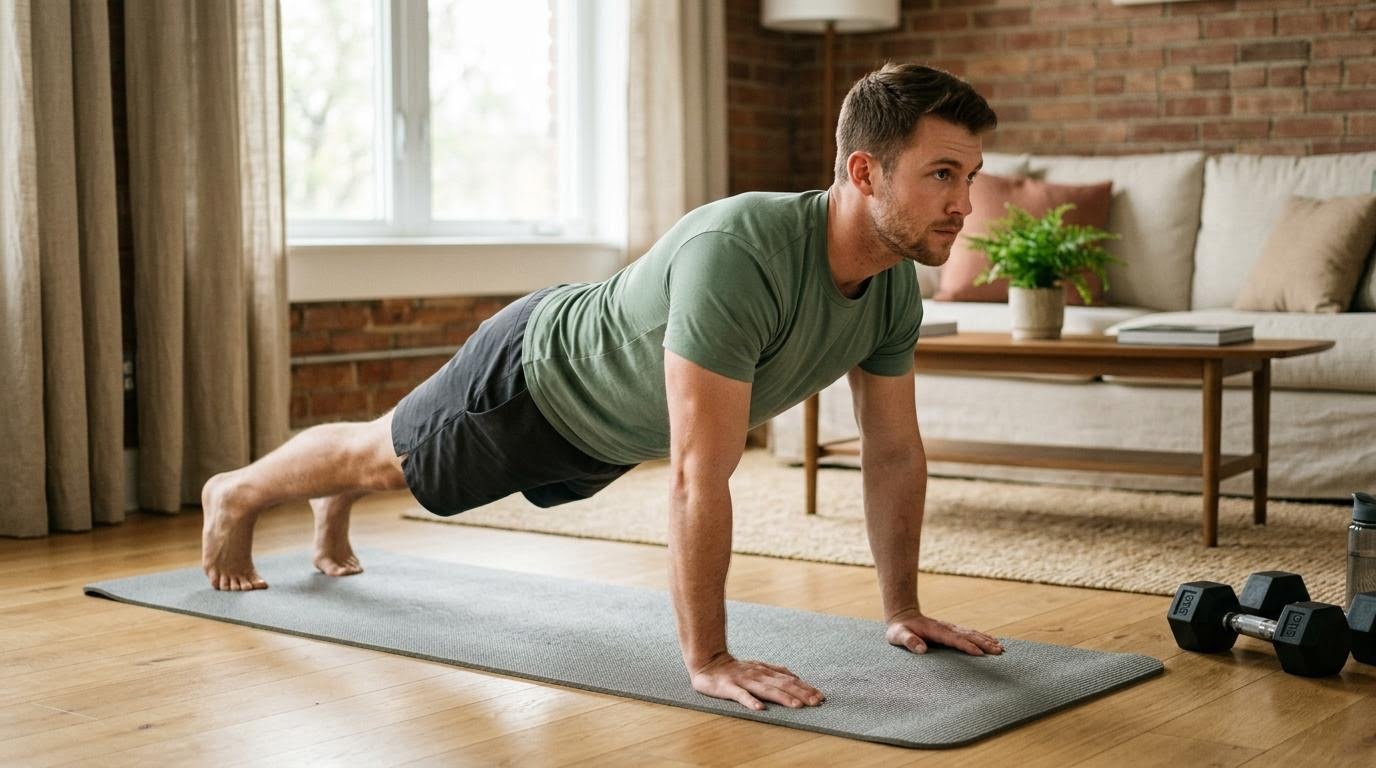
- Push-up (incline if needed): chest, shoulders, arms, and the core as a stabilizer.
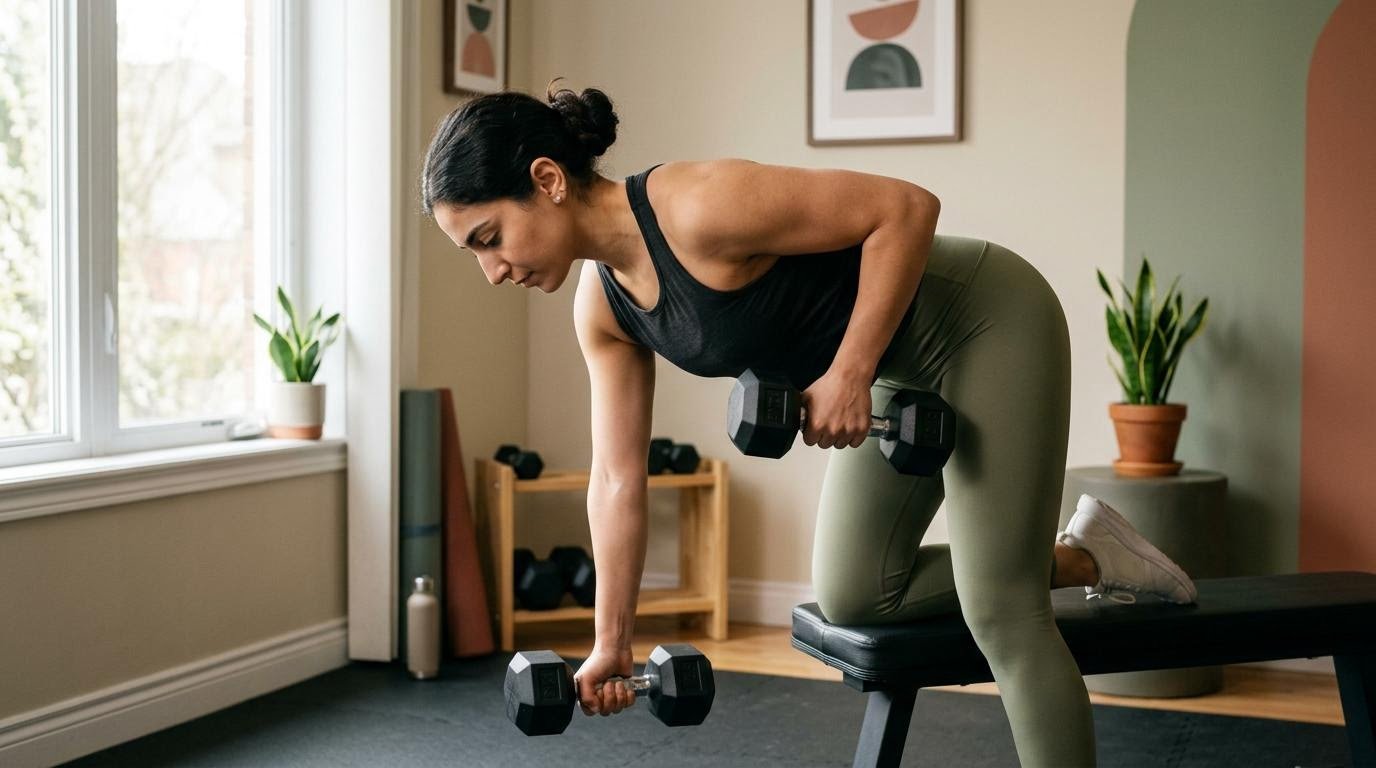
- Dumbbell bent-over row: upper back and arms, which balances all the pushing.
- Hip hinge or Romanian deadlift: hamstrings and glutes.
- Plank: trains the core to brace, which protects your back during every other lift.
Harvard Health suggests one or two sets of 8 to 12 repetitions per exercise. Choose a weight where the last two repetitions feel hard but your form stays clean. Rest a minute or two between sets, and leave a day between strength sessions so the muscle can recover.
How to progress without getting hurt
Keep the same weight until you can finish every repetition of every set with clean form, then make one small change at a time: add a repetition, add a set, slow the lowering phase, or step up to slightly heavier dumbbells. Changing everything at once makes soreness hard to read and injuries more likely. Sharp or joint pain is a signal to stop and swap the move for an easier version, not to push through. Ordinary muscle soreness that fades within a couple of days is expected, especially in the first two weeks.
A weekly plan built on the national minimums, not on motivation
Motivation is a poor foundation for a belly fat plan, because it fluctuates. Public health guidance gives you something sturdier. The CDC, in its adult activity overview last reviewed in December 2023, sets out the weekly baseline in the table below.
| Activity type | Weekly target for adults | How it can look |
|---|---|---|
| Moderate-intensity aerobic | 150 minutes | 30 minutes a day, 5 days a week |
| Vigorous-intensity aerobic (alternative) | 75 minutes | Shorter, harder sessions, or a mix of both types |
| Muscle-strengthening | At least 2 days | All major muscle groups: legs, hips, back, abdomen, chest, shoulders, arms |
Source: CDC, Adult Activity: An Overview, last reviewed 2023
The CDC also says that going beyond these amounts brings even more health benefits, and Mayo Clinic adds that people trying to lose weight may need to exercise more than the minimums. Treat the table as a floor you build on, not a ceiling.
A sample week you can adjust
- Monday: full-body strength session, 25 to 35 minutes.
- Tuesday: 30-minute brisk walk or easy cycle.
- Wednesday: rest, or a gentle 20-minute walk.
- Thursday: full-body strength session, using the same five moves with slightly heavier weight or one extra set.
- Friday: interval session, 20 minutes, using the walk-fast-walk pattern above.
- Saturday: a longer, easy activity you enjoy: a hike, a bike ride, a swim, a dance class.
- Sunday: rest, plus your waist measurement every second week.
If you have no equipment and 15 minutes, this 15-minute no-equipment cardio routine fills a cardio slot with lower-impact alternatives for sore knees. To see how aerobic work fits into the wider belly fat picture, read this guide to the aerobic exercise for belly fat, which explains why overall fat loss matters more than any single move.

Food, sleep, and alcohol decide how much of your effort shows at the waist
Exercise is the lever people overrate and underuse in the same breath. It protects your health, builds muscle, and widens the gap between what you eat and what you burn. It cannot cancel an eating pattern that keeps filling the tank faster than you drain it. The Harvard result above matters here: when calorie burn matched, belly fat loss matched, which means calories in and out are the real currency behind the fat burning exercises belly fat is supposed to respond to.
Cleveland Clinic recommends cutting back on processed foods, fast food, and alcohol alongside exercise. That advice is dull and consistent, which is usually a sign it is solid. A few specific swaps give you a head start:
- Keep protein in every meal, since it helps you feel full and supports the muscle you are training.
- Replace liquid calories, such as sugary drinks and most cocktails, with water or unsweetened options.
- Plan two or three default meals you can assemble without thinking, so a tiring day does not default to takeout.
- Protect your sleep. Tired people tend to move less and eat more, so a consistent bedtime quietly supports the plan.
What a realistic Wednesday looks like
Picture someone with a desk job who trains Monday and Thursday. On a Wednesday, a rest day, they walk for 20 minutes at lunch, cook a simple dinner from the two or three default meals they planned on Sunday, and go to bed at the same time as usual. Nothing in that day looks dramatic, and that is the point. The people who see their waist measurement drop over months are usually the ones with boring, repeatable days, not the ones who alternate between extreme effort and total collapse.
Be careful with promises of fast or targeted results. Products and programs that claim to melt belly fat quickly are selling a story the sources above do not support. A realistic pace, and one you can keep, is the only one that holds up under real life.

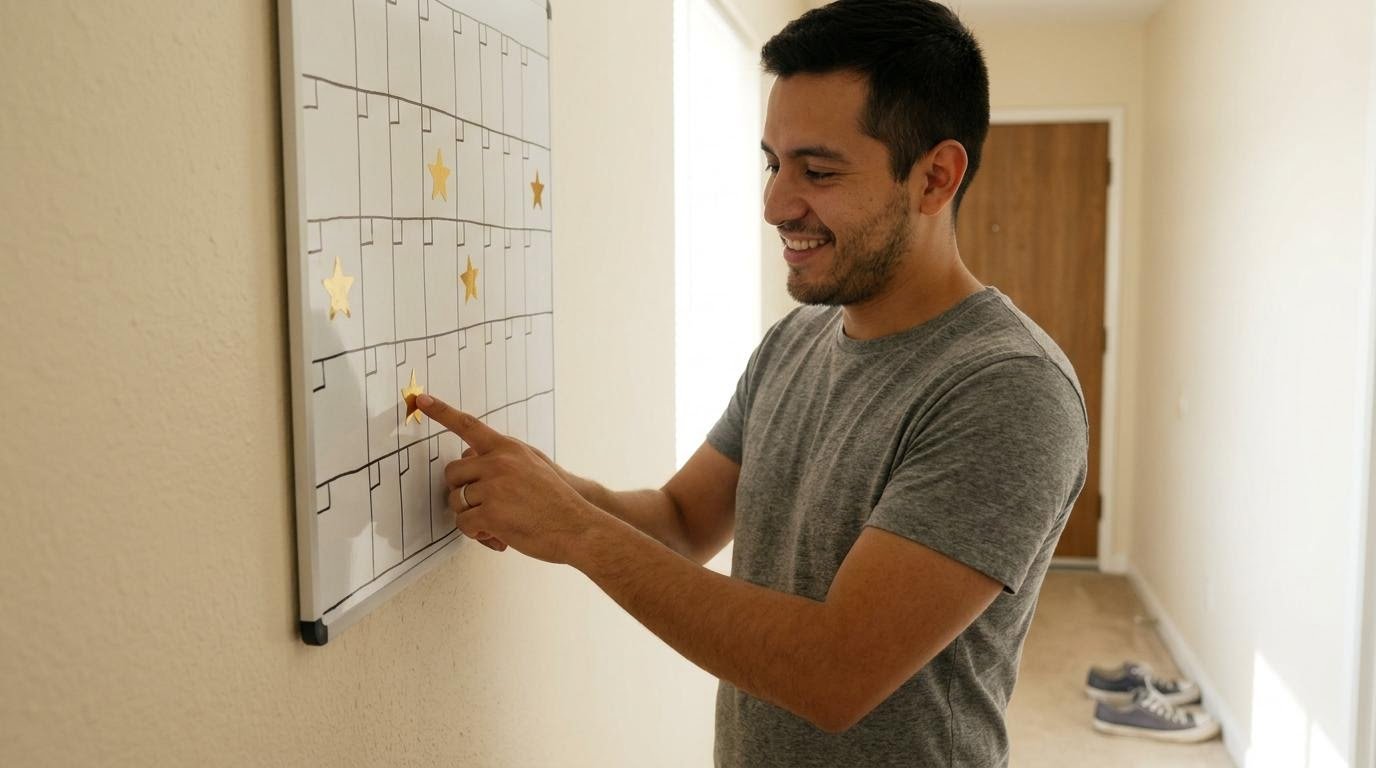
Your first week: two strength days, three cardio days, one measurement
Everything above compresses into a short list. The fat burning exercises belly fat responds to are not exotic. They are ordinary, repeatable habits that raise your total activity and protect your muscle while your eating pattern supports the change.
- Measure your waist at the navel and write it down.
- Schedule two strength sessions this week using the five moves. Put them in your calendar, not on a wish list.
- Add three cardio sessions you can finish without dread: a walk, a bike ride, one interval session.
- Pick one food swap, not five. Change one thing for two weeks, then add another.
- Re-measure in two weeks. If the number has not moved, adjust sleep and food before you add more exercise.
Start lighter than you think you should. A routine you can repeat for three months beats a heroic week followed by a month of soreness and skipped sessions.
Health disclaimer: This article is general information, not medical advice. Check with a doctor or other healthcare professional before starting a new exercise program or changing your diet, especially if you have a heart, joint, blood sugar, or blood pressure condition, take regular medication, are pregnant or recently postpartum, or are under 18. Stop exercising and get medical help if you feel chest pain, severe breathlessness, dizziness, or sharp pain.

Frequently asked questions
What are the best fat burning exercises for belly fat?
No single move is best. The combination with the most support is regular aerobic activity, such as brisk walking, cycling, or intervals, plus strength training for all major muscle groups. Mayo Clinic notes some evidence that high-intensity interval training and strength training can help reduce belly fat, and the CDC baseline of 150 minutes of moderate activity plus two strength days is a sound starting target.
Do crunches burn belly fat?
No. Crunches and sit-ups strengthen the abdominal muscles, but both Cleveland Clinic and Mayo Clinic say they do not remove the fat over those muscles. Keep them if you like them, for core strength and posture, but build your plan around total-body training.
Is HIIT better than steady cardio for belly fat?
Not for belly fat loss alone. In the study summarized by Harvard Health, moderate and high-intensity exercise led to about the same belly fat loss when calorie burn was equal, though only the high-intensity group improved blood sugar handling. Pick what you will keep doing, and try one interval session a week if your health allows it.
How long does it take to lose belly fat with exercise?
There is no honest fixed timeline, because it depends on your starting point, eating pattern, sleep, and consistency. Avoid any program that promises results in days. Track your waist measurement every two weeks, and judge progress over months rather than workouts.
Can I do fat burning exercises at home without equipment?
Yes. Squats, incline push-ups, planks, and hip hinges load the major muscle groups with no equipment. Progress them by adding repetitions, slowing the lowering phase, or adding one pair of dumbbells once the moves feel easy.
How many days a week should a beginner exercise?
Aim for the CDC baseline: 150 minutes of moderate-intensity activity per week, or 75 minutes of vigorous activity, plus muscle-strengthening work on at least two days. Beginners can reach it gradually, starting with three or four short sessions a week and adding time every couple of weeks.
References
- CDC: Adult Activity: An Overview, 2023
- Mayo Clinic: Belly fat in women: Taking and keeping it off, 2026
- Cleveland Clinic: Will Sit-ups Burn Off Your Belly Fat?, 2020
- Harvard Health Publishing: Add strength training to your fitness plan, 2015
- Harvard Health Publishing: Moderate- and high-intensity workout both burn belly fat, 2015
- Mayo Clinic News Network: Mayo Clinic Minute: Interval training fights aging, 2017