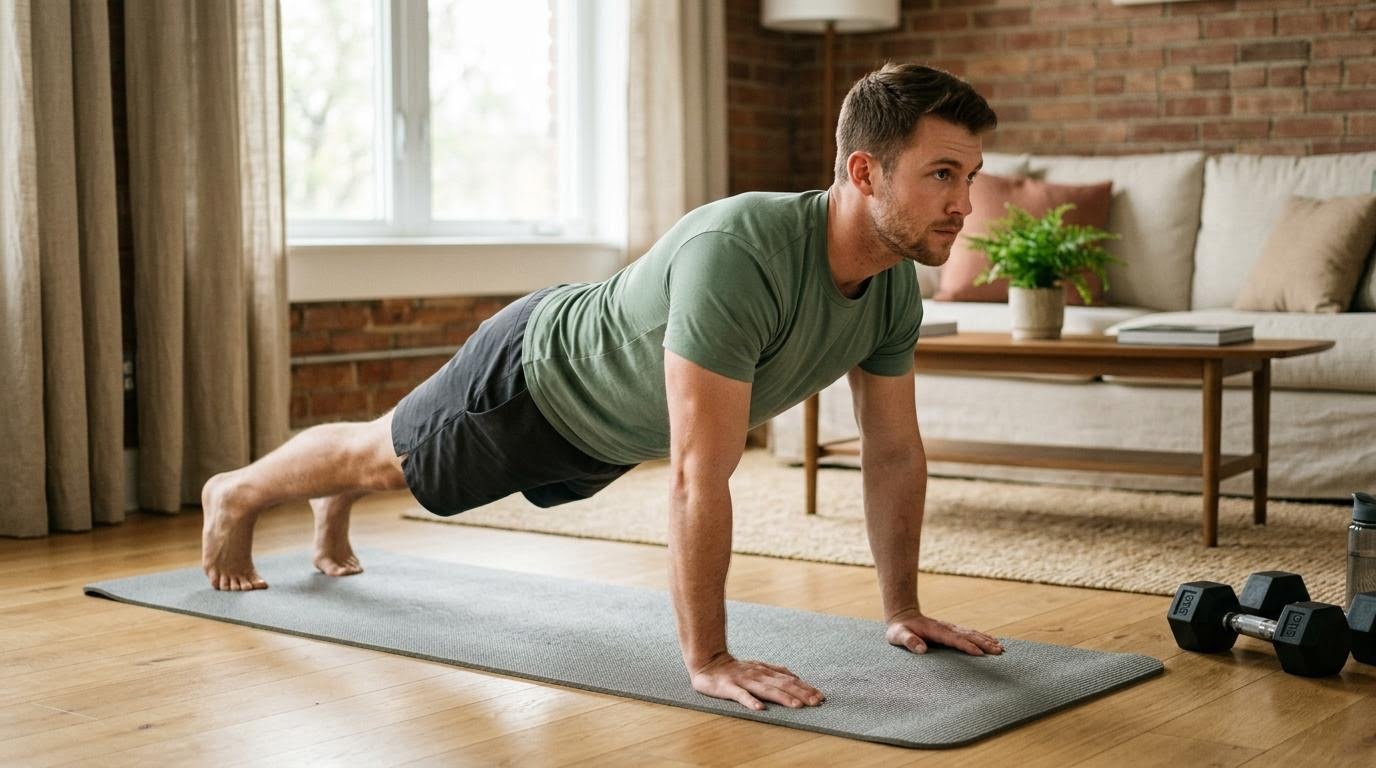


You do not need a gym membership, a treadmill, or a free hour to get a real cardio session. You need a plan you will actually repeat. This cardio workouts at home list gives you 12 no-equipment moves, a 19-minute interval session, a calorie table from Harvard Health, and a weekly template built around weight loss. Pick the version that fits your apartment, your knees, and your mood today.
Here is the pattern most people fall into. They search for a workout, find a 45-minute video full of burpees, hate every minute, and quit by Thursday. Sound familiar? The fix is not more willpower. It is choosing moves at the right intensity and stacking them into short blocks you can finish on a bad day.
Think of this article as a small group session. We will set the target first, then build the moves, then check the numbers so you know what the effort is actually worth.

Why a cardio workouts at home list should start with 150 minutes a week
Before you pick a single move, you need a target. The CDC's adult activity guidelines (2023) say adults need 150 minutes of moderate-intensity activity a week, or 75 minutes of vigorous-intensity activity, or an equivalent mix of the two. The same page recommends muscle-strengthening work on at least 2 days a week.
That 150-minute figure sounds big until you break it down. It is 30 minutes on five days. Split a session into two 15-minute blocks, one before work and one after dinner, and it stops feeling like a project. A short block you finish beats a long one you skip.
Use the talk test instead of a heart-rate gadget
"Moderate" and "vigorous" are vague words, so here is a check you can run in your living room. The NHS describes the talk test (2024) like this. At moderate intensity you can still talk but not sing. At vigorous intensity you cannot say more than a few words without pausing for breath.
The NHS also notes that 75 minutes of vigorous activity can give similar health benefits to 150 minutes of moderate activity. That is the non-obvious part. Hard intervals can cut your weekly time in half, but only if you can truly sustain the hard effort. Most beginners get further by starting at moderate intensity and adding intervals later.
Pick your intensity before you pick your move
- Low day: you can chat in full sentences. Good for tired days, sore joints, or thin apartment floors.
- Moderate day: you can talk but not sing. This is where most of your weekly minutes should live.
- Hard day: you can speak a few words at a time. Keep these short and keep them to one or two days a week.

12 no-equipment cardio moves, ranked from gentle to intense
Each move below works with zero equipment and a patch of floor about the size of a yoga mat. Do each for 40 seconds, rest 20 seconds, and move to the next. Three rounds of four moves from one group gives you roughly 12 minutes. Two groups back to back gives you a full session.
If you are brand new, start with our 15-minute beginner cardio routine first and come back here once it feels easy.
Low-impact moves (no jumping, apartment friendly)
Picture a third-floor apartment with a neighbor who works nights. Jumping is out. These four still push your heart rate up, because low impact does not mean low effort.
- March with arm drive. Lift your knees to hip height and pump your arms from hip to shoulder. The bigger the arm swing, the higher your heart rate climbs.
- Step jacks. Tap one foot out to the side while your arms sweep overhead, then switch. It is a jumping jack with the landing removed.
- Standing knee-to-elbow crunches. Bring your right knee to your left elbow, then switch. Twist from the waist and keep your chest tall.
- Shadow boxing. Throw fast jabs and crosses while you bounce lightly on your toes. Add a squat every fourth punch if you want more.
Moderate moves (you can talk but not sing)
- Jumping jacks. The classic. Land softly on the balls of your feet and keep your knees slightly bent.
- Squat to overhead reach. Sit your hips back into a squat, then stand tall and reach both arms to the ceiling. Keep the pace steady and quick.
- Skater hops. Leap sideways from one foot to the other, swinging your arms like a speed skater. Shorten the hop if the floor is hard.
- Slow mountain climbers. From a high plank, drive one knee toward your chest, then the other. Keep your hips level with your shoulders.
High-intensity moves (a few words at a time)
- Burpees without the push-up. Squat, step or jump your feet back to a plank, return, and stand. Add a small jump at the top when you are ready.
- Jump rope or phantom rope. Swing a rope, or mime it with no rope at all. Small hops, wrists doing the work, elbows tucked in.
- High-knee sprints in place. Run on the spot with your knees at hip height. This one wrecks you in 30 seconds, which is the point.
- Plank jacks. From a plank, hop your feet wide and back together. Slow it down if your lower back complains.
Here is the mild contrarian note. A move you can repeat for 40 seconds with good form beats a harder move you can only fake for 15. If your form falls apart, step down one group and keep the clock running.
Three ready-made circuits from the list
Choosing from 12 moves can stall you before you start, so here are three circuits to copy. Each uses 40 seconds of work and 20 seconds of rest, repeated for three rounds.
- The quiet circuit (about 12 minutes): march with arm drive, step jacks, standing knee-to-elbow crunches, shadow boxing. Safe for late evenings and shared walls.
- The sweat-through-lunch circuit (about 12 minutes): jumping jacks, squat to overhead reach, skater hops, slow mountain climbers. Moderate effort, no equipment, no shower required if you keep the pace honest.
- The short and sharp circuit (about 12 minutes): burpees without the push-up, phantom rope, high-knee sprints, plank jacks. Save this one for a day when you feel good, and stop a round early if your form slips.
Rotate through all three across a week and you will never repeat the same session twice in a row. Variety is not a gimmick here. It spreads the load across different joints and keeps the boredom that ends most routines from setting in.
Warm up in two minutes, cool down in two more
Cold muscles and sudden effort are a poor mix, so spend the first two minutes marching and rolling your shoulders, then add a few easy step jacks. Afterward, walk in place until your breathing settles and stretch your calves, hips, and chest for another two minutes. It adds four minutes to your session and makes the next day's workout far more likely to happen.
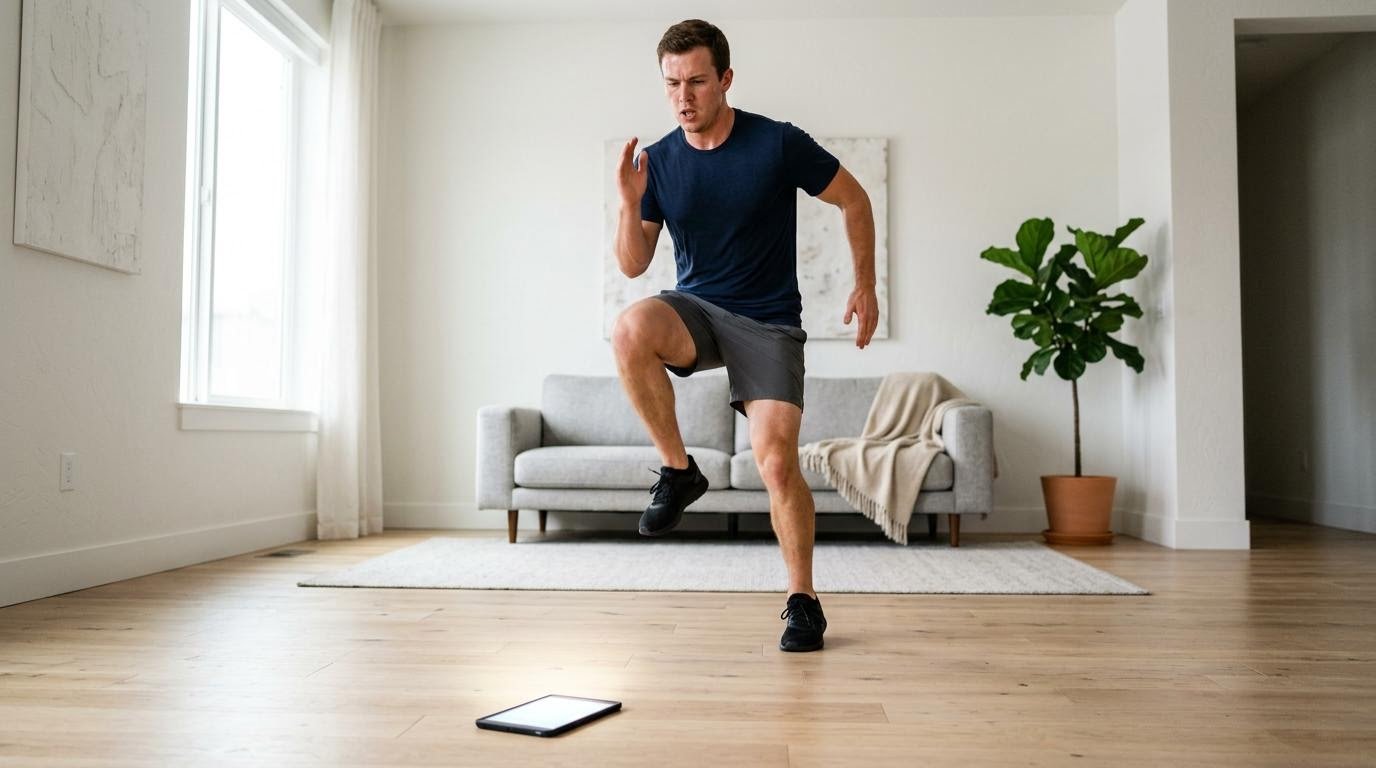
A 19-minute interval session for HIIT cardio workouts at home
Interval training is where your time-poor days get rewarded. Mayo Clinic's overview of high-intensity interval training (2016) describes HIIT as short bursts of maximal effort separated by short periods of low-intensity work that allow partial recovery. Its sample session has a three-minute warm-up, four to six repetitions of a 30-second sprint followed by a 60-second active recovery, and a three-minute cool-down.
We can borrow that pattern for HIIT cardio workouts at home. Here is a version that finishes in 19 minutes:
- Warm-up (3 minutes): march with arm drive, then step jacks, building speed gently.
- Block one (6 minutes): four rounds of 30 seconds hard on high-knee sprints, then 60 seconds easy marching.
- Reset (1 minute): walk in place and sip water.
- Block two (6 minutes): four rounds of 30 seconds hard on jump rope or phantom rope, then 60 seconds easy marching.
- Cool-down (3 minutes): slow walking, then gentle calf and hip stretches.
Notice the recovery is twice as long as the effort. That ratio is not wasted time. It is what lets you hit the second and fourth sprints at nearly the same quality as the first.
The same Mayo Clinic page cautions that HIIT programs need careful design to prevent injury, and that high-impact work is not appropriate for people with musculoskeletal issues or poor movement patterns. If that sounds like you, swap in the low-impact moves from the first group and keep the same timing.
How to tell whether an interval is hard enough
Skip the guesswork and use the talk test from earlier. During a hard 30-second burst you should only manage a word or two. During the 60-second recovery you should be able to say a short sentence again by the end. If you are still gasping when the next burst starts, lengthen the recovery. If you can chat through the hard part, speed up or pick a tougher move.
Also protect your landing. When fatigue builds, hops get heavier and knees take the hit. Swap a jumping move for a march or a step jack as soon as your landings sound loud, then bring the jumps back next session.
Want to follow along with a trained team instead of a stopwatch? Mayo Clinic's own channel has a guided interval session:

How many calories these moves burn, and why the number matters less than you think
Everyone asks the same question after a sweaty session: what did that actually burn? Harvard Health publishes a calories-burned table for 30 minutes of activity (2021) for three body weights. These home-friendly rows come straight from it:
| Activity (30 minutes) | 125 lb | 155 lb | 185 lb |
|---|---|---|---|
| Calisthenics, moderate | 135 | 162 | 189 |
| Aerobics, low impact | 165 | 198 | 231 |
| Dancing, fast | 180 | 216 | 252 |
| Aerobics, high impact | 210 | 252 | 294 |
| Rope jumping, slow | 226 | 281 | 335 |
| Calisthenics, vigorous | 240 | 306 | 336 |
| Rope jumping, fast | 340 | 421 | 503 |
Source: Harvard Health, 2021. Figures are estimates for calories burned in 30 minutes of the activity.
Read the 155-pound column. Fast rope jumping burns 421 calories in 30 minutes, while low-impact aerobics burns 198. That is roughly double for the same clock time, which is why intensity matters more than the name of the workout.
Now the part most calorie tables skip. The CDC's page on physical activity and your weight and health (2026) explains that burning calories through activity, combined with eating fewer calories, creates a calorie deficit that results in weight loss. It also says you may need more than the recommended weekly minutes to maintain your weight, and it stresses regular activity for keeping lost weight off.
Translate that into real life. A 30-minute session in the table burns somewhere between about 135 and 500 calories depending on the move and your body weight. A single snack can cancel that out. So cardio alone is rarely the lever that moves the scale. Its bigger job is building a habit that protects the weight you lose. If the deficit idea is new to you, our guide to what a calorie deficit is walks through the math.

Good cardio workouts at home to lose weight: a weekly template that fits real life
The best plan is the one that survives a busy week. Here is a seven-day template that uses the moves above, keeps hard days limited, and leaves room for the muscle-strengthening the CDC recommends on at least 2 days a week.
- Monday: 30-minute moderate circuit using moves 5 to 8.
- Tuesday: 20 minutes of bodyweight strength, such as squats, lunges, and push-ups.
- Wednesday: 30-minute low-impact circuit using moves 1 to 4.
- Thursday: 30-minute easy walk or bike ride. Active recovery, not a rest day in disguise.
- Friday: the 19-minute interval session from above.
- Saturday: 30 minutes of fast dancing or rope intervals. Pick the one you enjoy.
- Sunday: 20 minutes of bodyweight strength, then full rest.
Add up the cardio and you get about 139 minutes, with Friday's vigorous minutes counting for more than the moderate ones. That puts you at or near the 150-minute target without a single marathon session. These are good cardio workouts at home to lose weight because they are repeatable, and repeatable is what moves a weekly total.
If belly fat is your main target, read our breakdown of aerobic exercise for belly fat to see how cardio fits alongside the rest of your routine.
Three rules that keep the week from collapsing
- Set the alarm for the workout, not for waking up. A specific time beats a vague "later."
- Downgrade, never skip. On a rough day, do 10 minutes of low-impact moves. A short session keeps the habit alive.
- Change one thing at a time. Add minutes or intensity, not both in the same week, so you know what your body is handling.
How to progress without burning out
Once the template feels easy, resist the urge to double everything. Add two minutes to each circuit for a week. The following week, move one low-impact circuit up to a moderate one. Then, and only then, think about adding a second interval day. Each change is small enough that your joints, sleep, and motivation can keep up.
Common mistakes that stall a home cardio routine
- Going all-out every session. Hard days need easy days around them. If every workout ends with you flat on the floor, your week will end early.
- Skipping the recovery intervals. Cutting the 60-second rest turns quality sprints into one long, sloppy effort.
- Judging a workout by the sweat. Sweat reflects room temperature as much as effort. Trust the talk test, not the puddle.
- Waiting for the perfect setup. A towel on the floor and a phone timer is a complete gym for this list.

Start your cardio workouts at home list this week, not next Monday
Pick three moves from the list, set a timer for 12 minutes, and do them tonight. That is your cardio workouts at home list in action, and it needs no equipment, no subscription, and no perfect schedule. Once the first week feels normal, add the interval session on Friday and build toward the 150-minute target a block at a time.
Keep the effort honest with the talk test, treat the calorie table as a rough guide, and let consistency do the heavy lifting. The scale responds to what you repeat for months, not to the one brutal workout you survive once.
Health disclaimer: This article is general information, not medical advice. Talk with a doctor or other qualified healthcare professional before starting a new exercise program, especially if you have a heart, lung, or joint condition, high blood pressure, diabetes, or an injury, or if you are pregnant, postpartum, or under 18. Stop and seek medical help if you feel chest pain, dizziness, or unusual shortness of breath.

Cardio workouts at home list: your questions answered
What cardio can I do at home to lose weight?
Any move that lifts your heart rate to the moderate or vigorous zone counts. Marching with arm drive, step jacks, jumping jacks, skater hops, jump rope, and interval sprints all qualify. Pair them with a modest calorie deficit, since the CDC notes that activity combined with eating fewer calories is what creates weight loss.
Are at-home cardio workouts effective?
Yes, as long as the intensity is right. Your living room does not change the physiology. Use the talk test: if you can talk but not sing, you are in the moderate zone, and if you can only say a few words, you are in the vigorous zone. Both count toward your weekly total.
How often should you do cardio in a week?
The CDC's adult guidelines point to 150 minutes of moderate activity a week, which works out to 30 minutes on five days. You can also reach it with 75 minutes of vigorous activity or a mix of both. Add muscle-strengthening on at least 2 days a week.
What are good cardio workouts at home with no jumping?
Try marching with arm drive, step jacks, standing knee-to-elbow crunches, and shadow boxing. They keep both feet close to the floor, so they are easier on knees and quieter for neighbors. Add speed, bigger arm movements, or a short squat between rounds to raise the intensity without leaving the ground.
How long should a cardio workout at home be?
Between 12 and 30 minutes works for most people. Twelve minutes of three moves is a solid starter. Thirty minutes of moderate work five times a week hits the CDC's target. If you only have 19 minutes, the interval session above gives you hard efforts with built-in recovery.
Can you do cardio at home without equipment?
Absolutely. Every move in this article uses only your body weight, and rope jumping works with an imaginary rope. A mat helps with planks and mountain climbers, but a towel on a carpeted floor does the job too.
References
- CDC — Adult Activity: An Overview, 2023
- NHS — Physical activity guidelines for adults aged 19 to 64, 2024
- Mayo Clinic — Sprint, rest, repeat: Exploring the benefits of high-intensity interval training, 2016
- Harvard Health — Calories burned in 30 minutes for people of three different weights, 2021
- CDC — Physical Activity and Your Weight and Health, 2026
- Mayo Clinic (YouTube) — Mayo Clinic HIIT Workout for Mind & Body – Week 1